

Maddy summaryHF 3774 (Minnesota Statutes §169.222, new Subd. 4b) would require bicycle operators to stop before entering an intersection or crosswalk when approaching a steady yellow traffic light at a signal-controlled intersection. This bill directly affects cyclists in Minnesota who ride through intersections with traffic signals. The key provision mandates stopping for yellow lights, while clarifying that it does not change existing right-of-way rules (§169.20) and excludes situations where traffic is controlled by police or authorized personnel. The bill is currently in committee referral after its February 2026 introduction.
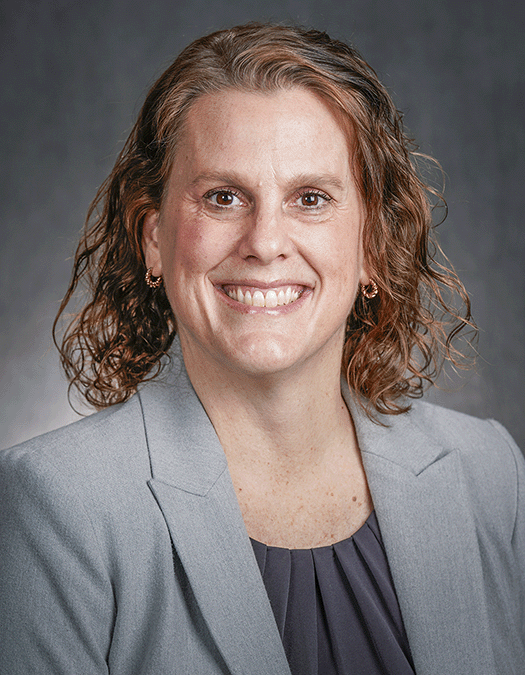
Rep. Kari Rehrauer
Sponsored bills
Maddy summaryHF 3483 modifies Minnesota's trespass law to require law enforcement to obtain a warrant signed by a judicial officer before entering property for civil immigration enforcement. It also prohibits local law enforcement from detaining individuals solely based on federal civil immigration detainers. The bill amends Minnesota Statutes § 609.605 to add a specific provision (subdivision 1, clause (6)) requiring a warrant with probable cause for immigration-related trespass entries. This directly affects local police and sheriff's departments by restricting their ability to act on federal immigration requests without judicial oversight. The law applies to all trespass offenses involving immigration enforcement activities on private property.
Maddy summaryHF 3810 requires a licensed driver to be physically present in the driver's seat of any commercial motor vehicle using an automated driving system (levels 4-5 automation) while operating on public roads. The bill mandates the person must monitor the vehicle, intervene if unsafe, and be ready to take control. Violations impose penalties: a $2,000 misdemeanor fine for first offenses, escalating to gross misdemeanors with doubled fines for repeat violations by the same owner or lessor. This directly affects commercial trucking and bus operators seeking to deploy fully autonomous systems. The law aims to ensure human oversight during automated operation of commercial vehicles.
Maddy summaryHF 3322 proposes a 10-cent excise tax on plastic drink containers (under 3 liters) sold to retailers in Minnesota, paid by bottle distributors (like beverage sellers or producers). The tax applies to most plastic bottles containing beverages (excluding drugs and infant formula) and begins January 1, 2026, expiring December 31, 2030. Revenue from the tax will fund Minnesota's water infrastructure account, prioritizing projects like sewer systems, water treatment, and contaminant removal in communities with low tax base per capita. Funds are distributed to local governments for eligible capital projects related to drinking water, wastewater, and stormwater systems.
Maddy summaryHF 1944 amends Minnesota law to require all state agencies, counties, cities, and towns to use federal standard time (not daylight saving time) year-round starting in 2025. It changes how time is referenced in state law to align with federal standards, meaning state government operations and references to time must follow federal rules. The bill automatically expires if federal law ever permits states to adopt year-round "advanced standard time." It directly affects all Minnesota local and state government entities that reference time in their operations or laws.
Maddy summaryHF 2986 requires Minnesota's public utilities to include specific details about virtual power plant programs in their resource plans and file formal tariffs with the Minnesota Public Utilities Commission by 2026. The bill directs utilities to create programs that aggregate customer-owned devices like solar panels, home batteries, electric vehicles, and smart thermostats to reduce peak electricity demand. These programs must demonstrate how they lower customer bills, cut emissions, avoid new infrastructure, and reduce reliance on fossil-fuel peaker plants during grid stress events. The legislation also allows utilities to recover costs associated with implementing these programs through customer rates. This directly affects all Minnesota public utilities and their ratepayers through new reporting requirements and program implementation.
Maddy summaryThis bill increases funding for Minnesota's Family Homeless Prevention and Assistance Program, raising the annual appropriation from $10.27 million to $45.27 million. The additional funds will be used to reduce homelessness risks and improve program effectiveness, with a portion designated for the housing development fund. The legislation also grants agencies flexibility in awarding grants to existing grantees and allows new grantees in certain areas to work with advisory committees or local care systems without meeting specific statutory requirements. These changes take effect immediately and establish a future funding base of $10.72 million starting in fiscal year 2028.
Maddy summaryThis bill allows Minnesota school districts with six-member boards and 1,000 or fewer students to vote on reducing their board size to five members. Districts can propose this change at any school election, and if voters approve it, only two directors will be elected for a four-year term instead of the current three. The legislation also maintains existing provisions for districts to expand from five to six members or from six to seven members through voter approval. This change directly affects independent school districts in Minnesota that meet the enrollment and current board size requirements.
Maddy summaryThis bill requires cannabis business license applications in Minnesota to be available in both English and Spanish, making the application process more accessible to Spanish-speaking applicants. The amendment updates state statutes to mandate that all required application forms and information be provided in these two languages, while also clarifying the specific details that must be included in applications. The law takes effect on January 1, 2027, and applies to all individuals and businesses seeking to obtain or renew cannabis licenses in the state.
Maddy summaryThis bill establishes a new legal right in Minnesota allowing individuals to sue if their name, likeness, or voice is used for commercial purposes without their permission. It defines likeness as any recognizable image of a person and voice as any sound that identifies a specific individual, covering both recorded and computer-generated versions. The law permits people to sell or license these rights and allows lawsuits to continue for up to 70 years after death if the person's identity was used commercially during that time. Courts can award damages for financial losses, profits made from the unauthorized use, and attorney fees, with triple damages available if the misuse was intentional. The bill includes exceptions for news reporting, criticism, satire, and other First Amendment-protected uses, ensuring free speech rights remain intact.