

Maddy summaryThis bill requires Minnesota public schools to establish anonymous reporting systems that allow students and others to report threats or concerning behavior without revealing their identity. By 2028, each public school must implement a system accessible 24/7 through mobile apps and multilingual crisis centers, staffed by trained counselors and connected to school safety teams. The legislation also mandates training for students on recognizing warning signs and reporting risks, along with a statewide list of third-party vendors offering these services. Schools may create their own systems or use a statewide option, while nonpublic schools can choose to participate but are not required to comply. The Department of Education will compile data on school-based teams and submit annual reports to legislative committees.
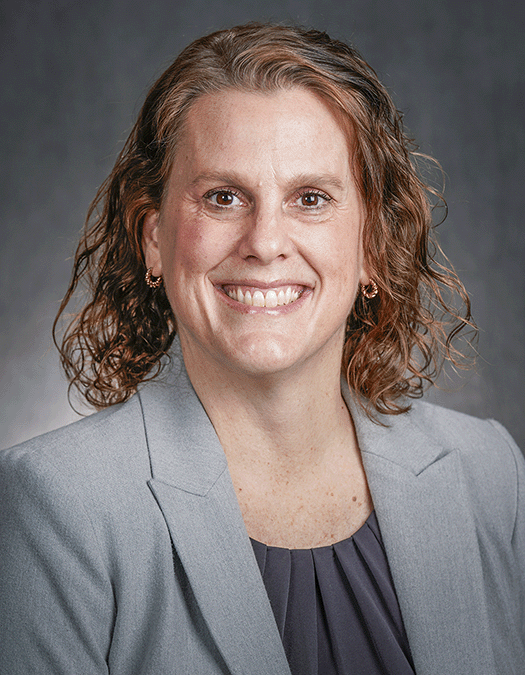
Rep. Kari Rehrauer
Sponsored bills
Maddy summaryThis bill requires the Minnesota commissioner of employment and economic development to create new rules that allow individuals receiving medical assistance waivers to access the extended employment program, regardless of which specific waiver service they are currently using. The legislation mandates that participation in the program may require individuals to submit a form confirming they are not receiving duplicate services reimbursed by multiple programs simultaneously. Additionally, the bill directs the commissioner to remove an existing rule that currently restricts eligibility for the extended employment program. These changes would expand access to employment services for people on medical assistance waivers while maintaining safeguards against double reimbursement.
Maddy summaryThis bill expands Minnesota's crime of disseminating personal information to protect all individuals, not just law enforcement officers, and creates a new civil lawsuit option for victims of such disclosures. It allows people to sue those who knowingly share their private information online or publicly when it creates an immediate danger to their safety, permitting courts to award damages for emotional distress, civil penalties up to $10,000, and legal fees. The law includes exceptions for lawful criminal investigations, public interest reporting, and other legal proceedings, and it would take effect on August 1, 2026, allowing affected individuals to file claims in Minnesota courts.
Maddy summarySF 3596 creates a one-time state-funded emergency rental assistance program for Minnesota counties and Tribal governments to help eligible households facing housing instability. Eligible households must have income at or below 200% of the federal poverty level, experienced financial hardship after August 31, 2025, and be at risk of eviction or homelessness. The program covers up to two months of prospective rent, past-due rent, utility costs, or related fees for qualifying households. Counties and Tribal governments must distribute funds within four months of the bill's effective date and return any unspent money to the state.
Maddy summaryHF 3617 bans the possession of semiautomatic military-style assault weapons in Minnesota, including specific firearms like AR-15 rifles and AK-47s, as well as weapons with features such as folding stocks, pistol grips, or detachable magazines. The bill defines these weapons broadly to cover both listed models and similar firearms with minor modifications, such as redesigned versions or enhanced features. Possessing a banned weapon would be a criminal offense under amended statutes, with penalties established for violations. This law directly affects individuals who own or possess these firearms, making such possession illegal under state law.
Maddy summaryHF 3618 bans the possession of specific semiautomatic military-style assault weapons (like AR-15s, AK-47s, and Uzis) and ammunition magazines holding more than 10 rounds in Minnesota. It defines these weapons broadly to include models listed in the bill, as well as firearms with features like folding stocks, pistol grips, or threaded barrels. The bill creates criminal penalties for possessing these banned weapons or magazines, directly affecting individuals who own them. The law would amend Minnesota statutes to enforce this ban and penalties, applying to anyone in the state who possesses such firearms or magazines.
Maddy summaryHF 3353 expands personal information protections currently available to Minnesota judges and court staff to also cover state legislators. It defines "covered official" to include current and former lawmakers, protecting their residential addresses, phone numbers, email addresses, and children's school names from public posting. The bill requires entities to remove such protected information within 30 days of a valid request, with legal action available for non-compliance. It also creates a 12-member legislative task force (including members from the Legislative Commission on Data Practices and appointed officials) to study and report on privacy protections for all government officials by 2027. The bill appropriates funds for these efforts.
Maddy summaryHF 3657 establishes a task force to study property tax relief for primary homes (homestead properties) in Minnesota. The task force, composed of legislators, local government representatives, and tax officials, must analyze how current tax policies affect homeowners, compare tax burdens over time, and explore options for reducing property taxes with minimal impact on state funding. It will focus specifically on residential properties classified as homesteads under state law, including homes and adjacent land. The task force must submit its recommendations to the legislature by February 1, 2027, but cannot directly change tax rates. This is a study bill, not a tax law change.
Maddy summaryHF 3781 establishes a Legislative Commission on Legislative Security in Minnesota. The commission will study security needs for state legislators and staff while serving in their districts and review proposed bills affecting security for elected officials. It consists of 14 members (seven from each chamber, with majority limits) appointed at the start of each legislative session, and must elect a chair alternating between the Senate and House annually. The bill creates a new permanent body to analyze security issues and make recommendations, without changing existing laws.
Maddy summaryHF 3770 allows Minnesota school districts and charter schools to skip all statewide assessments (including alternate tests and English language proficiency exams) for the 2025-2026 and 2026-2027 school years. This opt-out is specifically permitted due to impacts from federal Immigration and Customs Enforcement (ICE) activities on students, staff, and school communities. School districts must notify the state education commissioner promptly if they choose to opt out. The bill directly affects public and charter schools seeking to avoid standardized testing during these two academic years.