

Maddy summaryHF 2372 creates a voluntary "Minnesota Civic Seal" designation for high school students who complete specific civics requirements. To earn the seal, students must complete approved civics coursework, complete a project-based civic assessment, participate in at least one civic activity outside class (like voting in student elections or community service), and demonstrate civic dispositions. School districts may choose to participate but cannot charge students fees, must provide information about the program to all students, and must affix the seal to diplomas and transcripts for qualifying graduates. The program begins for students graduating in 2027 or later, with the Department of Education developing the insignia and guidelines to ensure equitable access for all students.
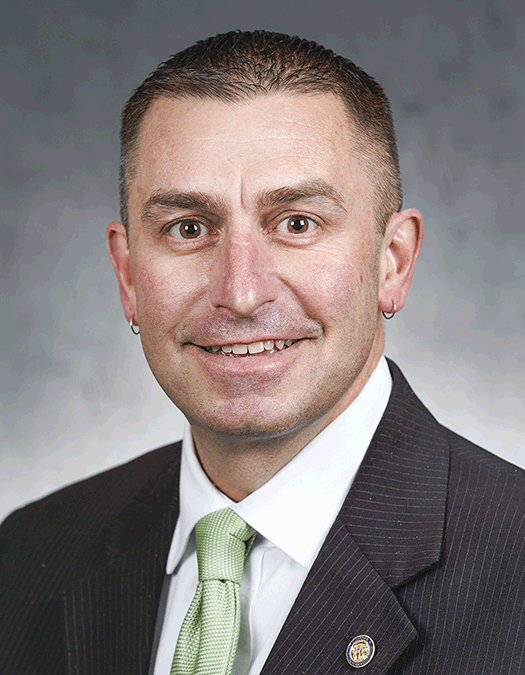
Rep. Josiah Hill
Sponsored bills
Maddy summaryThis bill requires Minnesota employers with 50 or more employees to provide 90 days of advance notice before using artificial intelligence or automation to displace workers, and it mandates a 90-day transitional employment period during which affected employees receive continued wages and access to employer-funded retraining programs. The legislation defines technological displacement as job losses or significant hour reductions caused by AI systems and requires employers to notify employees, labor organizations, state labor officials, local government leaders, and workforce development boards about the changes. Employers who fail to comply face penalties including ineligibility for state grants and tax incentives for five years, potential civil fines of up to $10,000 per violation, and liability for up to 60 days of back pay and benefits to affected workers.
Maddy summaryThis bill would allow veterans with a total service-connected disability to park for free at the Minneapolis-St. Paul International Airport for up to ten days within any 90-day period starting in 2027. To qualify, veterans must provide documentation such as a driver's license with a veteran designation, a military ID showing a 100 percent disability rating, or a letter from the Department of Veterans Affairs confirming their disability status. The bill requires the airport commission to establish a waiver process by December 2026 and conduct outreach to veterans organizations statewide. Any parking beyond the ten free days would be charged at the standard rate.
Maddy summaryHF 2689 modifies Minnesota's physical therapy practice rules, primarily affecting licensed physical therapists, their assistants, and students in physical therapy programs. The bill clarifies supervision requirements: physical therapists must have direct patient contact during at least every second treatment session when supervising student physical therapists or student physical therapist assistants, and telecommunications (except within a facility) cannot satisfy "on-site supervision" for students. It repeals outdated sections of the law (148.65, subd. 9 and 148.77) and updates definitions for "physical therapy" and student roles. The bill does not specify the nature of the new criminal penalties mentioned in its title.
Maddy summaryHF 3456 implements recommendations from the state auditor's fire relief association working group by updating Minnesota's firefighter retirement statutes. It clarifies key terms like "firefighting service" to include fire prevention and volunteer emergency medical personnel, and defines "separate from active service" and "break in service" more precisely. The bill adds new rules allowing firefighters who leave service and return to active duty to regain pension eligibility, provided they meet specific service requirements under the relief association's bylaws. This directly affects firefighters who take breaks in service but later return to active roles with their fire department.
Maddy summaryThis bill establishes a new legal right in Minnesota allowing individuals to sue if their name, likeness, or voice is used for commercial purposes without their permission. It defines likeness as any recognizable image of a person and voice as any sound that identifies a specific individual, covering both recorded and computer-generated versions. The law permits people to sell or license these rights and allows lawsuits to continue for up to 70 years after death if the person's identity was used commercially during that time. Courts can award damages for financial losses, profits made from the unauthorized use, and attorney fees, with triple damages available if the misuse was intentional. The bill includes exceptions for news reporting, criticism, satire, and other First Amendment-protected uses, ensuring free speech rights remain intact.
Maddy summaryThis bill allocates $1,000,000 from Minnesota's arts and cultural heritage fund to support the hosting of a world snow-sculpting championship. The funds would be given to the Greater Stillwater Chamber of Commerce Foundation through the commissioner of administration to cover event costs. This legislation directly affects the Stillwater area by providing financial resources to organize the international competition. The money is designated for fiscal year 2027 and is intended to support the logistics and execution of the championship event.
Maddy summaryThis bill allocates $125,000 from the state's general fund in fiscal year 2027 to support youth trafficking and sexual exploitation prevention services in the Twin Cities metropolitan area. The funding will be given to the Office of Justice Programs to grant money to Citizens Against Sex Trafficking for their Power Over Predators program. The program must expand its services to include youth, parents, and community members by collaborating with youth groups, recovery support groups, domestic violence support groups, and the Ramsey County correctional facility. These efforts aim to provide victim-centered, trauma-informed support, awareness, and education to prevent youth trafficking, sexual violence, and exploitation. The appropriation is designated as a one-time funding allocation.
Maddy summaryHF 3653 increases funding for school safety programs in Minnesota. It establishes new formulas: public school districts receive $100 per adjusted pupil unit for safe schools aid (starting 2027), plus a $36 per unit levy; charter schools get $100 per unit; and cooperative school units receive $35 per unit. The bill requires all funds to be used exclusively for specific safety purposes, including security upgrades, mental health services, drug prevention programs, violence prevention, and cybersecurity measures in schools. This affects all public school districts, charter schools, and cooperative school units statewide, with funding effective for fiscal year 2027 and later.
Maddy summaryThis bill allocates $365,000 for fiscal year 2026 and $710,000 for fiscal year 2027 from the environmental fund to support PFAS biomonitoring in eastern Minnesota metropolitan communities. The funds will be transferred from the Pollution Control Agency to the commissioner of health to continue testing for per- and polyfluoroalkyl substances in human populations. The appropriation becomes available immediately upon final enactment and remains valid until the money is fully spent. This legislation directly impacts public health monitoring efforts in specific eastern metro areas by providing dedicated funding for ongoing chemical exposure studies.