

Maddy summaryHF 1434 requires commercial websites sharing material harmful to minors (defined as content with sexual depictions lacking artistic value for minors) to verify users are 18+ if 25% or more of the site’s pages contain such material. It mandates age verification using approved methods like commercial databases, prohibits retaining user identifying information, and creates a private right of action for parents to sue violators. The Minnesota Attorney General can enforce the law through civil actions, and commercial entities face $25,000 penalties per violation. This bill directly affects websites meeting the 25% harmful content threshold and targets operators of commercial platforms accessible to Minnesota residents.
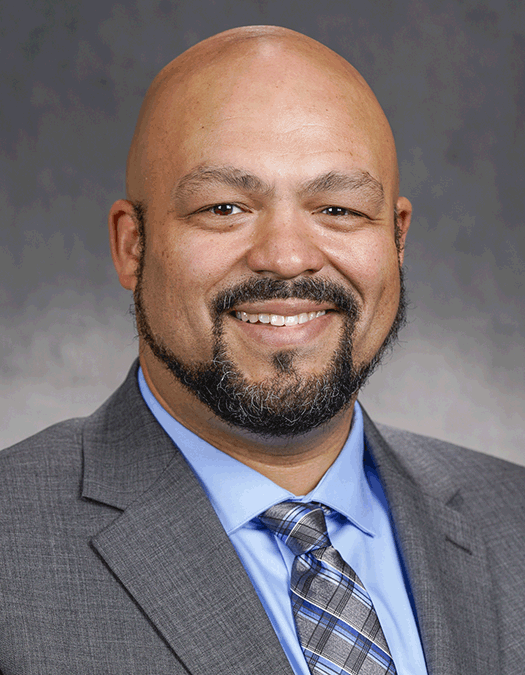
Rep. Walter Hudson
Sponsored bills
Maddy summaryThis bill proposes a constitutional amendment that would exempt Minnesota local governments and school districts from complying with state mandates unless the state provides funding to cover the costs of compliance. The bill defines a state mandate as any requirement that affects daily operations, changes resource allocation, or alters spending priorities for these entities. If passed, it would allow local governments to formally refuse compliance through a resolution if they believe funding is insufficient, while also creating a process for agencies to contest these decisions through hearings. The amendment would be submitted to voters at the 2026 general election and would take effect on January 1, 2027, if approved.
Maddy summaryThis bill establishes the Parenting Time Enforcement Task Force to study issues related to enforcing court-ordered parenting time and addressing custody interference in Minnesota. The task force will consist of 12 members drawn from the legislature, judiciary, law enforcement, legal professionals, and parents with lived experience, who will meet to evaluate current enforcement mechanisms and identify barriers to effective implementation. By January 2027, the group must submit a report with findings and recommendations to improve parenting time enforcement while protecting child safety, and the task force will expire in June 2027. The bill also authorizes funding from the general fund to support the task force's administrative operations and meetings.
Maddy summaryThis bill designates the Quality Learning Center in Hennepin County as a historic place under Minnesota state law. It achieves this by amending Minnesota Statutes section 138.664 to add a new subdivision specifically naming the facility. The change is administrative and does not alter the center's operations or funding, but it formally recognizes the building's historical significance within the state's historic preservation framework.
Maddy summaryThis bill exempts agricultural products and equipment from Minnesota's regulations on products containing PFAS, a type of chemical compound. It requires pesticide registrants to disclose intentionally added PFAS ingredients and allows manufacturers of agricultural items to submit PFAS information as part of their annual registration process rather than separately. The legislation also repeals previous rules that would have banned certain consumer products containing PFAS, ensuring that agricultural materials remain unaffected by those restrictions. Additionally, the bill mandates that any future PFAS bans on consumer goods must receive approval from the commissioner of agriculture if they involve pesticides, fertilizers, or soil amendments.
Maddy summaryThis bill renames the Perpich Center for Arts Education to the Perpich Quality Learning Center for Arts Education. It amends Minnesota Statutes section 129C.10 to update the official name of the organization's governing board. The legislation requires the state revisor to replace all instances of the old name with the new name throughout Minnesota statutes. This change directly affects the state agency responsible for arts education and its administrative structure.
Maddy summaryThis bill modifies the duties of Minnesota's Department of Human Services commissioner regarding how the state handles federal SNAP fiscal disallowances and sanctions. It adds a definition for MAXIS, the computer system used to determine eligibility for public assistance programs, and updates the commissioner's responsibilities to include developing performance measures that focus on reducing inequities, improving program coordination, and minimizing administrative burdens for families. The legislation also grants the commissioner expanded authority to monitor county agencies, enforce compliance with federal and state welfare laws, and adjust benefits when necessary to align with regulations. Additionally, it requires the commissioner to report biennially on grants received and program performance to legislative committees.
Maddy summaryHF 2453 allows state agencies, local governments, and similar entities to permit the use of untreated rainwater or stormwater for outdoor purposes (like watering non-edible plants or cleaning) where there's no risk of human or animal consumption or immersion. It specifically prohibits using this water for drinking, swimming, or growing food crops for humans or livestock. The bill creates a new legal requirement for these entities to allow such outdoor water use under defined safety conditions.
Maddy summaryHF 845 modifies Minnesota's net metering rules for small-scale renewable energy systems. It allows customers with systems under 40 kilowatts to choose between receiving compensation based on the utility's avoided costs or the average retail electricity rate. The bill clarifies key terms like "designated meter" and "contiguous property" to streamline billing for these systems. This directly affects residential and small business customers with solar panels or similar renewable installations who generate excess electricity for the grid.
Maddy summaryHF 2169 modifies Minnesota's unintentional murder in the second degree statute to include cases where someone causes death while violating a protective order issued by a court in another U.S. state, the District of Columbia, Tribal Lands, U.S. territories, Canada, or a Canadian province. This change directly affects individuals who violate protective orders from these additional jurisdictions and cause a death, expanding the circumstances under which this offense applies. The bill amends Minnesota Statutes section 609.19, subdivision 2, to explicitly include such out-of-state orders as part of the definition. The amendment takes effect August 1, 2025, for crimes committed on or after that date.