

Maddy summaryHF 275 modifies Minnesota's trapping regulations by changing how often certain traps must be checked. It allows body-gripping traps and snares (that can't drown animals) to be tended only once every third calendar day, instead of daily. The bill also permits foot-encapsulating traps within 50 feet of water without special permits during mink and muskrat season, while maintaining other restrictions. These changes replace an existing rule requiring daily snare checks (Minnesota Rules 6234.2400, subpart 10), directly affecting fur trappers and wildlife management practices.
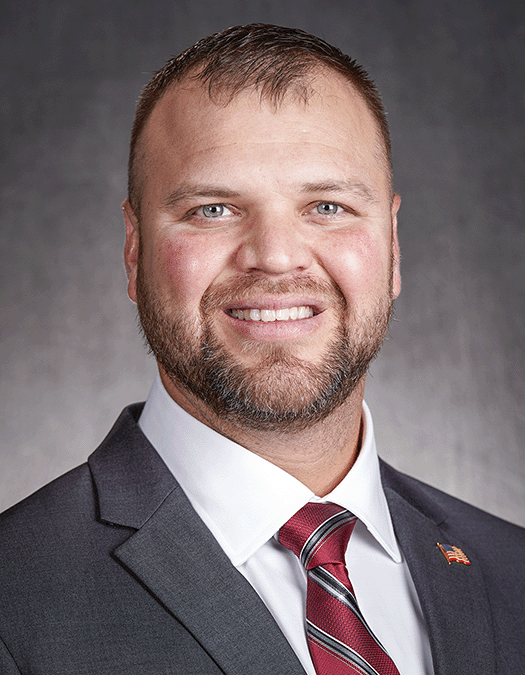
Rep. Bidal Duran
Sponsored bills
Maddy summaryThis bill modifies how members of Minnesota's Peace Officer Standards and Training Board are selected, changing the composition from 17 members with specific appointment sources to a more structured system that requires the governor to consider candidate slates submitted by relevant professional associations. The key change involves replacing language about appointing members "from among" specific groups with language requiring the governor to consider candidate slates submitted by organizations like the Minnesota Sheriffs' Association and the Minnesota Chiefs of Police Association for certain board positions. The bill also establishes staggered four-year terms for initial appointments and includes a provision preventing current board members from being immediately reappointed for four years, with these provisions set to expire in 2031. These changes take effect on January 1, 2027, and apply to the board's membership structure and appointment process.
Maddy summaryHF 7 modifies multiple public safety laws in Minnesota. It requires law enforcement agencies to make bail/bond information public and mandates county attorneys to publicly report reasons for dismissing charges. The bill establishes mandatory minimum sentences for certain sex trafficking offenses and requires individuals subject to stays in sexual conduct cases to register as predatory offenders. It also increases penalties for assaulting police officers, obstructing highway/airport traffic, and expands law enforcement's use of tracking devices on fleeing vehicles. These changes apply directly to law enforcement agencies, prosecutors, and individuals involved in criminal cases.
Maddy summaryThis bill modifies Minnesota's "Read Act" to require literacy instruction based on "science of reading" research, emphasizing evidence-based methods like phonics and decoding while explicitly excluding the three-cueing system. It establishes a new Office of Achievement and Innovation within the Department of Education to support literacy implementation and creates a statewide school performance reporting system. The bill also allows school boards to opt out of complying with certain recently enacted state education laws or rules and authorizes fund transfers for education programs through fiscal year 2029. These changes directly affect all Minnesota public school districts, educators, and students by reshaping literacy instruction requirements and school accountability systems.
Maddy summaryHF 2819 provides $3.3 million in one-time funding from the general fund to build wastewater infrastructure on the Red Lake Reservation. The bill directs the Public Facilities Authority to grant this money to the Red Lake Band of Chippewa Indians for constructing a wastewater stabilization pond and associated water/sewer lines in the Little Rock District. This funding directly supports the reservation's water infrastructure needs and is available until the project is completed. The appropriation is effective upon final enactment and aligns with existing state infrastructure grant procedures.
Maddy summaryHF 21 would require a three-fifths supermajority vote in both the Minnesota House and Senate to extend a peacetime emergency declaration beyond 14 days. Currently, such extensions beyond 14 days could be approved by the Executive Council, but this bill would shift that authority to the legislature. The bill directly affects governors seeking to prolong emergency powers and the legislative process for reviewing those requests. It does not change the initial 14-day emergency declaration period or the governor's authority to declare emergencies under existing criteria. Note: This bill was introduced but not passed during the 2025 legislative session.
Maddy summaryHF 2809 establishes a new crime for protesting directly in front of or about a person's home (excluding homes used as businesses). It makes this a misdemeanor, escalating to a gross misdemeanor if the person has a prior conviction under this law or ignores court orders like protection orders. The bill specifically allows peaceful protests about community meetings or assemblies held at locations commonly used for public discussion. This law applies to residential properties only and takes effect August 1, 2025.
Maddy summaryHF 1567 extends Minnesota's existing personal information protections for judicial officials to peace officers (including police officers). The bill defines protected information as residential addresses, family details, non-work contact information, and children's names/schools attended. It requires peace officers to submit written notification to request protection, which expires after five years unless renewed. The law prohibits government entities and others from publicly sharing this protected information online or through other means, with limited exceptions for news reporting. This directly affects Minnesota peace officers by safeguarding their personal details from public disclosure.
Maddy summaryHF 1 establishes a centralized Office of Inspector General (OIG) for Minnesota state government, replacing existing agency-specific inspector general offices. The OIG will oversee state spending, require agencies to halt payments when fraud is suspected, and mandate a fraud reporting hotline for employees and contractors. It directly affects all state agencies and recipients of state funds (such as contractors and organizations administering state programs) by requiring them to report suspected fraud and prohibiting retaliation against whistleblowers. The bill also specifies the OIG must coordinate with the legislative auditor and amends statutes related to fraud detection, waste prevention, and oversight.
Maddy summaryHF 3495 expands eligibility for school safety grants to include nonpublic schools and Tribal contract schools in Minnesota, previously only allowing public school districts and charter schools to apply. The bill appropriates $24.3 million for 2024 (with additional funds for 2026) to fund security-related facility improvements, cybersecurity insurance premiums, and associated costs for eligible schools. It amends existing law to explicitly include these school types in the grant program and allocates up to $100,000 for grant administration. This one-time appropriation is available until June 30, 2029.