

Maddy summaryThis bill prohibits local government officials (mayors, city councils, county boards, or chief law enforcement officers) from disarming peace officers who are in good standing and not under investigation or disciplinary action, unless another law specifically authorizes it. It directly affects peace officers and the local officials who manage their employment. The key provision amends Minnesota Statutes section 626.8452 to add this restriction, ensuring qualified officers cannot be disarmed without legal justification. The law takes effect the day after it is enacted.
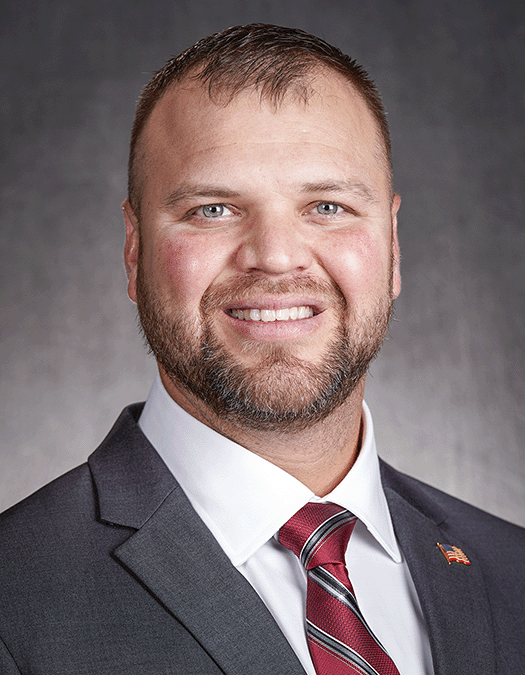
Rep. Bidal Duran
Sponsored bills
Maddy summaryHF 1116 creates a formal process for prosecutors to maintain a "Brady-Giglio list" of Minnesota peace officers with documented credibility issues, such as untruthfulness, criminal convictions, or disciplinary problems. It requires prosecutors to adopt clear policies for adding officers to this list, including providing written notice to the officer before designation and allowing them to review relevant records and request reconsideration. The bill also prohibits law enforcement agencies from firing or disciplining an officer solely because prosecutors identified exculpatory evidence related to the officer. This directly affects peace officers whose credibility is under review and sets new procedural standards for prosecutors handling such cases.
Maddy summaryHF 1119 amends Minnesota law to establish a felony charge for drivers who flee or attempt to flee a peace officer while knowingly evading them and simultaneously violating specific traffic laws. It directly affects drivers who flee police and either fail to obey traffic signs/signals/markings (under MN Statutes 169.06, subdivisions 4, 4a, 4b, 5, 6, 7, or 8) or fail to stay on the proper side of the road (under 169.18). The key provision elevates this behavior to a felony punishable by up to five years in prison, a $10,000 fine, or both. The law takes effect August 1, 2025, applying to offenses committed on or after that date.
Maddy summaryHF 767 increases penalties for arson committed against political organizations or motivated by political reasons. It amends Minnesota Statutes 609.561, 609.563, 609.5631, and 609.5632 to add specific circumstances that elevate penalties. For example, arson targeting a building housing a political organization (under §609.561) carries a maximum 25-year prison sentence, while lesser offenses with political motivation face enhanced fines and jail terms. The law applies to crimes committed on or after August 1, 2025, and directly affects individuals who commit arson against political organizations or for political statements.
Maddy summaryHF 1202 requires certain interagency group meetings to be open to the public. Specifically, it amends Minnesota's open meeting law to include "interagency groups of state employees making recommendations regarding permitting decisions of a public body" under the requirement that all such meetings must be accessible to the public. This directly affects state interagency groups involved in permitting decisions, ensuring their discussions about these decisions are transparent. The bill extends existing public meeting requirements to these specific groups without creating new procedures. (HF 1202, "Interagency group meetings required to be open to the public")
Maddy summaryHF 1201 exempts the Minnesota Department of Transportation (MnDOT) from paying sales and use taxes on materials, supplies, and equipment used for road construction, improvement, and maintenance projects. This policy change directly affects MnDOT by reducing costs for purchasing necessary items for public highway projects. The bill amends Minnesota Statutes to add a specific tax exemption under section 297A.71 for these purchases, effective after June 30, 2025. The change simplifies tax compliance for MnDOT on road-related procurement without altering broader tax policy.
Maddy summaryThis bill allows Lake of the Woods County to issue temporary liquor licenses for the Baudette Arena Association without following a specific restriction in Minnesota law (Minnesota Statutes §340A.412, subd. 4, cl. (7)). It directly affects the Baudette Arena Association, enabling it to serve alcohol temporarily at its premises. The key provision removes a legal barrier that would otherwise prevent the county from granting these licenses. The bill is limited to this single venue and county, with no broader policy changes.
Maddy summaryHF 636 removes the requirement for a permit to carry a firearm in public places for eligible Minnesotans, while creating an optional permit system. The bill amends Minnesota Statutes 624.714 to state that anyone not prohibited by state or federal law (and at least 21 years old) may carry a firearm without a permit in public places - defined as government-owned property or private property open to the public, excluding homes, businesses, gun shops, and hunting areas. An optional permit, which requires proof of pistol safety training and background checks for disqualifying offenses, remains available for those who choose it. This change directly affects eligible residents who currently need permits to carry firearms in public, eliminating that barrier while preserving the option for a permit.
Maddy summaryHF 542 authorizes local law enforcement agencies to place stationary automated license plate readers (ALPRs) in specific highway areas, including trunk highways, county state-aid highways, and county highways. The bill requires agencies to provide 14-day notice to highway authorities before and after placement, including exact location details, and mandates that ALPRs be mounted on existing traffic infrastructure like signs or lighting devices. It prohibits placements that create collision hazards or interfere with highway operations and restricts use to locations within the agency’s jurisdiction. This law updates Minnesota’s highway regulations to clarify where and how ALPRs may be installed, directly affecting local police departments and highway authorities managing those rights-of-way.
Maddy summaryHF 577 appropriates $6 million in state bond funds to Lake of the Woods County for new law enforcement and government facilities. The funds will cover designing, building, and equipping these facilities, including expanded mental health and emergency operations spaces, while improving accessibility, energy efficiency, safety, and security. The state will issue bonds up to $6 million to cover this appropriation, following standard bond procedures under Minnesota law. This bill directly affects Lake of the Woods County government by providing capital funding for public safety infrastructure.