

Maddy summaryHF 1118 requires Minnesota law enforcement agencies to provide specific benefits to peace officers diagnosed with posttraumatic stress syndrome (PTSD) resulting from work-related traumatic events. The bill mandates agencies pay for unreimbursed lost wages (up to one year) and unreimbursed medical expenses, including psychiatric care (up to one year), if an officer meets all three conditions: 1) suffers a debilitating psychological reaction to a traumatic event, 2) is diagnosed with PTSD by a mental health professional, and 3) cannot perform job duties without reassignment. It clarifies benefits apply regardless of physical injury and defines "traumatic event" to include lawful use of force causing death or serious injury, direct exposure to violence, or witnessing such events. The law affects all Minnesota peace officers covered under the statute and sets clear, time-limited benefit provisions.
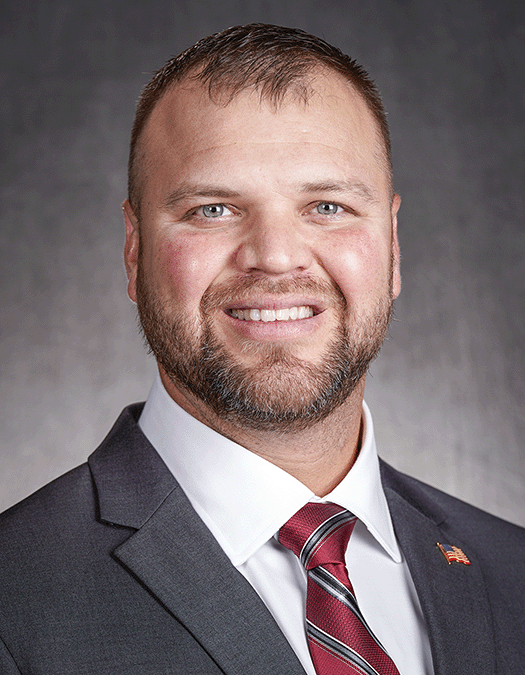
Rep. Bidal Duran
Sponsored bills
Maddy summaryHF 543 appropriates state funds for county attorney offices to cover costs of attending anti-human trafficking training. The bill allocates money from the general fund for fiscal year 2026 to reimburse all participating Minnesota county attorney offices equally for training expenses. This provides direct financial support to county prosecutors who handle human trafficking cases, ensuring consistent access to specialized training resources.
Maddy summaryThis bill repeals a provision in Minnesota law that previously barred charging individuals with attempting sexual extortion. It allows prosecutors to file attempt charges for sexual extortion attempts, which were previously unchargeable under Minnesota Statutes 609.3458, subdivision 3. The change applies to crimes committed on or after August 1, 2025, directly affecting individuals who make threats to coerce sexual acts without completing the act. This policy shift enables legal accountability for preparatory acts in sexual extortion cases.
Maddy summaryHF 2 requires state agency employees to immediately report suspected fraud to law enforcement and legislative committee leaders when they have reason to believe fraud exists in agency programs. It mandates that all state agencies post current organizational charts online with contact details for leadership and division heads. The bill strengthens grant management by requiring agencies to conduct unannounced monitoring visits before final payments for grants over $50,000 (and annually for grants over $250,000), perform financial reconciliations prior to disbursement, and withhold funds from grantees failing to submit required progress reports. Violating these grant management requirements constitutes a misdemeanor under the bill.
Maddy summaryHF 765 requires judges to impose longer prison sentences for repeat violent offenders in Minnesota. Specifically, it mandates aggravated sentences (up to the statutory maximum) for those convicted of a violent felony with two or more prior violent felony convictions and deemed a danger to public safety. The bill also requires consecutive sentencing for these offenders and prohibits probation, parole, work release, or early release until the full sentence is served - overriding several existing statutes. This applies only to violent offenders convicted of a felony on or after August 1, 2025, and excludes certain offenses like those under sections 152.023 or 152.024.
Maddy summaryHF 480 requires Minnesota county attorneys to document specific details (including dismissal reasons, victim input, and offense dates) when dismissing felony charges. It mandates that county attorneys forward this anonymized data to the Sentencing Guidelines Commission and post it on public websites. The Commission must then include a summary and analysis of these dismissal reports in its annual legislative report. The law applies to felony dismissals occurring on or after August 1, 2025.
Maddy summaryHF 1200 exempts cooperative electric associations in Minnesota from four specific clean energy standards under Minnesota Statutes § 216B.1691. The bill adds a new exemption (subdivision 11) that removes these member-owned utilities from requirements for eligible energy technology, solar energy, carbon-free energy, and distributed solar energy standards. This directly affects cooperative electric associations, which serve many rural and community-based areas across Minnesota. The change modifies the existing law to exclude these cooperatives from the renewable energy targets applied to other electric utilities. The bill does not alter the standards themselves but removes a category of utilities from compliance obligations.
Maddy summaryHF 14 proposed a temporary moratorium on most light rail transit project development spending by the Metropolitan Council in seven Minnesota counties (Anoka, Carver, Dakota, Hennepin, Ramsey, Scott, and Washington). The bill prohibited funds for planning, design, environmental analysis, land acquisition, and construction of new light rail projects, but exempted the Southwest Light Rail (Green Line Extension) and prior contractor payments. The moratorium would have expired once the Green Line Extension began revenue operations. The bill was introduced, amended, and ultimately not passed by the legislature.
Maddy summaryHF 1331 requires the commissioner of natural resources to conduct an annual statewide survey to estimate Minnesota's wolf population. The survey must cover the entire state - not just historic wolf habitats - and be completed each year. This amendment to Minnesota Statutes section 97B.646 (wolf management) adds this requirement to the existing framework, which already includes a wolf management plan and quarterly mortality reporting. The bill directly affects state wildlife management practices under the Department of Natural Resources.
Maddy summaryThis bill transfers responsibility for the Old Williams School property from Lake of the Woods County to Minnesota's Commissioner of Natural Resources, who must maintain and use the site. The Commissioner must consult with the Pollution Control Agency and submit a report by February 1, 2026, detailing cleanup, maintenance, and usage options to relevant legislative committees. The bill directly affects Lake of the Woods County (removing its management duties) and the Natural Resources Commissioner (assigning new responsibilities).