

Maddy summaryHF 1007 appropriates $5 million from Minnesota's general fund for the World Junior Hockey Championships hosted in Minnesota during December 2025 and January 2026. The funds, available until June 2027, are directed to Minnesota Sports and Events through Explore Minnesota to cover event-related costs. This bill provides specific financial support for the tournament's operational expenses. It directly affects the state's tourism organization and the event organizer, Minnesota Sports and Events. The legislation is a straightforward funding measure with no additional policy provisions.
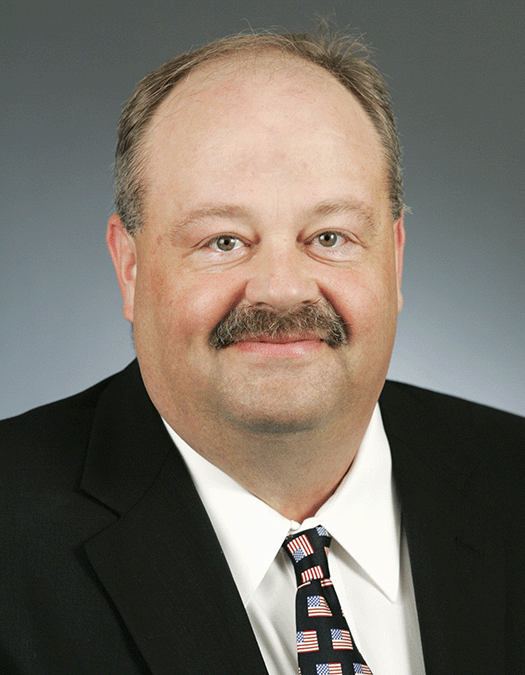
Rep. Greg Davids
Sponsored bills
Maddy summaryHF 715 increases Minnesota's medical assistance payment rates for ambulance services. It raises rates by 5% effective January 1, 2017, for providers outside major metro areas or in communities with fewer than 1,000 residents. The bill also adds a 2026 rate increase (specified as "..." percent in the text) and creates a fuel adjustment mechanism: if gasoline prices exceed $3.00 per gallon, ambulance payment rates adjust by 1% for every 10-cent price change. These changes affect ambulance providers, managed care plans, and county purchasing plans that pay for ambulance services under Minnesota's medical assistance program.
Maddy summaryHF 2712 allocates $8.5 million from the state general fund for one-time improvements to the Capitol tunnel under Rev. Dr. Martin Luther King Jr. Boulevard and east of the State Capitol. The funds will cover designing, constructing, and equipping the tunnel to meet Americans with Disabilities Act (ADA) requirements, directly benefiting people with disabilities who use Capitol facilities. The bill specifies that the funding is available until the project is completed or abandoned, with no ongoing annual appropriations. This is a straightforward infrastructure funding measure focused on accessibility compliance, not a policy change affecting broader legislation.
Maddy summaryHF 2659 appropriates $4 million from state bond proceeds to fund the renovation of La Crescent's regional ice arena. The city of La Crescent will receive the funds to design, construct, and equip the arena, specifically including replacing its outdated R-22 refrigerant system and installing a rooftop solar energy system. The state will issue up to $4 million in bonds to cover this appropriation, following standard state bond procedures. This bill directly affects La Crescent residents and users of the regional ice arena by enabling facility upgrades and energy improvements.
Maddy summaryThis bill exempts sales tax on tickets and admissions for intercollegiate sports events at Minnesota's public colleges and universities. It applies to all intercollegiate sports recognized by national athletic associations, covering events at state universities, community colleges, technical colleges, and the University of Minnesota. The exemption takes effect for sales after June 30, 2025. This change directly affects public institutions of higher education and fans purchasing tickets for these events.
Maddy summaryHF 1603 makes Minnesota's paramedic scholarship program permanent, providing annual funding to support students entering paramedic training. It appropriates $3.2 million each for fiscal years 2026 and 2027 - $3 million for up to 600 annual scholarships, $100,000 for promotion, and $100,000 for administration. The program directly benefits students at Minnesota postsecondary institutions pursuing paramedic careers by reducing financial barriers. The bill also requires annual reports tracking scholarship distribution, program locations, costs, and workforce demand data to the legislature.
Maddy summaryHF 93 establishes a state grant program to help ambulance services train and hire emergency medical technicians (EMTs). Licensed ambulance services that had at least 50% of their staff as EMTs in the prior year can apply for grants to cover specific costs, including EMT program tuition, certification fees, background checks, and up to $26 per hour in wages during training. The program appropriates $750,000 for fiscal year 2026 and $750,000 for fiscal year 2027 from the general fund. Grants must be used solely for these defined training and staffing expenses, with applicants required to detail planned hires and training hours. This directly supports ambulance services in addressing staffing shortages by reducing training costs.
Maddy summaryHF 1458 modifies Minnesota's requirements for becoming a certified public accountant (CPA). It extends current standards (150 college credits plus one year of relevant work experience) until July 1, 2030, after which new applicants will need either a master's degree plus one year of experience or a bachelor's degree plus two years of experience. The bill also establishes reciprocity, allowing CPAs licensed in other states with comparable requirements to practice in Minnesota without additional exams. This directly affects current and future CPA applicants in Minnesota and out-of-state CPAs seeking to practice in the state.
Maddy summaryHF 1292 expands eligibility for Minnesota's beginning farmer tax credits by adding specific requirements to qualify. It defines "beginning farmer" as someone who has entered farming within the last ten years, meets net worth limits, provides majority day-to-day farm labor, demonstrates farming knowledge or experience, shows profit potential through projected earnings, and completes a financial management program (with a waiver available for those with agricultural degrees or experience). The bill directly affects new or recent farmers seeking to establish operations in Minnesota, particularly those who may not have met prior eligibility criteria. The changes amend Minnesota Statutes section 41B.0391, aiming to support entry into farming through targeted tax assistance.
Maddy summaryHF 2536 appropriates $1.44 million from state bond proceeds to fund the predesign, design, and construction of a four-mile paved segment of the Shooting Star State Trail. The project extends from Taopi south to the Iowa state line, creating a pedestrian and bicycle pathway under existing trail authority. The bill authorizes the state to issue bonds up to $1.44 million to cover these costs, with funds managed by the commissioner of natural resources. This directly affects Minnesota’s state trail system and future trail users, not specific individuals or groups.