

Maddy summaryHF 2988 extends the tax exemption for Minnesota State High School League event tickets and admissions, and continues the annual transfer of associated sales tax savings to a nonprofit foundation. The bill amends statutes to maintain the exemption for league events (sec. 297A.70, subd. 11a) and the requirement for the League to transfer those savings to the foundation (sec. 128C.24) until July 1, 2037. The foundation uses these funds to award grants, prioritizing athletic fee scholarships for students, while considering gender balance, school size, and geographic location. This directly affects high school students participating in league activities by preserving access to financial support through the existing program. The extension applies to all future sales and purchases after the bill's enactment date.
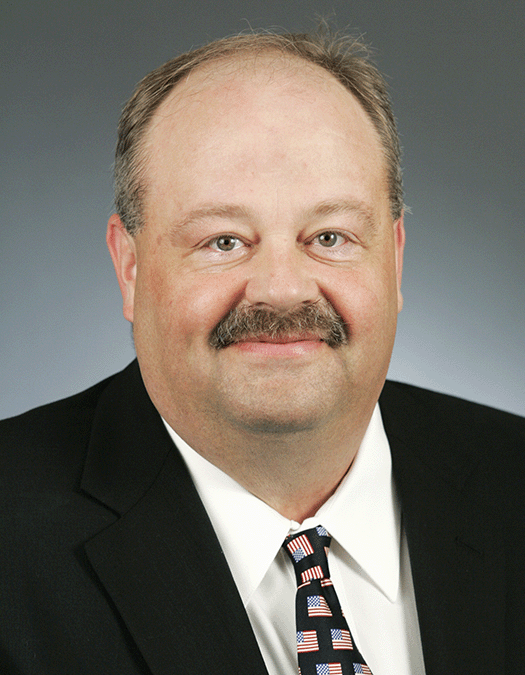
Rep. Greg Davids
Sponsored bills
Maddy summaryHF 474 appropriates $200,000 from Minnesota's general fund to replace the existing statue of Henry Mower Rice in the U.S. Capitol's Statuary Hall with a statue of Hubert H. Humphrey. The funds cover removing Rice's statue, transporting it to the Minnesota Historical Society, recasting Humphrey's statue (currently at the state capitol), and erecting the new statue. This one-time appropriation is specifically for the physical replacement project in the Capitol. The bill directly affects Minnesota's representation in the Statuary Hall collection.
Maddy summaryHF 174 modifies how rural electric cooperative associations are taxed in Minnesota. It replaces personal property taxes on their rural distribution lines and equipment with a flat $10 tax per 100 members (or fraction thereof) for these associations. The bill applies specifically to co-ops organized under Minnesota's cooperative laws that provide electricity to farmers in rural areas, excluding substations and generation equipment. This tax replaces all local property taxes on qualifying infrastructure and must be paid annually by March 1. The changes take effect for tax assessments starting in 2025.
Maddy summaryHF 2961 expands Minnesota's sales tax exemption for certain restaurant meals and drinks. It adds two new exemptions: (1) complimentary meals and beverages (including alcohol) provided to customers at no cost, and (2) employee meals and non-alcoholic beverages purchased by restaurants. These exemptions apply to restaurants defined under Minnesota Statutes §157.15, subdivision 12. The changes take effect July 1, 2025, removing sales tax from these specific transactions.
Maddy summaryHF 1165 renames the Minnesota Higher Education Facilities Authority to the Minnesota Health and Education Facilities Authority and authorizes it to finance health care facilities in addition to its existing role supporting higher education. The bill increases the agency's bonding capacity, allowing it to issue more bonds to fund construction and improvements for both health care and educational facilities. This directly affects health care organizations and institutions of higher education in Minnesota by expanding their access to financing for facility projects. The legislation also updates the authority's board composition requirements to include members with expertise in health care, higher education, and finance.
Maddy summaryHF 443 modifies Minnesota's property tax rules for airport facilities. It provides a 50% reduction in tax capacity for specific airport properties in cities with 50,000-150,000 residents (not operated by the Metropolitan Airports Commission) used as hangars for aircraft storage/repair or for passenger areas like check-in counters. This tax relief applies to property taxes payable from 2026 through 2037. The bill specifically targets smaller city airports, excluding those in Minneapolis/St. Paul and Metropolitan Airports Commission facilities.
Maddy summaryHF 2550 establishes a new Local Business Construction Impacts Assistance Program to support businesses affected by highway and street construction projects in Minnesota. It requires transportation authorities to appoint business liaisons and create communication plans for projects expected to cause "substantial business impacts" (like reduced access, parking, or visibility for at least one month). The program provides financial assistance to eligible businesses experiencing "extensive business impacts" (impairment for 60+ days) due to covered projects, such as highway work in cities or counties. This bill directly affects local businesses near construction zones and aims to mitigate economic disruption through proactive communication and financial support.
Maddy summaryHF 2527 establishes a 30 miles per hour speed limit on a specific segment of Beltrami County State-Aid Highway 20, from the intersection with Highway 21 to the entrance of Lake Bemidji State Park. The bill directly affects drivers traveling on this highway segment and requires the Beltrami County engineer to install appropriate speed limit signs. It amends Minnesota Statutes by adding a new subdivision to section 169.14, overriding standard speed limits for this location. The new speed limit takes effect the day after the bill is enacted, once the required signs are installed.
Maddy summaryHF 1964 appropriates $9.6 million from state bonds to renovate paved state trails established under Minnesota law. The funds, sourced through bonds sold by the state, will be managed by the commissioner of natural resources for trail projects prioritized under existing statutes. This bill directly affects Minnesota's state trail system and the agencies responsible for maintaining it. The legislation creates a specific funding mechanism to support infrastructure improvements on designated paved trails.
Maddy summaryHF 1352 modifies Minnesota's definition of "residential generator" for solid waste management billing. It clarifies that multi-unit properties like apartment buildings, condos, or manufactured home parks where residents aren't separately billed for waste services (and the owner/association pays directly) are explicitly included as residential generators. This directly affects property owners, associations, and waste service providers managing such properties. The change ensures consistent billing responsibility for waste services in these multi-residence settings, effective July 1, 2025.