

Maddy summaryHF 837 requires Minnesota's commissioner of commerce to apply to the federal government by December 31, 2026, for a waiver continuation under federal law (42 U.S.C. § 18052). This waiver is needed to keep Minnesota's premium security health insurance plan operating after 2027, as its future depends on federal approval. The bill also directs a one-time transfer of $413 million from the state general fund to the premium security plan account in fiscal year 2026. This funding supports the state's health insurance program for qualifying residents. The bill directly affects Minnesota's health insurance program and state budget management.
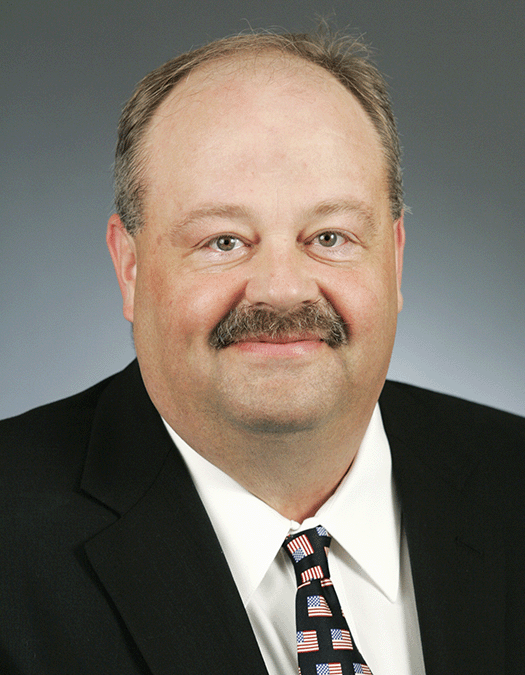
Rep. Greg Davids
Sponsored bills
Maddy summaryThis bill recognizes Minnesota's historic state flag (described as a blue flag with a central emblem featuring 19 stars, the word "MINNESOTA," and scenes from the Great Seal) and grants all Minnesotans the right to display it. It requires the lieutenant governor to set standards for its display on state property, mandating it be shown during specified holidays and on Capitol grounds during legislative sessions. The bill also allows the historic flag to be displayed on other public property for ceremonial purposes, while requiring it to be placed beneath the official state flag when both are displayed together. It directly affects all Minnesotans who display the flag and government entities managing public property.
Maddy summaryHF 2512 creates a property tax exemption for real estate owned and operated by congressionally chartered veterans service organizations in Minnesota. The bill amends Minnesota Statutes to exempt qualifying property under section 273.13, subdivision 25, paragraph (d), clause (3), from property taxes. The commissioner of veterans affairs must annually provide a list of eligible organizations to the commissioner of revenue by January 1. This exemption applies to assessment year 2025 and later. The bill directly affects these veterans service organizations by reducing their property tax burden on qualifying properties.
Maddy summaryThis bill appropriates $14 million from state bond proceeds to fund Phase 1 of a new bike trail connecting Harmony to Caledonia, following Highway 44 and Highway 52 through Canton, Mabel, and Spring Grove. The funds will cover property acquisition, easements, predesign, and design work for the trail. The state is authorized to issue up to $14 million in bonds to finance this project, with unspent funds potentially used for engineering and construction. The bill directly affects the cities along the route and the Minnesota Department of Natural Resources, which will manage the trail development.
Maddy summaryHF 167 modifies Minnesota's individual income tax system by removing limits on subtracting Social Security benefits, allowing taxpayers to subtract all their Social Security income without phaseout thresholds or maximums. It also updates income tax brackets, raising the first tax bracket threshold to $47,620 for married couples filing jointly and $47,620 for single filers (from $38,770 and $26,520, respectively). The bill additionally modifies property tax refund rules, though specific changes aren't detailed in the provided text. These changes apply to taxable years beginning after December 31, 2024.
Maddy summaryHF 2336 establishes a tax credit for corporations that establish or maintain their headquarters in Minnesota. To qualify, corporations must meet specific criteria, including having at least $250 million in worldwide revenue, employing 250+ eligible workers at the headquarters, making a $10 million minimum investment in eligible expenses (like relocation, renovation, or employee training), and creating or maintaining jobs. The credit equals 10% of eligible employee wages per worker (capped at $20,000 per employee) or 60% of total eligible expenses, whichever is lower. The bill also requires the state to report on the program's implementation and impact.
Maddy summaryHF 75 modifies Minnesota's renewable energy standard to clarify which hydroelectric facilities qualify as "eligible energy technology." The bill specifies that hydroelectric projects must either have a capacity under 100 megawatts or, if 100+ megawatts, have been operational since February 8, 2023. This directly affects electric utilities generating hydroelectric power seeking to comply with the state's renewable energy requirements. The change maintains existing eligibility rules without altering the 100-megawatt threshold or operational date criteria. (Amends Minn. Stat. § 216B.1691, subd. 1.)
Maddy summaryHF 24 amends Minnesota Statutes section 145.423 to require that infants born alive during an abortion be immediately recognized as human persons under the law and receive medical care. The bill mandates that medical personnel take "all reasonable measures consistent with good medical practice" to preserve the life and health of such infants, including compiling appropriate medical records. It directly affects healthcare providers performing abortions in Minnesota by establishing specific medical care obligations for infants born alive. The proposed changes would have taken effect the day after enactment, though the bill was not passed.
Maddy summaryHF 2335 modifies Minnesota's rules for Medicare supplement insurance (Medigap) policies to prevent health insurers from denying coverage or charging more due to preexisting conditions. It directly affects Medicare beneficiaries in Minnesota, including those under 65 who qualify due to disability, when applying for Medigap during the six-month period after first enrolling in Medicare Part B or during open enrollment. The bill requires insurers to offer coverage without preexisting condition limits during these enrollment windows and mandates automatic reinstatement of policies without new waiting periods if a policyholder loses Medicaid eligibility (medical assistance) and notifies the insurer within 90 days. This ensures more stable and accessible coverage for Minnesotans relying on Medicare.
Maddy summaryThis bill expands tax increment financing (TIF) revenue uses for Minnetonka, Richfield, and St. Louis Park. It allows these cities to redirect up to 15% more TIF revenue (previously limited to local projects) to transfer directly to local housing trust funds. Funds transferred must support rental housing for households at or below 80% of area median income or homeownership for households at or below 120% of area median income. The transferred funds no longer count as TIF revenue for annual reporting purposes under state law.