

Maddy summaryHF 549 requires Minnesota cities receiving certain local government aid to dedicate a specific portion of that funding to housing programs. This portion is calculated as the city's "housing need percentage," based on the share of housing built before 1940 and between 1940-1970 (using U.S. Census data). Cities must use this dedicated amount for housing development, redevelopment, or rehabilitation - on top of existing housing funds - and the requirement starts for aid payable in 2026. It directly affects all Minnesota cities receiving the specified local government aid.
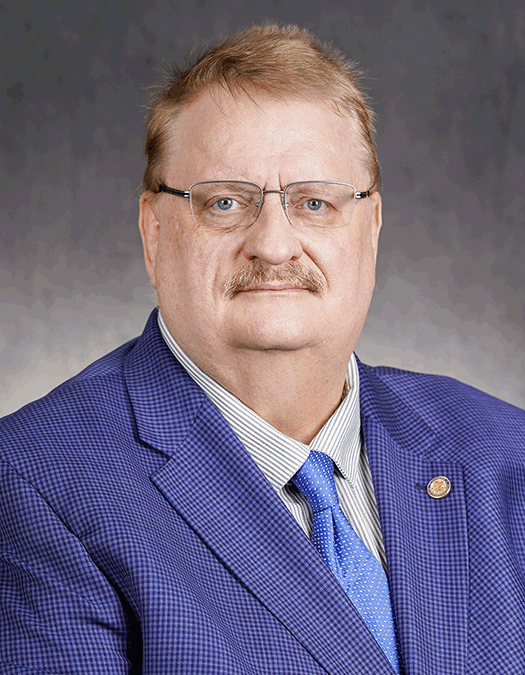
Rep. Duane Quam
Sponsored bills
Maddy summaryHF 588 establishes a trust for Supplemental Security Income (SSI) benefits received by foster children in Minnesota. It requires child welfare agencies to send all SSI payments directly to a dedicated "foster children assistance trust" account instead of using them for general agency expenses, and mandates written notice to foster children aged 13+ about the trust. Agencies must report annually on SSI usage to the state commissioner of children, youth, and families, who then submits a compiled report to the legislature. This applies specifically to foster children receiving SSI benefits, ensuring those funds are solely used for their care and tracked transparently. The trust must be managed separately from general state funds with strict accounting requirements.
Maddy summaryHF 555 proposes a constitutional amendment to allow owners of certain properties to vote on local tax and bond votes in the area where their property is located, even if they don’t live there. Specifically, it would grant voting rights to owners of agricultural land, nonhomesteaded noncommercial real property, or small business property (as defined by law). The amendment, if approved, would add this eligibility to Minnesota’s voting requirements in Article VII, Section 1 of the state constitution. The proposal must be submitted to voters in the 2026 general election with a specific yes/no question about this change.
Maddy summaryThis bill prohibits municipalities from accepting their own municipal IDs as valid identification for state or federal services. A "municipal ID" is defined as a photo ID issued by a city or town that includes basic personal details like name, birthdate, and address. The law specifically states that such IDs cannot be used to prove identity when accessing state services or federally administered programs run by the state. This directly affects residents who might rely on municipal IDs for government interactions and requires state agencies to stop accepting them for identification purposes.
Maddy summaryHF 637 clarifies that election judges in Minnesota are not considered employees of the local government body (like a county) that appoints them. The bill specifically prohibits appointing authorities from requiring election judges to meet employment conditions unrelated to their election duties, such as background checks or training typically required for permanent staff. This directly affects election judges and local election officials who appoint them. The bill amends Minnesota law to prevent local governments from imposing unnecessary employment rules on temporary election judges.
Maddy summaryHF 553 prohibits state and local government agencies from accepting municipal identification cards as valid proof of identity for state or federal services. The bill specifically affects residents who rely on city-issued municipal IDs (like photo IDs with name, birthdate, and address) to access services such as welfare programs, healthcare, or driver's license renewals. It requires state agencies and local governments to reject municipal IDs for any service requiring identification, regardless of local ordinances. The law defines "municipal ID" as a card issued by a city to residents living within its boundaries for at least 30 days. The bill takes effect immediately upon final enactment.
Maddy summaryHF 563 requires Minnesota cities receiving certain local government aid to dedicate a specific portion of that funding - calculated as their pre-1940 housing percentage multiplied by their city formula aid amount - to improve housing built before 1940. This dedicated funding can be used directly for urban renewal projects or as grants/low-interest loans to property owners, covering updates to utilities, infrastructure, wiring, plumbing, insulation, heating, cooling, or energy efficiency systems. Cities must dedicate this amount unless it totals less than $100 (in which case no minimum is required), and this funding is in addition to other existing housing program resources. The requirement applies to aid payable in 2025 and future years.
Maddy summaryHF 556 establishes a pilot program to provide grants to Minnesota local law enforcement agencies that lack sufficient equipment for responding to active shooter incidents in schools. Agencies may apply for grants to purchase specific equipment needed for such emergencies, with priority given to those without existing response equipment. Applications must detail school locations, student populations, and include a plan for secure, rapid-access storage of the equipment within schools. The bill appropriates a one-time $... from the general fund for fiscal year 2026 to administer this program.
Maddy summaryThis bill modifies how Minnesota distributes funds from the Arts and Cultural Heritage Fund. It requires at least 47% of annual appropriations to be allocated directly to the Minnesota State Arts Board for grants and services, rather than being distributed through regional councils. The remaining funds are then distributed to regional arts councils based on population, using a new formula that divides the total by the number of regional councils plus one. This directly affects the Minnesota State Arts Board and regional arts councils in administering arts funding. The change clarifies the distribution process without creating new programs or altering funding levels.
Maddy summaryHF 552 modifies Minnesota's prompt payment law for state contracts. It requires state agencies to pay subcontractors directly from contract retainage funds (money held back from payments) if a prime contractor becomes unable to pay (e.g., due to bankruptcy), up to the amount owed for completed work. If retainage funds are insufficient, payments must be distributed proportionally based on amounts owed. The law applies to contracts entered into on or after July 1, 2025, and affects state agencies, prime contractors, and subcontractors working on state projects.