

Maddy summaryHF 69 requires most Minnesota cities, towns, and school districts to hold general elections on the first Tuesday after the first Monday in November during even-numbered years. Cities of the first class (like Minneapolis) may instead choose to hold elections in odd-numbered years, but must adopt a transition plan adjusting terms of office and provide 180 days' notice. The bill amends election statutes to mandate this standardized schedule, with cities of the first class needing to follow specific procedures including potential voter referendums. This directly affects local election timing for over 800 Minnesota municipalities and school districts.
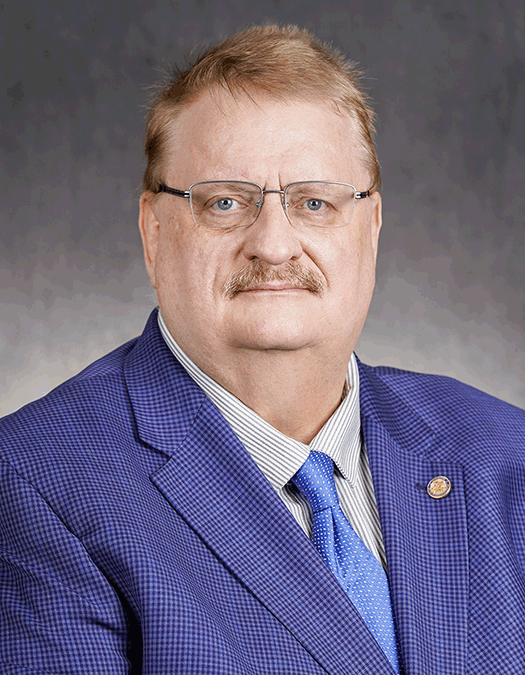
Rep. Duane Quam
Sponsored bills
Maddy summaryHF 594 changes Minnesota's state primary election date to align with the presidential primary nomination date. This affects all Minnesota voters participating in primary elections and election officials managing polling locations. The bill amends specific election statutes to update the timing requirements for state primaries and adjusts procedures for presidential nomination primaries. Key provisions include modifying deadlines for establishing combined polling places and updating reporting requirements to reflect the new primary schedule. The change ensures state primaries occur on the same day as presidential nomination primaries, streamlining election administration.
Maddy summaryHF 913 requires local canvassing boards to complete two specific election-related tasks before certifying election results. These tasks are ballot reconciliation (as defined in Minnesota Statute §204C.20) and postelection review (as defined in §206.89). The bill directly affects canvassing boards, which are local election officials responsible for verifying election results. It amends Minnesota Statutes §204C.31, subdivision 3, to mandate that certification cannot occur until both processes are finished. This changes the procedural timeline for election certification without altering voting rules or affecting voters directly.
Maddy summaryHF 911 proposes a constitutional amendment to allow owners of specific properties to vote on local property tax questions. It would grant voting rights in the precinct where their property is located to owners of agricultural land, nonhomesteaded noncommercial real property, or small business property (commercial/industrial property where the owner operates a small business). The bill includes implementing language for registration and voting procedures through the Secretary of State, permitting absentee or mail voting for these property owners. This amendment must be submitted to voters in the 2026 general election for approval. If ratified, it would change Minnesota's voting eligibility under Article VII, Section 1 of the state constitution.
Maddy summaryHF 70 withdraws Minnesota from the National Popular Vote Interstate Compact, a multi-state agreement that would have awarded the state's presidential electors based on the national popular vote winner. The bill amends Minnesota election law to remove the requirement to follow this compact, returning the process to the state's traditional method of selecting electors based on the winner of Minnesota's statewide popular vote. It repeals two specific sections of law (208.051 and 208.052) that implemented the compact's provisions. This change directly affects how Minnesota's presidential electors are chosen in future elections, aligning with the state's current electoral system.
Maddy summaryHF 585 modifies Minnesota teacher licensing rules to ease transitions for educators moving from other states. It adds an exemption (Minnesota Statutes §122A.185, subd. 1(4)) so teachers who completed a state-approved program and passed licensing exams in another state no longer need to take redundant Minnesota exams. The bill also shortens probationary periods (§122A.40, subd. 5(f)) for teachers with three consecutive years of teaching experience in another state or Minnesota, requiring only a one-year probation instead of the standard three years. This directly affects out-of-state licensed teachers seeking to teach in Minnesota public schools.
Maddy summaryHF 366 appropriates $1.2 million from the general fund for a one-time resurfacing project on Trunk Highway 74 in Winona County. The funds cover work from north of Elba to County State-Aid Highway 30, including design, engineering, and construction using methods like Otta seal. This bill directly affects Winona County residents and travelers using this highway segment by improving road conditions. The appropriation is available until June 30, 2028, and is limited to the specified highway section.
Maddy summaryHF 593 establishes a process for Minnesota to select delegates to a potential constitutional convention called under Article V of the U.S. Constitution. It requires the Senate majority leader, Senate minority leader, House speaker, and House minority leader to each appoint one delegate, with the four appointing authorities jointly selecting a fifth delegate by unanimous choice. The bill also allows for alternate delegates and sets a 30-day appointment deadline before the convention's scheduled date. This procedural bill directly affects Minnesota's legislative leadership and applies only if Congress convenes such a convention. It does not change Minnesota's constitution but creates a framework for delegate selection.
Maddy summaryHF 559 requires courts to order convicted individuals who falsely report emergencies to pay restitution. The bill mandates that courts order full restitution to public agencies for their emergency response costs and to direct victims of the false report. This amendment to Minnesota Statutes section 609.78 (2024) applies specifically to those convicted under the statute for making fictitious emergency reports. The restitution requirement does not limit victims' ability to seek additional damages in civil court.
Maddy summaryHF 564 prohibits public school libraries from containing pornographic material and bans sexually explicit content in public elementary school libraries. The bill amends Minnesota Statutes by adding a new section requiring these restrictions. It directly affects all public school libraries across Minnesota, with stricter rules applying specifically to elementary schools. The law creates a clear policy change by defining and banning specific material types in these educational settings.