

Maddy summaryHF 545 restricts how public union representatives in Minnesota can use paid time off for union duties. The bill amends state law to prohibit public employers from allowing union officials to use this time for political activities, such as campaigning or lobbying. It directly affects elected or appointed union representatives (including those in school districts) who receive paid time off to perform union duties. The key provision explicitly states that time off provided under this law must not be used for political purposes.
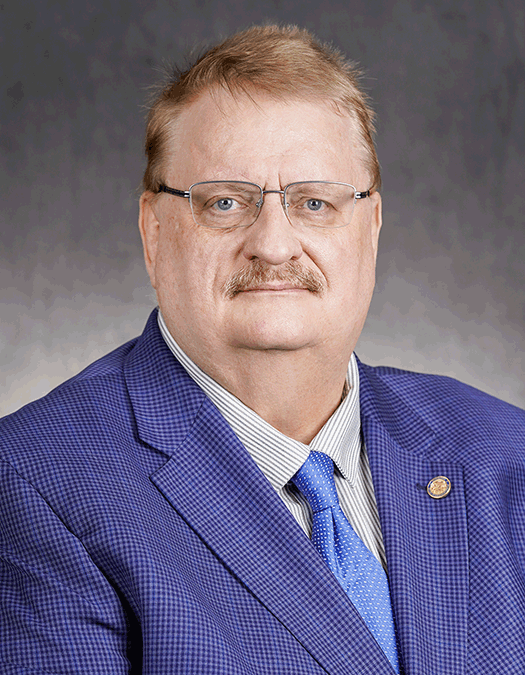
Rep. Duane Quam
Sponsored bills
Maddy summaryHF 598 repeals Minnesota's law allowing counties to provide secure absentee ballot drop boxes for voters to return completed ballots. It removes the specific authorization for drop boxes from election statutes (repealing Minn. Stat. § 203B.082) and amends the main absentee voting section to eliminate drop boxes as a return option. This means county auditors and municipal clerks can no longer establish or maintain drop boxes for absentee ballots, requiring voters to instead mail ballots or hand-deliver them in person to election offices by 8:00 p.m. on election day. The change directly affects local election officials and voters who previously used drop boxes for absentee ballot returns.
Maddy summaryHF 590 modifies rules for how staff in licensed residential programs can use residents' electronic benefit transfer (EBT) cards to buy food. It requires staff to be listed as an authorized representative of the resident before making purchases and mandates that programs keep a log of all such transactions. Residential programs must also maintain these purchase records according to existing requirements in Minnesota law. This bill directly affects licensed residential facilities and their staff who handle food purchases for residents using EBT cards.
Maddy summaryHF 560 requires Minnesota's driver's license and identification card applicant process to use facial recognition technology. The bill mandates that the commissioner compare applicants' photos against state, FBI, and other law enforcement databases to prevent duplicate licenses, stop ID fraud, and speed up processing. If a match is found, a department employee reviews it, and law enforcement must validate the match before a license can be issued. This applies to all applicants and renewals starting January 1, 2027, directly affecting anyone seeking these state-issued IDs.
Maddy summaryHF 586 establishes a new funding program that awards additional state money to Minnesota public schools based on two student success metrics: graduation rates (measured as points above 90%) and college enrollment success (measured as points above 90% for graduates enrolled in in-state colleges without remedial courses). Schools must meet both metrics to qualify, with funding calculated as a share of total available funds based on their combined performance scores. The program applies to the 2026-2027 school year and beyond, appropriating specific funds for fiscal years 2026 and 2027. It directly affects public schools that meet the defined performance thresholds, providing incentive aid tied to measurable student outcomes.
Maddy summaryHF 595 makes the major political party affiliation of election judges publicly accessible data in Minnesota. The bill requires appointing authorities to maintain and publish a list showing each election judge's party affiliation (or if they don't affiliate with a major party), classifying this as "public data on individuals" under state law. This replaces a previous restriction that limited such information to other election judges for verifying party balance requirements. The change directly affects election judges (individuals appointed to oversee voting) and allows any member of the public to access this information through official records.
Maddy summaryHF 565 requires Minnesota public schools to designate restrooms, locker rooms, changing rooms, and showers exclusively by sex based on biological characteristics (chromosomes and anatomy). It defines "sex" as determined by a person's chromosomes and anatomy, prohibiting individuals with a Y chromosome from using facilities designated for females. Schools must provide separate, private areas for students based on sex in all facilities where students may be undressed, with limited exceptions for single-occupancy spaces due to special circumstances. The bill also includes separate provisions for athletic teams, restricting female-designated teams to those without a Y chromosome.
Maddy summaryHF 548 allocates $2.4 million in state bond funds to improve intersections along U.S. Highway 14 in Byron, Minnesota. The bill specifically funds planning, design, and construction of grade-separated interchanges at key intersections with Olmsted County State-Aid Highways 3 and 5. It authorizes the state to issue bonds up to $2.4 million, with proceeds deposited into the trunk highway fund to cover environmental analysis, right-of-way acquisition, and building these interchanges. The project directly affects Byron residents and commuters using U.S. Highway 14 by replacing at-grade traffic signals with safer, more efficient interchanges.
Maddy summaryHF 546 appropriates $3 million from state bond proceeds to fund a solar array and electric vehicle charging stations in the parking area at Rochester International Airport. The city of Rochester will receive a grant to cover predesign, construction, and related work, including site preparation. The funds will be provided through state bonds authorized under Minnesota law, with prior project costs counted toward the city's required nonstate contribution. This bill directly affects Rochester International Airport operations and local infrastructure development.
Maddy summaryHF 587 requires school districts in Minnesota that perform below the state average in key academic metrics to have their prekindergarten programs evaluated by the Parent Aware quality rating system. This applies specifically to districts whose pre-K programs do not meet state benchmarks for student readiness, as defined by performance measures in education law. The evaluation will determine if these programs qualify for state funding under the Parent Aware system, which sets quality standards for early childhood education. The bill amends existing statutes to mandate this review process for underperforming districts, starting in 2026.