

Maddy summaryHF 597 proposes a constitutional amendment to limit Minnesota's state spending increases to inflation plus population growth. If adopted, it would require the state to calculate spending changes using the Minneapolis-St. Paul Consumer Price Index and federal population estimates, excluding federal funds, tax refunds, and certain reserves. Any spending exceeding this limit would require returning excess revenue to taxpayers via property tax refunds or permanent tax rate cuts. The amendment must be submitted to voters in the 2026 general election with the question: "Shall the Minnesota Constitution be amended to prohibit state spending increases in excess of inflation and population growth?"
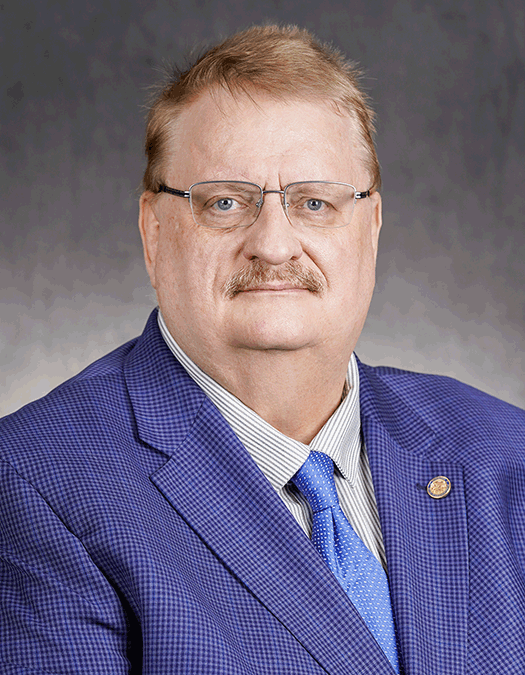
Rep. Duane Quam
Sponsored bills
Maddy summaryHF 592 requires Minnesota's Department of Human Services to create and implement a customer service survey for applicants seeking medical assistance or long-term services and supports between November 2025 and May 2026. The survey will collect feedback on wait times and form complexity from applicants. By November 2026, the department must submit a detailed report to the legislature, including survey results, recommendations to reduce application processing times, improve staff training, develop expedited processes for certain applicants, and propose technology improvements to streamline applications across public assistance programs. This bill directly affects individuals applying for these services and the state agencies administering them.
Maddy summaryHF 600 prohibits major political parties in Minnesota from accepting contributions from registered lobbyists, political committees, political funds, or unregistered associations during regular legislative sessions. It also bans these entities from making contributions to political parties or their campaign committees during sessions. The bill specifically prevents contributions for event access or facility membership during sessions, treating such payments as violations. This applies to all major political parties and their affiliated committees operating within the legislature during session days. The law takes effect the day after final enactment.
Maddy summaryHF 547 appropriates $3.2 million in state bond funds to the city of Stewartville for road improvements on a one-mile section of 15th Avenue NE. The funds will be used to pave the roadway, address drainage issues, and replace culverts and storm sewers at the intersection with 6th Street NE. This bill directly affects Stewartville residents and businesses by improving local infrastructure in a specific corridor adjacent to the city limits. The funding comes from state bonds authorized under Minnesota Statutes, with the project effective upon final enactment.
Maddy summaryHF 644 appropriates $44.8 million from state bond proceeds to fund a new regional wastewater treatment facility in Goodhue County. The funds will support the design, construction, and infrastructure connections for a facility serving the cities of Zumbrota, Goodhue, Pine Island, and Wanamingo, as well as connecting to the Prairie Island Indian Community's Elk Run settlement lands. The bill authorizes the state to issue bonds up to $44.8 million under Minnesota's bond laws to cover these costs. This project aims to create a state-of-the-art regional wastewater facility that will replace outdated infrastructure.
Maddy summaryHF 591 allows nurses licensed under the Nurse Licensure Compact (NLC) to practice in Minnesota during specific emergencies without needing a separate Minnesota license. It applies to out-of-state nurses with active NLC licenses who are contracted by Minnesota healthcare facilities (like hospitals or clinics) during declared peacetime health emergencies or critical pandemic/disease outbreaks. Healthcare providers must verify the nurse’s license is in good standing and report details to the state health commissioner within 60 days after the emergency ends. The provision expires if Minnesota joins the Nurse Licensure Compact. This bill directly affects NLC-licensed nurses seeking to work temporarily in Minnesota and Minnesota healthcare systems facing staffing shortages.
Maddy summaryHF 596 classifies the major political party affiliation of election judges as publicly available data, making it accessible to anyone. The bill amends Minnesota Statutes to require appointing authorities to maintain a public list of election judges' party affiliations (or a note if they don't affiliate with a major party), while repealing a prior rule that restricted sharing this information only to precinct-level election judges for verifying party balance requirements. This changes current practice by removing the prior restriction that limited access to election judges within the same precinct. The bill directly affects election judges (whose party affiliation becomes public) and the public (who can now access this information).
Maddy summaryHF 562 requires Minnesota's Commissioner of Transportation to study the state's needs for specialized snow-clearing equipment during severe winter weather. The study must analyze current equipment supply, deployment plans, capabilities of existing equipment, costs for new equipment, and potential partnerships with neighboring states, while gathering input from regional districts. The commissioner must submit a final report to transportation committees by February 1, 2026, using existing funds without new appropriations. This bill directly affects state transportation operations and planning but does not enact new equipment requirements or funding.
Maddy summaryHF 557 appropriates funds for Minnesota school districts to provide firearm simulator training to teachers and staff for responding to school emergencies, and to supply firearms with biometric locks to eligible school staff. It directly affects school districts where schools are located at least three minutes from law enforcement response time. The bill provides grants for training (Section 1) and grants for firearms (Section 2), requiring staff receiving firearms to complete prior training. Funding is allocated from the general fund for fiscal year 2026. The bill focuses on equipping designated school personnel with both training and weapons in specific high-risk school locations.
Maddy summaryHF 68 requires Minnesota counties to hold retention elections for individuals appointed to certain county offices, directly affecting appointed officials like county auditors or clerks. The bill mandates a first retention election at the next general election after the law takes effect; if voters reject retention, the appointee must leave by January 1 of the following year, and the county board must appoint a new person. If approved, the official remains in office and faces a retention election every four years at general elections. The ballot will ask voters: "May the county board retain [name] as the person appointed and responsible for the functions of [county office title]?" with "Yes" or "No" options.