

Maddy summaryHF 3757 appropriates $6.5 million from state bonds to fund a new education learning center in East Grand Forks for students with autism, cognitive disabilities, emotional/behavioral disorders, and other special needs. The bill authorizes the state to issue bonds to cover the full cost, eliminating the need for local matching funds. This center will house a regional Level IV special education program under Minnesota Statutes, section 16A.695. The funding directly supports students requiring specialized educational services in East Grand Forks and surrounding areas.
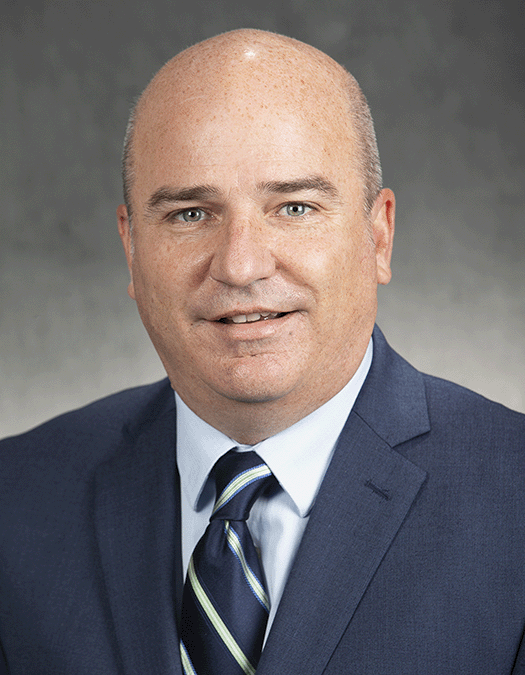
Rep. John Burkel
Sponsored bills
Maddy summaryHF 3671 establishes an eight-year term limit for public members of Minnesota's Lessard-Sams Outdoor Heritage Council, effective July 1, 2026. Public members (appointed by the governor, Senate, and House) may serve no more than eight years total, with a six-month exception allowed only to fill a vacancy. This change applies to all public members appointed on or after the effective date, and years served before July 2026 count toward the limit. The bill directly affects individuals appointed to advise on outdoor heritage issues like wetlands, wildlife habitat, and natural resource policy. It does not impact legislative members or the council's advisory role.
Maddy summaryHF 3673 appropriates $988,000 from state bond proceeds to fund a new well and pump house facility in the city of Middle River, Minnesota. The funds will cover the design, construction, and equipment for infrastructure providing safe, clean drinking water to Middle River residents. The bill authorizes the state to issue up to $988,000 in bonds to cover this cost, following Minnesota's bond procedures. This is a direct capital investment for municipal water infrastructure, not a broader policy change.
Maddy summaryHF 1301 authorizes hunters with a Federal Aviation Administration remote pilot certificate to use small drones to locate and recover deceased big game (like deer or elk) after hunting, effective January 1, 2027. It amends Minnesota Statutes § 97B.115 to permit this drone use while maintaining the existing ban on remote-controlled hunting. The bill requires the Commissioner of Natural Resources to submit a report by January 1, 2026, with recommendations on licensing, insurance, equipment rules, property rights protections, and potential fees for implementing the drone program. This directly affects hunters, wildlife managers, and landowners in Minnesota. The bill focuses on practical logistics for drone-assisted game recovery, not on changing hunting regulations.
Maddy summaryHF 3567 removes an exemption that previously allowed watershed districts and drainage authorities in Minnesota to bypass standard eminent domain procedures when taking property. The bill requires these entities to follow the state's standard eminent domain process (under Chapter 117) for all takings related to drainage or watershed projects, rather than using their own special procedures. This change directly affects property owners in areas where these districts operate, ensuring they receive the same procedural protections as in other eminent domain cases. The law takes effect on August 1, 2026, applying to all takings occurring on or after that date.
Maddy summaryHF 3583 authorizes the city of Roseau to impose a local sales tax of up to 0.5% (in addition to existing taxes) for specific projects, subject to voter approval. The tax revenues must fund two projects: $4.3 million for renovating the Roseau Memorial Arena and $8.2 million for building a new community and wellness center. The city may also issue up to $12.5 million in bonds to finance these projects, with the tax continuing until the projects are fully funded or for up to 30 years. This bill directly affects Roseau residents through the new tax and the resulting public facility investments.
Maddy summaryHF 3580 appropriates $125,000 for wolf-related livestock compensation (Minnesota Statutes § 3.737) and $125,000 for elk-related crop/fence damage compensation (§ 3.7371), both for fiscal year 2026. The bill funds direct payments to affected farmers, covers up to $5,000 for livestock valuation assessments, and allocates $40,000 for producer grants to prevent elk crop damage. Funds may transfer between programs if claims exceed normal levels, and all money must be spent by June 30, 2027. This one-time appropriation directly supports Minnesota agricultural producers facing wildlife-related losses.
Maddy summaryHF 3581 modifies Minnesota's gambling exemption rules for county agricultural societies. It increases the annual prize limit from $50,000 to $100,000 for these societies conducting exempt lawful gambling events, such as raffles at county fairs. The bill updates Minnesota Statutes §349.166, subdivision 2, to clarify this higher limit specifically for qualifying agricultural societies defined under section 38.01. This change affects county agricultural societies seeking to operate exempt gambling activities without a license, aligning their prize cap with the existing limit for other exempt organizations.
Maddy summaryHF 3582 provides $734,000 in state funding to the city of Kennedy for replacing its aging water storage tanks. The money will be raised through state bond sales and transferred to Kennedy via the Public Facilities Authority to cover all project stages, including planning, design, engineering, and construction. This bill directly affects Kennedy by enabling a critical upgrade to its water infrastructure. The funds are drawn from the bond proceeds fund as specified in the legislation.
Maddy summaryHF 1 establishes a centralized Office of Inspector General (OIG) for Minnesota state government, replacing existing agency-specific inspector general offices. The OIG will oversee state spending, require agencies to halt payments when fraud is suspected, and mandate a fraud reporting hotline for employees and contractors. It directly affects all state agencies and recipients of state funds (such as contractors and organizations administering state programs) by requiring them to report suspected fraud and prohibiting retaliation against whistleblowers. The bill also specifies the OIG must coordinate with the legislative auditor and amends statutes related to fraud detection, waste prevention, and oversight.