

Maddy summaryThis bill creates a new program in Minnesota that offers financial incentives to retail gas stations for selling specific biofuel blends containing 11 to 15 percent ethanol. Starting in 2028, eligible stations that have not previously sold these biofuels and have not received other state biofuel grants can receive up to five cents per gallon in payments, with a total annual cap of $50,000 per station. The program is funded by a one-time $5 million appropriation from the state's general fund and requires stations to submit monthly sales reports and verify their volumes with state records. The commissioner of agriculture will administer the program and has the authority to create rules for its implementation.
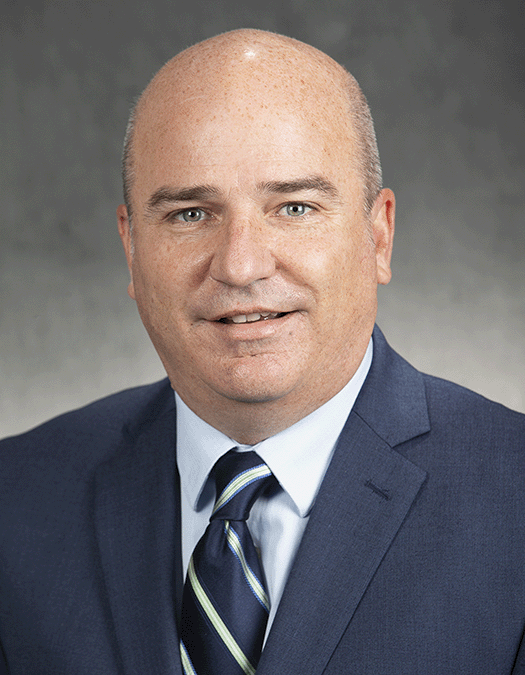
Rep. John Burkel
Sponsored bills
Maddy summaryThis bill amends Minnesota's pesticide control laws to clarify the definition of "currently unavoidable use" for PFAS chemicals. It directly affects agricultural regulators, pesticide manufacturers, and farmers by establishing criteria for when certain PFAS applications are considered necessary. The key provision states that unavoidable use applies when a PFAS is essential for health, safety, or societal functioning and no reasonable alternatives exist, while also allowing consideration of pest resistance and health impacts of alternatives. This change provides clearer guidance on when PFAS use can be permitted despite environmental concerns.
Maddy summaryThis bill removes a ban on establishing new white-tailed deer farms in Minnesota by amending state law. It allows individuals to register with the Board of Animal Health to legally operate new farms for raising white-tailed deer, while maintaining existing registration requirements for all farmed deer. The legislation does not change rules for current farm owners or their ability to transfer registrations to family members. Only the prohibition on new farm registrations is lifted, and all farms must still comply with existing registration and oversight procedures.
Maddy summaryThis bill prohibits individuals convicted of a crime of violence from receiving Minnesota's major public assistance programs, including MFIP, medical assistance, food support, and MinnesotaCare. It achieves this by adding new disqualification clauses to existing state statutes that specifically target those with violent crime convictions, while maintaining eligibility rules for other offenses. The law applies to convictions under Minnesota law or equivalent statutes from other states or the federal government, and it removes a previous provision that allowed certain drug-related benefits to continue under specific conditions.
Maddy summaryHF 3562 modifies Minnesota's motor vehicle registration tax for passenger cars and hearses. It reduces the tax rate from 1.54-1.575% to 1.25-1.285% of a vehicle's manufacturer's suggested retail price (MSRP), depending on whether the vehicle was first registered in Minnesota before or on/after November 16, 2020. The tax amount decreases each year based on the vehicle's age (e.g., 100% of MSRP in year one, dropping to 10% in year ten), then becomes a flat $20 annually after the 10th year. This bill directly affects Minnesota vehicle owners paying registration fees for passenger cars and hearses, effective for registrations starting January 1, 2027.
Maddy summaryThis bill exempts veterinary products from Minnesota's prohibition on products containing PFAS chemicals. It directly affects veterinarians, pet owners, and manufacturers of animal health products by allowing these items to contain PFAS under specific conditions. The key provision amends state law to exclude medical and veterinary devices from PFAS restrictions, aligning them with federal regulations overseen by the FDA and USDA. This change ensures that animal healthcare products are not blocked by state-level PFAS bans that would otherwise apply to other consumer goods.
Maddy summaryHF 7 modifies multiple public safety laws in Minnesota. It requires law enforcement agencies to make bail/bond information public and mandates county attorneys to publicly report reasons for dismissing charges. The bill establishes mandatory minimum sentences for certain sex trafficking offenses and requires individuals subject to stays in sexual conduct cases to register as predatory offenders. It also increases penalties for assaulting police officers, obstructing highway/airport traffic, and expands law enforcement's use of tracking devices on fleeing vehicles. These changes apply directly to law enforcement agencies, prosecutors, and individuals involved in criminal cases.
Maddy summaryThis bill modifies Minnesota's "Read Act" to require literacy instruction based on "science of reading" research, emphasizing evidence-based methods like phonics and decoding while explicitly excluding the three-cueing system. It establishes a new Office of Achievement and Innovation within the Department of Education to support literacy implementation and creates a statewide school performance reporting system. The bill also allows school boards to opt out of complying with certain recently enacted state education laws or rules and authorizes fund transfers for education programs through fiscal year 2029. These changes directly affect all Minnesota public school districts, educators, and students by reshaping literacy instruction requirements and school accountability systems.
Maddy summaryThis bill allocates $225,000 from the workforce development fund to support grants for secondary career and technical education programs offering meat cutting and butchery training. The funding can be used to purchase equipment, renovate facilities, and train faculty, with individual grants capped at $75,000 and up to 10% reserved for faculty development. Priority may be given to applicants collaborating with Minnesota State Colleges and Universities or local industry partners. The Department of Employment and Economic Development must submit a report by January 15, 2028, detailing awarded grants and unfunded requests to relevant legislative committees.
Maddy summaryHF 21 would require a three-fifths supermajority vote in both the Minnesota House and Senate to extend a peacetime emergency declaration beyond 14 days. Currently, such extensions beyond 14 days could be approved by the Executive Council, but this bill would shift that authority to the legislature. The bill directly affects governors seeking to prolong emergency powers and the legislative process for reviewing those requests. It does not change the initial 14-day emergency declaration period or the governor's authority to declare emergencies under existing criteria. Note: This bill was introduced but not passed during the 2025 legislative session.