

Maddy summaryHF 23 amends Minnesota Statutes section 181.932 to strengthen whistleblower protections for public employees. It expands the list of protected disclosures to include reporting gross mismanagement or waste of public funds (subsection 7), clarifies protections for health care quality concerns (subsection 4), and adds specific scenarios like reporting truthful scientific studies (subsection 5) or classified service communications about state services (subsection 6). These changes directly affect state and local government employees who report violations of law, safety risks, or financial misconduct. The bill modifies existing anti-retaliation language to explicitly cover these new disclosure types while maintaining that protected disclosures cannot override other legal data protections.
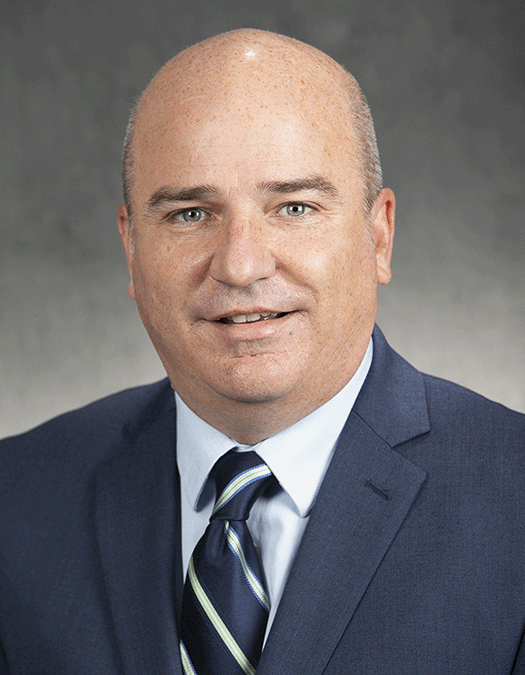
Rep. John Burkel
Sponsored bills
Maddy summaryHF 28 amends Minnesota energy law to add a specific exemption for data centers. It defines "emergency backup generator" and creates a new exemption (section 216B.243, subdivision 8(12)) allowing data centers to install combinations of backup generators totaling 50,000 kilowatts or more without undergoing certain regulatory reviews. This directly affects large data center operators by streamlining approval for their critical backup power systems. The bill modifies existing exemption rules to explicitly cover these high-capacity generator setups, reducing regulatory hurdles for data center infrastructure projects.
Maddy summaryHF 1845 expands Minnesota's definition of "veteran" to include two specific groups: (1) Hmong veterans naturalized under the federal Hmong Veterans' Naturalization Act of 2000, and (2) individuals who served honorably with secret guerrilla units or irregular forces operating from Laos in support of U.S. forces between February 28, 1961, and May 14, 1975. The bill amends Minnesota Statutes section 197.447 to add these categories to the existing definition, ensuring these veterans qualify for state benefits. It also creates an advisory task force of veterans, experts, and community members to help determine eligibility under the new definition. This change directly affects Hmong veterans and Laotian-based veterans who previously may not have met Minnesota's veteran criteria.
Maddy summaryMinnesota's legislature has passed a resolution requesting Congress to call a constitutional convention under Article V of the U.S. Constitution. The resolution asks for proposed amendments to impose budget rules on federal spending, reduce federal government authority over states, and limit terms for federal officials and members of Congress. This is a procedural step - Minnesota is formally petitioning Congress, not creating new laws. The resolution serves as Minnesota's ongoing application for such a convention, pending similar actions by two-thirds of states.
Maddy summaryHF 75 modifies Minnesota's renewable energy standard to clarify which hydroelectric facilities qualify as "eligible energy technology." The bill specifies that hydroelectric projects must either have a capacity under 100 megawatts or, if 100+ megawatts, have been operational since February 8, 2023. This directly affects electric utilities generating hydroelectric power seeking to comply with the state's renewable energy requirements. The change maintains existing eligibility rules without altering the 100-megawatt threshold or operational date criteria. (Amends Minn. Stat. § 216B.1691, subd. 1.)
Maddy summaryHF 25 establishes a state grant program administered by Minnesota's Department of Health to fund nonprofit women's pregnancy centers and maternity homes. The program provides financial support for services like housing, medical care, parenting education, and mental health resources to help pregnant women and new mothers - particularly those facing homelessness or crisis - carry pregnancies to term and care for their children. Eligible organizations must be nonprofits offering free or low-cost services without promoting abortion, providing abortion care, or referring women to abortion providers. Grant funds cannot be used for abortion-related activities, and strict privacy rules require written consent before sharing personal information about clients. The bill appropriates state funds for this program while reducing other health-related appropriations.
Maddy summaryHF 24 amends Minnesota Statutes section 145.423 to require that infants born alive during an abortion be immediately recognized as human persons under the law and receive medical care. The bill mandates that medical personnel take "all reasonable measures consistent with good medical practice" to preserve the life and health of such infants, including compiling appropriate medical records. It directly affects healthcare providers performing abortions in Minnesota by establishing specific medical care obligations for infants born alive. The proposed changes would have taken effect the day after enactment, though the bill was not passed.
Maddy summaryHF 169 replaces Minnesota's previous tiered tax on gambling with a flat 8.5% tax on all lawful gambling receipts (minus prizes paid). This bill directly affects gambling organizations operating in Minnesota, including casinos, racetracks, and bingo halls. The key change eliminates the old "combined net receipts tax" system - which taxed profits at progressive rates based on revenue levels - and substitutes a simpler flat-rate calculation. The new tax takes effect July 1, 2025, and applies to all gambling except paper pull-tabs, tipboards, electronic bingo, and specific exempt games.
Maddy summaryHF 1225 eliminates all-terrain vehicle (ATV) registration fees for Minnesota veterans with a 100% service-connected disability. It amends Minnesota Statutes to exempt these veterans from paying the standard $60 (public use) or $6 (private use) three-year registration fee, instead providing free registration. Veterans must provide proof of their 100% disability rating from the U.S. Department of Veterans Affairs or military retirement board. This change directly affects qualifying veterans who own ATVs, removing a financial burden tied to vehicle registration. The policy modifies existing fee structures under Minnesota Statutes § 84.922, subdivision 5.
Maddy summaryHF 66 establishes a fixed 7- to 10-day filing period (excluding holidays) for candidates seeking to fill vacant Minnesota state legislative seats through special elections. It standardizes the timeline by requiring such elections to occur within 35 to 45 days of the governor issuing a writ, depending on the vacancy timing, and prohibits elections during specific holiday periods. This bill replaces prior flexible rules with clear, consistent deadlines for all legislative vacancies. The changes apply to vacancies occurring on or after the bill's effective date.