

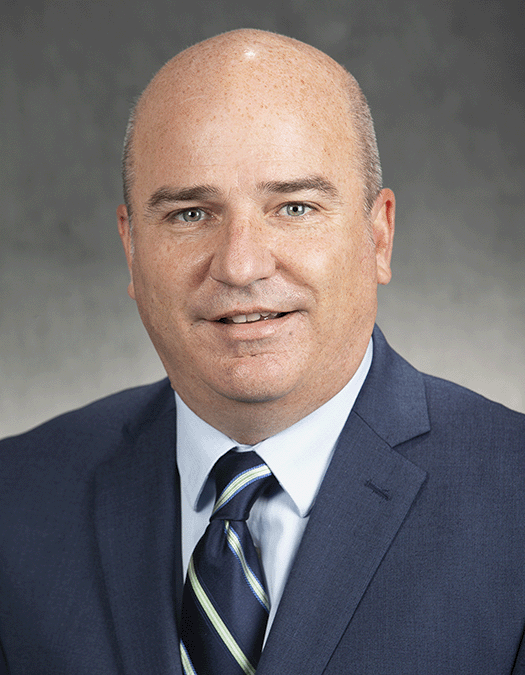
Maddy summaryHF 279 appropriates $752,000 from the natural resources fund for specific all-terrain vehicle (ATV) trail projects in St. Louis County and $200,000 for a route study in Duluth. The St. Louis County funds will support four local club projects - including engineering, construction, and right-of-way acquisition for trails managed by the Alborn Dirt Devils, Ranger Snowmobile/ATV, Twig Area Trail Riders, and Quad Cities ATV clubs. The Duluth study aims to establish connectivity for ATV routes in the western part of the city. All funds are one-time appropriations available until June 30, 2028.
Rep. John Burkel
Sponsored bills
Maddy summaryHF 281 appropriates $380,000 for the Voyageur Country ATV Trail system and $175,000 for the Prospectors Loop Trail system in St. Louis County. The funds, from the natural resources fund, are for one-time use on trail design, right-of-way acquisition, permitting, and construction through June 2028. This bill directly affects St. Louis County by providing targeted funding for specific ATV trail projects.
Maddy summaryHF 1582 modifies Minnesota's Teachers Retirement Association (TRA) benefits for educators. It allows teachers with 30 years of service to retire at age 60 without reduced annuity payments (previously requiring 35 years), adjusts early retirement penalties, and increases postretirement cost-of-living adjustments. The bill also raises employer contribution rates for school districts (from 13.3% to 17.3% for basic members) and increases pension adjustment revenue rates for school districts starting in 2026. These changes directly affect current and future TRA members, school districts funding retirement costs, and the state's retirement system budget.
Maddy summaryHF 1676 modifies Minnesota's rules for farmed deer (Cervidae) to strengthen chronic wasting disease (CWD) management. It requires annual herd inventory verification by veterinarians, 14-day reporting of deer movements, and mandatory CWD testing for deer over six months that die or are slaughtered. If CWD is detected, owners must depopulate herds within 30 days, maintain fencing for ten years, post biohazard signs, and disclose CWD history to future property buyers. The bill directly affects deer farmers and landowners in CWD-affected areas, adding specific reporting, testing, and long-term land-use restrictions. These changes aim to prevent CWD spread through stricter monitoring and response protocols.
Maddy summaryHF 11 delays the implementation of Minnesota's Paid Leave Law from 2026 to 2027, affecting employers, employees, and state agencies responsible for administering the program. The bill amends multiple statute sections to adjust key dates, including the start of employer premium payments (now January 1, 2027) and administrative requirements like public outreach and annual reporting. This one-year delay provides additional time for businesses to prepare for the new paid leave program without changing the law's core requirements. The law's substance - such as premium rates and fund management - remains unchanged, only the rollout timeline is extended.
Maddy summaryHF 1242 establishes Minnesota's Commercial Driver Training Assistance Program, providing financial support for individuals seeking commercial driver's license (CDL) training. The program offers first-come, first-served funding to cover training costs, requiring applicants to document job shadowing with at least two motor carriers. It mandates the commissioner to set up application procedures, maintain a public website with program details, and limit administrative costs to 3% of funds. The bill directly affects aspiring CDL holders, commercial driver training schools (designated as "registered providers"), and motor carriers (designated as "registered employers"). It also updates road test definitions and scheduling rules for driver licensing.
Maddy summaryHF 1057 modifies Minnesota's definition of "employee" for earned sick and safe time benefits. It explicitly excludes certain workers, including independent contractors, specific emergency service personnel (like volunteer firefighters and ambulance attendants), elected officials, and farm workers under limited conditions. Farm workers are excluded if employed by a small farm (5 or fewer employees) or if their work totals 28 days or less per year. This change directly affects these excluded groups by determining who qualifies for the state's sick and safe time protections.
Maddy summaryThis bill appropriates $1 million from Minnesota's arts and cultural heritage fund to the city of Thief River Falls for repairing two National Register-listed historic buildings. $750,000 will fund HVAC, roof, and energy-efficient window upgrades at the Soo Line Depot, while $250,000 covers similar work at the Carnegie Library. All repairs must follow federal historic preservation standards, and the funds are one-time, available until projects are completed. The city directly receives and manages the funding for these specific rehabilitation efforts.
Maddy summaryHF 1250 appropriates $168.5 million from Minnesota's Outdoor Heritage Fund for fiscal year 2026 (with $775,000 for 2027) to fund specific conservation projects. It directs funding toward acquiring land and restoring habitat for prairies, wetlands, and wildlife management areas across Minnesota, including projects in Martin County, the southern Red River Valley, and riparian buffer programs. Key provisions include $3.69 million for prairie chicken habitat partnerships, $4.97 million for wildlife management area acquisitions, and $4.09 million to expand habitat protection on private lands through conservation easements. These funds directly support state agencies and conservation partners working to protect native prairie ecosystems and wildlife habitats. The bill specifies that funds must be used for land acquisition, restoration, and habitat enhancement under existing conservation programs.
Maddy summaryHF 1063 modifies Minnesota's financial reporting requirements for licensed grain buyers. It mandates that grain buyers submit annual financial statements - including a balance sheet, income statement, and cash flow statement - prepared by an independent accountant. The required review level depends on annual grain purchases: buyers handling $7.5 million or more must undergo a review or audit, while those handling $20 million or more must have a full audit with an opinion statement. Small buyers purchasing under $1 million annually and paying with cash or certified checks are exempt from these reporting rules.