

Maddy summaryHF 3688 amends Minnesota law to allow municipal utilities and cooperative electric associations to count spending on fuel-switching improvements for low-income households toward their required energy conservation spending. Specifically, it adds a provision letting these utilities apply costs for efficient fuel-switching (like replacing oil heating with natural gas or electric systems) to meet their 0.2% spending requirement for low-income conservation programs. This change applies to fuel-switching improvements installed after the bill's effective date and expands eligible expenses beyond traditional weatherization. The bill directly affects utilities required to spend on low-income energy programs and the low-income households receiving these upgrades.
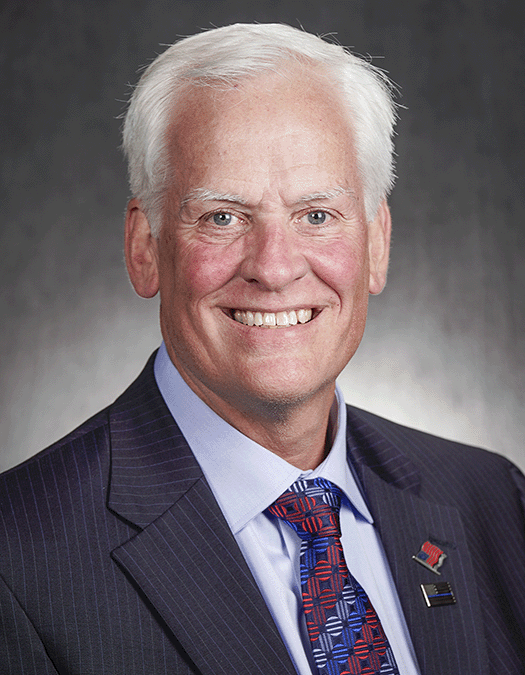
Rep. Tom Sexton
Sponsored bills
Maddy summaryHF 3436 requires drivers approaching a stopped school bus displaying flashing red lights to stop at least 20 feet away. The bill amends Minnesota Statutes section 169.444 to mandate this stop until the bus retracts its stop arm and turns off the red lights. It also adds a new provision requiring drivers to prepare to stop within 20 feet when a bus shows prewarning amber lights, signaling red lights are about to activate. This law directly affects all drivers operating vehicles near school buses in Minnesota, aiming to improve safety for children boarding or exiting buses. The bill takes effect the day after final enactment.
Maddy summaryHF 485 amends Minnesota law to allow the Public Utilities Commission to issue certificates of need for new nuclear power plants with a maximum capacity of 300 megawatts. This change permits the construction of smaller-scale nuclear facilities, which were previously prohibited under existing statute. The bill specifically modifies Minnesota Statutes section 216B.243 to add this exception while maintaining the ban on larger nuclear projects. It directly affects nuclear developers seeking to build these smaller plants and the commission responsible for reviewing such applications.
Maddy summaryHF 2372 creates a voluntary "Minnesota Civic Seal" designation for high school students who complete specific civics requirements. To earn the seal, students must complete approved civics coursework, complete a project-based civic assessment, participate in at least one civic activity outside class (like voting in student elections or community service), and demonstrate civic dispositions. School districts may choose to participate but cannot charge students fees, must provide information about the program to all students, and must affix the seal to diplomas and transcripts for qualifying graduates. The program begins for students graduating in 2027 or later, with the Department of Education developing the insignia and guidelines to ensure equitable access for all students.
Maddy summaryThis bill modifies the structure and rules governing Minnesota's Board of Cosmetologist Examiners, directly affecting cosmetologists, estheticians, nail technicians, and related professionals in the state. Key changes include updating how board members are appointed to ensure representation from different sectors of the industry, clarifying definitions for various roles like cosmetologists, estheticians, and managers, and adjusting how schools and their administrators are defined. The legislation also revises licensing fee schedules and removes an outdated section from the state statutes. These adjustments aim to modernize regulations while maintaining oversight of cosmetology practices across Minnesota.
Maddy summaryHF 3748 appropriates $250 million from the general fund for grants to replace lead service lines in municipal water systems. This funding directly helps water utilities and homeowners affected by lead pipes, which pose health risks. The grants are administered by the Public Facilities Authority under Minnesota Statutes, section 446A.077, and are available until June 30, 2034. The bill provides one-time state funding to accelerate the replacement of hazardous lead pipes in drinking water infrastructure.
Maddy summaryHF 845 modifies Minnesota's net metering rules for small-scale renewable energy systems. It allows customers with systems under 40 kilowatts to choose between receiving compensation based on the utility's avoided costs or the average retail electricity rate. The bill clarifies key terms like "designated meter" and "contiguous property" to streamline billing for these systems. This directly affects residential and small business customers with solar panels or similar renewable installations who generate excess electricity for the grid.
Maddy summaryThis bill requires Minnesota's social studies standards to include information about the dangers and perils of communism and socialism, specifically during the 2030-2031 review and revision of state academic standards. The legislation mandates that the state commissioner incorporate details about estimated lives lost and negative outcomes associated with these ideologies into the updated curriculum. It directly affects Minnesota public school systems by setting a specific requirement for future social studies education content. The bill takes effect on July 1, 2026, and does not change current curriculum requirements but establishes a mandate for future revisions.
Maddy summaryThis bill appropriates $350,000 from state bond proceeds to fund a maintenance facility in the city of Medford. The money will be used to plan, design, build, and equip the facility, with funds directed through the commissioner of employment and economic development. The state will issue bonds to raise the necessary capital, following existing state laws and constitutional requirements for bond sales. The legislation takes effect the day after it is passed by the legislature.
Maddy summaryThis bill creates a new crime called disruption of worship services in Minnesota, targeting individuals who enter religious buildings with the intent to disrupt scheduled services by committing a crime. The law defines a religious establishment as a building used for worship that is clearly marked with a sign or other identifier. First-time offenders face gross misdemeanor charges, while repeat offenders could be charged with a felony punishable by up to five years in prison or a fine of $10,000 or both. The provisions take effect on August 1, 2026, and apply only to crimes committed on or after that date.