

Maddy summaryThis bill creates a new program in Minnesota that offers financial incentives to retail gas stations for selling specific biofuel blends containing 11 to 15 percent ethanol. Starting in 2028, eligible stations that have not previously sold these biofuels and have not received other state biofuel grants can receive up to five cents per gallon in payments, with a total annual cap of $50,000 per station. The program is funded by a one-time $5 million appropriation from the state's general fund and requires stations to submit monthly sales reports and verify their volumes with state records. The commissioner of agriculture will administer the program and has the authority to create rules for its implementation.
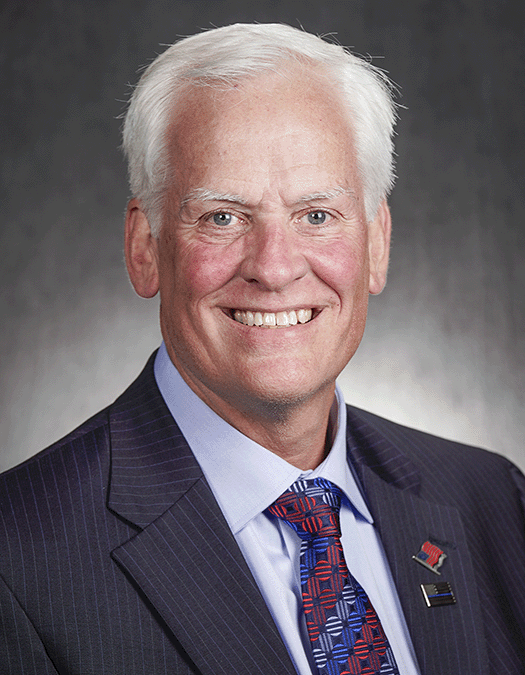
Rep. Tom Sexton
Sponsored bills
Maddy summaryHF 3562 modifies Minnesota's motor vehicle registration tax for passenger cars and hearses. It reduces the tax rate from 1.54-1.575% to 1.25-1.285% of a vehicle's manufacturer's suggested retail price (MSRP), depending on whether the vehicle was first registered in Minnesota before or on/after November 16, 2020. The tax amount decreases each year based on the vehicle's age (e.g., 100% of MSRP in year one, dropping to 10% in year ten), then becomes a flat $20 annually after the 10th year. This bill directly affects Minnesota vehicle owners paying registration fees for passenger cars and hearses, effective for registrations starting January 1, 2027.
Maddy summaryThis bill (HF 3754) is procedural, amending Minnesota Statutes to align the state's tax code with a specific federal tax exclusion. It adds a reference to section 70204 of federal law (Public Law 119-21), which excludes employer contributions to "Trump accounts" from gross income for federal tax purposes. The change ensures Minnesota's tax code matches this federal provision, directly affecting employers making contributions to such accounts. The amendment is effective retroactively to when the federal change took effect.
Maddy summaryHF 7 modifies multiple public safety laws in Minnesota. It requires law enforcement agencies to make bail/bond information public and mandates county attorneys to publicly report reasons for dismissing charges. The bill establishes mandatory minimum sentences for certain sex trafficking offenses and requires individuals subject to stays in sexual conduct cases to register as predatory offenders. It also increases penalties for assaulting police officers, obstructing highway/airport traffic, and expands law enforcement's use of tracking devices on fleeing vehicles. These changes apply directly to law enforcement agencies, prosecutors, and individuals involved in criminal cases.
Maddy summaryThis bill modifies Minnesota's "Read Act" to require literacy instruction based on "science of reading" research, emphasizing evidence-based methods like phonics and decoding while explicitly excluding the three-cueing system. It establishes a new Office of Achievement and Innovation within the Department of Education to support literacy implementation and creates a statewide school performance reporting system. The bill also allows school boards to opt out of complying with certain recently enacted state education laws or rules and authorizes fund transfers for education programs through fiscal year 2029. These changes directly affect all Minnesota public school districts, educators, and students by reshaping literacy instruction requirements and school accountability systems.
Maddy summaryThis bill modifies how gas and electric utilities in Minnesota must report certain expenses when requesting rate increases, requiring them to provide detailed itemized lists of travel, entertainment, and employee-related costs. It specifically mandates that utilities separate and disclose expenses for categories like lodging, food, entertainment, board member compensation, top executive salaries, and lobbying activities, including vendor names and business purposes for each item. The legislation also removes an expiration date that previously limited how long utilities could recover certain infrastructure costs, allowing them to continue seeking reimbursement for these expenses indefinitely. These changes apply to public utilities filing rate cases with the Minnesota Public Utilities Commission and affect how regulators evaluate the reasonableness of utility operating expenses.
Maddy summaryHF 2553 repeals Minnesota Statutes section 216B.246, which granted existing electric transmission companies (called "incumbent owners") priority rights to build new transmission lines connected to their facilities under federal planning approvals. This affects public utilities, municipal power agencies, and other entities previously defined as "incumbent electric transmission owners" under the repealed law. The bill removes their automatic right to construct new lines without competitive bidding or review. The change eliminates a specific legal provision without adding new requirements or creating new processes.
Maddy summaryHF 3813 authorizes Waseca County to impose a local sales tax of up to 0.375% (three-eighths of one percent) on retail sales, subject to voter approval. The tax revenues must cover the county's collection costs and finance up to $45 million for constructing a new judicial center, including associated bond costs. The county may issue bonds up to $45 million without triggering standard debt limits or requiring a separate bond election. The tax expires after 30 years or when project costs are fully covered, whichever comes first. This bill directly affects Waseca County residents through the new tax and the county government through its funding mechanism for the judicial center project.
Maddy summaryHF 3686 modifies Minnesota's state energy grant program by changing the priority order for matching federal energy funds. It moves nonprofit organizations from being grouped with businesses (previously clause 3) to being grouped with investor-owned utilities (new clause 4) in the priority list for grant awards. This change directly affects nonprofits and investor-owned utilities seeking state-matched grants for federal energy programs. The bill does not create new funding but alters which entities receive priority when applying for these specific matching grants.
Maddy summaryHF 3545 repeals a requirement for Minnesota to adopt new residential energy codes with specific efficiency targets. It removes Section 326B.106, subdivision 1(g), which would have mandated the commissioner to adopt updated residential energy codes starting in 2026, aiming for a 70% reduction in energy use by 2038. This repeal eliminates the obligation to implement these incremental code changes and the associated reporting requirements for residential construction. The bill directly affects residential builders, developers, and local building officials who would have been required to comply with future energy code standards. The repeal does not impact existing energy codes or commercial energy code requirements.