

Maddy summaryThis bill is a House resolution that formally impeaches Minnesota Governor Timothy J. Walz for alleged corrupt conduct in office. It directly affects the Governor by charging him with four specific articles of misconduct, including concealing fraud in state programs, obstructing oversight investigations, prioritizing political narratives over transparency, and failing to enforce laws protecting public funds. If adopted by the House, the resolution would immediately suspend the Governor's duties while the Senate conducts a trial to determine whether he should be removed from office. The bill also requires the Speaker of the House to serve formal notice of the charges to the Governor and directs the Chief Clerk to send copies of the resolution to relevant state officials.
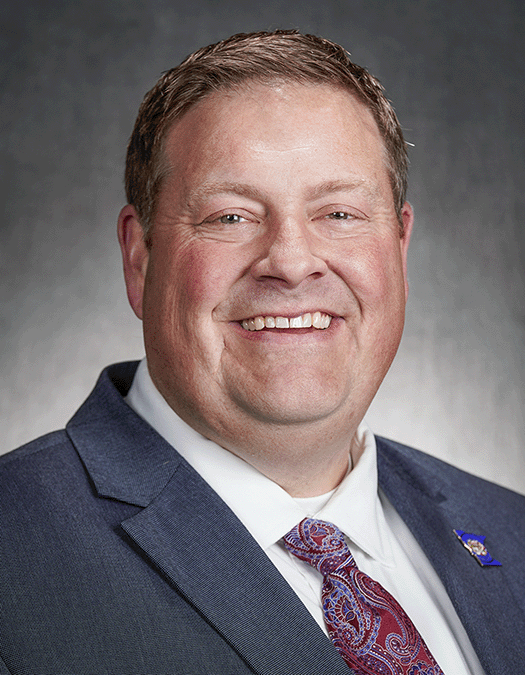
Rep. Keith Allen
Sponsored bills
Maddy summaryThis bill directs the Minnesota School Safety Center to create and distribute evidence-based model safety plans for K-12 schools, requiring districts to adopt similar plans by May 2028. It establishes strict criteria for what counts as "evidence-based," mandating that safety strategies be backed by strong research or well-designed studies before they are implemented. The legislation also enables anonymous threat reporting systems in schools and requires the safety center to consult with licensed mental health professionals when developing these plans. Additionally, the bill modifies grant programs for school buildings and cybersecurity while increasing funding for safe schools initiatives.
Maddy summaryThis House resolution initiates the formal impeachment process against Keith Ellison, Minnesota's Attorney General, alleging corrupt conduct and crimes while in office. The bill directs the House to adopt six articles of impeachment that accuse Ellison of abusing his office to defend unlawful protest activity, undermining religious liberty protections, failing to enforce laws impartially, engaging in conflicts of interest, and soliciting political support in exchange for favorable treatment. If adopted, the resolution immediately bars Ellison from exercising his duties as Attorney General until the Senate conducts a trial and votes on his acquittal or conviction. The House Speaker must serve notice of the charges to Ellison, and the enrolled resolution must be transmitted to the Governor, Secretary of State, and Senate leadership to begin the constitutional impeachment proceedings.
Maddy summaryThis bill modifies Minnesota's African American Family Preservation and Child Welfare Disproportionality Act to strengthen protections for children of color in the child welfare system. It requires social services agencies to make "active efforts" rather than just "reasonable efforts" to keep African American and disproportionately represented children in their homes, reunify them with families, and involve families in all service decisions. The law mandates that agencies consider cultural and social values when providing services, ensures community members from communities of color serve as court advocates, and requires ombudspersons to monitor compliance with these new standards. Additionally, the bill expands placement options to include relatives and community members before removing children from their homes.
Maddy summaryThis bill amends Minnesota's gross receipts tax law to explicitly include hospitals and health care providers as taxable entities while excluding licensed chiropractors from the list of providers subject to the tax. The legislation defines "health care provider" to include various medical service providers such as doctors, dental professionals, and ambulance services, while listing specific exclusions like pharmacies, nursing homes, and home health agencies. A new provision adds licensed chiropractors to the list of excluded providers, clarifying that they will not be required to pay the gross receipts tax on their services. The changes will take effect for gross revenues received after December 31, 2026, and apply to the state's existing gross receipts tax framework.
Maddy summaryHF 3513 defines key terms for autonomous vehicles in Minnesota Statutes, establishing a regulatory foundation for future rules. It adds definitions for terms like "automated driving system" (level 4/5 vehicles), "dynamic driving task," "minimal risk condition," and "on-demand autonomous vehicle network" to clarify operational standards. The bill does not impose new restrictions or requirements but creates the terminology needed for future legislation governing autonomous vehicle safety and operation. This procedural update prepares Minnesota’s legal framework for regulating self-driving technology as it develops.
Maddy summaryThis bill amends Minnesota law to clarify which healthcare professionals can serve as medical consultants for community health boards. It specifies that advanced practice nurses must be certified as clinical nurse specialists or nurse practitioners by a national organization acceptable to the Minnesota Board of Nursing. The change directly affects community health boards and the healthcare providers working with them, ensuring medical consultants meet defined credentialing standards. The bill modifies existing statute (145A.02, subd. 15) to add this clarity without expanding the list of eligible professions.
Maddy summaryThis bill modifies how Minnesota calculates registration taxes for passenger cars and hearses by lowering the tax rate based on the vehicle's manufacturer's suggested retail price. It changes the tax calculation for new vehicles registered on or after November 16, 2020, and reduces the percentage of the vehicle's value taxed for each subsequent year of ownership. The legislation also establishes a process to transfer money from the state's general fund to the highway user tax distribution fund to cover any revenue shortfall caused by these tax reductions.
Maddy summaryThis bill updates Minnesota's definition of an all-terrain vehicle by increasing the maximum weight limit from 2,000 to 3,500 pounds. It also raises the annual fee for nonresidents to operate an all-terrain vehicle on state trails from $30 to $50. The collected fees will continue to fund grants for local governments to build and maintain all-terrain vehicle trails. These changes affect vehicle owners, operators, and the state's natural resources management system.
Maddy summaryThis bill establishes a one-time property tax refund program for Minnesota property owners who paid eligible taxes in 2026, affecting residential, agricultural, and commercial property classifications. The program allocates $4 billion from the state general fund to provide refunds based on a percentage calculated by the Department of Revenue, with applications accepted between July 15 and September 15, 2026. Any unclaimed refund amounts will automatically be converted into property tax credits for 2027 on the properties where no refund was requested. The legislation defines specific property categories eligible for the refund and sets clear deadlines for application processing and payment distribution.