

Maddy summaryHF 5 modifies Minnesota's tax structure by repealing the retail delivery fee and establishing an "unlimited Social Security subtraction," allowing taxpayers to subtract all their Social Security benefits from state taxable income. It redirects transportation funding by creating a "transportation advancement account" and requires specific distribution percentages: 36% to metropolitan counties, 28% to county highway funds, 23% to larger cities, 34% to small cities, 15% to town roads, and 1% to food delivery support. The bill also mandates tax analysis and reporting requirements for transportation funding impacts and modifies several tax statutes, including those governing Social Security benefit subtractions. These changes directly affect Minnesota taxpayers, local governments, and transportation agencies, effective July 1, 2025.
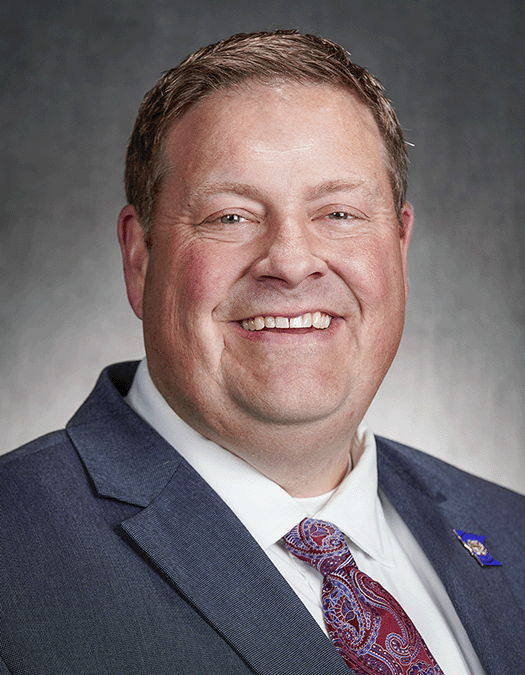
Rep. Keith Allen
Sponsored bills
Maddy summaryHF 2393 amends Minnesota Statutes section 145A.02, subdivision 15, to clarify which licensed health professionals can serve as medical consultants for community health boards. Currently, the definition includes licensed physicians, osteopathic physicians, physician assistants, and certified advanced practice nurses. The bill modifies this list to specify exactly which professions qualify under the statute. This change directly affects community health boards seeking medical advisors and the eligible health professionals who may provide such services. The amendment aims to ensure clarity in who can legally advise these boards on medical matters.
Maddy summaryThis bill updates Minnesota's fencing rules for farmed deer and elk to better prevent them from escaping or interacting with wild animals. It mandates that all perimeter fences be at least 96 inches tall and made of high-tensile material, while requiring two redundant gates at every entry point. Owners must immediately fix any fence defects that allow animals to enter or exit, with other repairs due within 14 days, and facilities found with violations face additional reinspection fees. The legislation also gives animal health officials the power to revoke a farm's registration and order the removal or destruction of animals if the facility has multiple escape incidents or fails to correct identified safety issues.
Maddy summaryThis bill updates Minnesota's individual income and corporate franchise tax laws to align with recent federal changes to Section 179 expensing. It amends the state's tax code to include specific federal provisions related to Section 179, which allows businesses to deduct the full purchase price of qualifying equipment and software investments in the year they are placed in service. The changes apply retroactively to match the effective date of the corresponding federal law, ensuring Minnesota taxpayers follow the same rules as federal law. This update primarily affects Minnesota businesses and individuals subject to state income taxes who claim Section 179 deductions.
Maddy summaryThis bill updates Minnesota's tax code to align with recent federal changes regarding bonus depreciation for business property. It directly affects individual income and corporate franchise taxpayers by incorporating federal provisions that allow for full expensing of certain business assets. The legislation amends state statutes to include specific federal law sections and ensures that Minnesota's tax rules remain synchronized with federal tax policies. Changes take effect immediately upon enactment, with retroactive application matching the timing of the corresponding federal rules.
Maddy summaryThis bill updates Minnesota's tax laws to align with recent federal changes regarding the deduction for business interest expenses. It directly affects Minnesota businesses and individual taxpayers by modifying how state tax calculations reference federal tax code provisions. The legislation amends Minnesota Statutes section 290.01 to include specific federal public law sections related to business interest deductions and clarifies that these changes apply retroactively to match federal effective dates.
Maddy summaryThis bill authorizes the state of Minnesota to issue bonds totaling up to $2,235,000 to fund improvements for the dental assisting program at South Central College's North Mankato campus. The funds will be used to design, renovate, and equip classroom and laboratory spaces specifically for this program. The money will come from the bond proceeds fund and is managed by the Board of Trustees of the Minnesota State Colleges and Universities. The bill requires the commissioner of management and budget to handle the bond sale according to existing state statutes and constitutional provisions.
Maddy summaryThis bill establishes a temporary sales tax holiday for the entire month of July 2026 to commemorate the 250th anniversary of the United States. It directly affects Minnesota retailers and consumers by exempting the sale of most tangible personal property from state sales tax during this period. The exemption applies to all retail sales from July 1 through July 31, 2026, but excludes alcohol, taxable cannabis products, and motor vehicles. The bill takes effect the day after it is finalized and signed into law.
Maddy summaryThis bill authorizes the issuance of state bonds to fund $9.16 million in capital improvements at South Central College's North Mankato campus. The funds will be used to design, construct, renovate, and equip classroom and laboratory spaces specifically for the dental assisting program, as well as to replace the campus boiler system. The money will come from the bond proceeds fund and is managed by the Minnesota State Colleges and Universities Board of Trustees. The legislation is effective immediately upon final enactment.
Maddy summaryThis bill allocates $6,925,000 to South Central College for replacing the boiler system at its North Mankato campus. To fund this project, the state will issue bonds up to the allocated amount, following existing state laws and constitutional requirements. The money will be used for design, construction, and equipment installation of the new boiler system. The appropriation becomes effective the day after the bill is finalized.