

Maddy summaryThis bill proposes adding a new section to the Minnesota Constitution that explicitly states a preborn child has a right to life. It defines a preborn child as a living human fetus from fertilization until live birth and requires voter approval at the 2026 general election for the amendment to take effect in 2027. The text includes specific language ensuring that medical treatment to save a pregnant person's life or the removal of a nonviable or deceased fetus remains allowed.
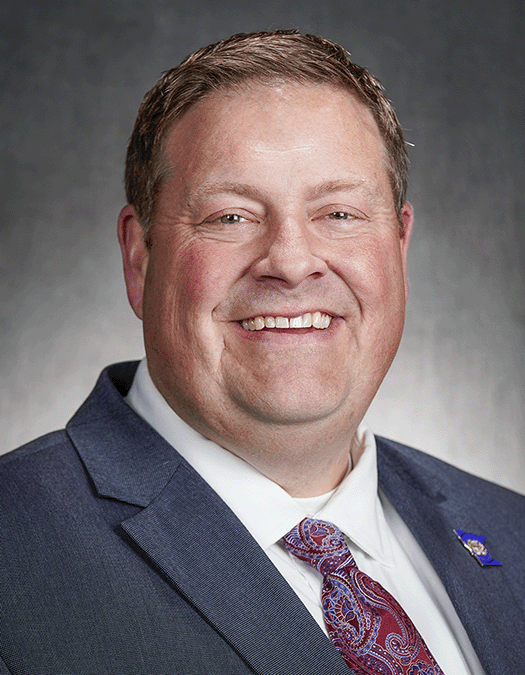
Rep. Keith Allen
Sponsored bills
Maddy summaryThis bill temporarily suspends the state motor fuels tax in Minnesota for a specific period in 2026, directly affecting drivers, fuel retailers, and businesses that purchase gasoline and diesel. Under the legislation, the tax rate is set to zero cents per gallon or per thousand cubic feet for all fuel types during the designated timeframe, which begins shortly after the bill is enacted and ends in early September 2026. To offset the lost revenue from this suspension, the state will transfer money from its general fund to the Department of Transportation to cover the costs that would have been collected from fuel taxes. The bill also allocates a one-time appropriation to the Department of Revenue to cover the administrative expenses required to implement this temporary tax pause.
Maddy summaryHF 3682 requires Minnesota's commissioner of management and budget to establish a grantee fraud risk rating system for state agencies administering grants, based on vendor risk management principles. This system will set specific grants management requirements for agencies, directly affecting all state executive agencies that distribute or manage grant funds. The bill mandates the commissioner to create centralized policies, serve as a point of contact for grants management, oversee technology systems, and provide a single public listing of grant opportunities and recipients. It also authorizes the commissioner to approve exceptions to these policies for specific programs, with exceptions expiring after five years. The law aims to standardize fraud prevention and improve oversight across all state grant programs.
Maddy summaryThis bill updates Minnesota's tax laws to align with recent federal changes regarding how businesses can deduct research and development expenses. It directly affects Minnesota businesses by allowing them to claim these deductions under state law in the same way they are treated under federal rules. The legislation amends existing tax statutes to include specific federal provisions about expensing research expenditures and ensures the state's rules match federal timelines for these changes.
Maddy summaryHF 3563 requires Minnesota licensing boards to automatically suspend or revoke licenses, or deny license applications, when a licensee or applicant is convicted of specific theft or fraud crimes listed in Minnesota law (including offenses under sections like 609.23, 609.496, and 609.52). This directly affects licensed professionals - such as healthcare providers, contractors, and financial advisors - who face criminal convictions for these offenses. The bill mandates that boards take formal action upon conviction, rather than allowing licenses to remain active despite criminal findings. It amends Minnesota Statutes 214.10 to establish this requirement, effective immediately after enactment.
Maddy summaryHF 82 clarifies the scope of practice for licensed athletic trainers in Minnesota. The bill defines "athletic training" to include specific activities like injury prevention, emergency care, assessment, rehabilitation, and clinical decision-making within the trainer's expertise. It requires athletic trainers to work under a primary physician's direction, with documented protocols updated yearly, and limits initial treatment of undiagnosed injuries to 30 days (or less as specified by the physician). This directly affects athletic trainers, primary physicians, and healthcare facilities employing them, ensuring clear boundaries for their practice while preventing overlap with other licensed professions like physical therapy or medicine.
Maddy summaryThis bill allows Minnesota counties to create official lists of agricultural lands that should be protected from electric power facility development. Counties can designate parcels as agricultural priority land if they have high crop productivity ratings or have been classified as prime farmland by the Natural Resources Conservation Service. Once a county submits its list to the state Public Utilities Commission, the commission cannot issue site permits for large power plants on those designated lands unless the county board specifically approves an exception. Landowners have the right to opt out of having their property included on the list before the county submits it to the state. The new rules would take effect on January 1, 2027.
Maddy summaryHF 1266 appropriates $25.7 million from state bonds to fund the design, construction, and equipment of a new nonsecure juvenile detention facility in Moorhead, Clay County. The bill authorizes the state to issue bonds up to this amount to cover the costs, with funds directed to Clay County through the commissioner of public safety. This bill directly affects Clay County and the operation of its juvenile detention system by providing funding for a specific facility project.
Maddy summaryHF 3802 amends Minnesota's energy certificate of need exemptions, removing the requirement for certain energy projects to seek state approval. The bill specifically exempts projects like wind/solar facilities (including repowering projects that don't exceed capacity limits), transmission line upgrades (e.g., converting to natural gas or increasing efficiency by ≤10%), and energy storage systems from the standard review process. It also clarifies exemptions for small transmission lines (≤1 mile) and upgrades using existing rights-of-way. These changes directly affect energy developers and utilities building or modifying infrastructure, streamlining approval for projects that align with existing state energy policies. The bill focuses on updating technical definitions and scope rather than creating new regulatory requirements.
Maddy summaryThis bill establishes the SAVE Minnesota Act, which requires voters to present a specific photo identification card to register to vote and to cast their ballots. To obtain this new voter identification card, applicants must provide proof of their U.S. citizenship and may receive certain vital records, such as birth certificates, without a fee. The legislation also creates a new voter identification card program, modifies existing driver's license requirements, and sets up a process for handling provisional ballots. Additionally, the bill includes funding provisions to support the administration of these new election procedures and establishes a children's trust fund.