

Maddy summaryHF 1873 requires transit agencies to obtain written approval from all affected cities, counties, and towns before requesting federal funds for transit guideway projects. Municipalities must review preliminary and final design plans within 45 days (or 60 days for final changes), and can request specific modifications if disapproving. Cities, counties, or towns may revoke approval at any time before federal funding is secured, triggering a review process similar to initial disapproval. The bill applies to all transit guideways except light rail projects and prohibits federal funding requests until all local approvals are secured.
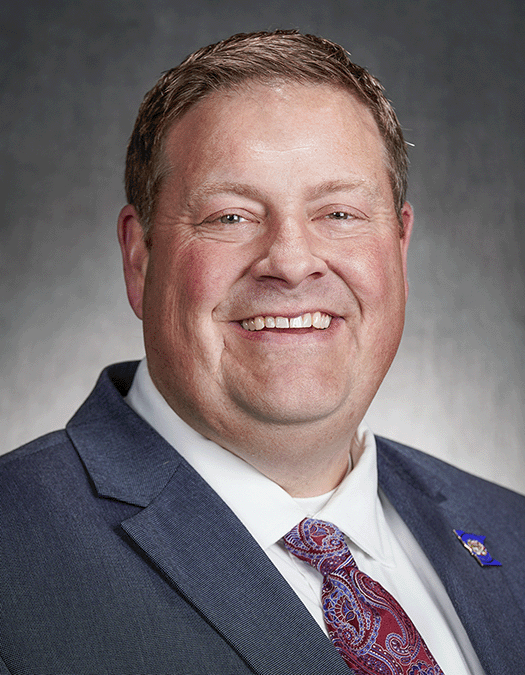
Rep. Keith Allen
Sponsored bills
Maddy summaryHF 1875 restricts social media access for minors in Minnesota. It prohibits social media platforms from allowing children under 14 to create accounts, requiring immediate termination of existing accounts (with a 90-day dispute period) and permanent deletion of personal data. For 14-15 year olds, platforms must obtain parental consent for account creation or maintenance; without consent, accounts must be terminated after 90 days. The bill also requires anonymous age verification for websites deemed harmful to minors, meaning platforms must confirm a user’s age without collecting personal information. These rules apply to platforms meeting specific criteria, including features like infinite scrolling or autoplay.
Maddy summaryHF 1463 appropriates $25 million annually (fiscal years 2026-2027) from the general fund for Minnesota town roads and $10 million annually for town bridges. The funds will be distributed under existing rules in Minnesota Statutes section 162.081 to support local road and bridge maintenance programs. This bill directly affects Minnesota's town road and bridge systems by providing dedicated state funding for upkeep. It does not create new policies or alter current distribution methods, only allocating existing budget resources.
Maddy summaryHF 1874 requires a lifetime ban on operating commercial motor vehicles (CMVs) for drivers who use a CMV to commit specific felony offenses. The ban applies to crimes involving controlled substances (like drug trafficking) or forced labor/human trafficking offenses. This law, effective August 1, 2025, also imposes civil penalties for such violations. It directly affects commercial drivers convicted of these crimes by permanently prohibiting them from operating CMVs.
Maddy summaryHF 17 amends Minnesota's handgun permit law to create lifetime permits for carrying concealed handguns, replacing the previous temporary permits. It also reduces the application fee for these permits, capping it at $100 or the actual processing cost (whichever is lower), with $10 of each fee deposited into the general fund. The bill maintains existing requirements, including proof of firearm safety training (via certified courses or peace officer employment) and in-person application submissions with specific documents like training certificates and photo ID. This directly affects Minnesotans seeking or renewing concealed carry permits, streamlining the process by eliminating renewal fees and duration limits.
Maddy summaryThis bill modifies Minnesota's renewable energy standards by expanding which hydroelectric projects count toward clean energy goals (including facilities over 100 megawatts if operating since 2023). It allows electric utilities to request delays in meeting renewable, solar, or carbon-free energy requirements if the commission determines it serves the public interest, considering factors like cost impacts and system reliability. The bill also expands sales tax exemptions for residential heating fuels and electricity, and prohibits demolition of fossil-fuel power plants under specific conditions. Additional provisions include supporting carbon capture technology and removing barriers to new nuclear power plants.
Maddy summaryHF 72 prohibits entities or organizations receiving state funding from making campaign expenditures or spending money on political activities. It directly affects nonprofits and other groups that receive state funds through direct appropriations, competitive grants, or other legislatively named funding programs. The law bans using any state-funded money for political purposes, including supporting candidates or ballot measures, effective July 1, 2025. This policy change aims to separate public funds from political campaign activities.
Maddy summaryHF 367 authorizes individuals or entities injured by intentional highway obstructions to sue for damages and reasonable attorney fees. It applies to anyone who deliberately interferes with, obstructs, or makes a public highway dangerous for passage (e.g., reckless driving or improper construction). The bill specifies that state agencies or political subdivisions must choose between civil action under this law or criminal prosecution for the same conduct, but cannot pursue both. Exemptions cover emergency responders, utility workers, and others acting within their official duties. The law takes effect August 1, 2025, for causes of action accruing after that date.
Maddy summaryHF 1475 abolishes Minnesota's Metropolitan Council and transfers its core responsibilities to other state entities. Specifically, it moves the Council's duties to the commissioners of Administration and Natural Resources, shifts transportation and transit functions to the Department of Transportation, and creates a new metropolitan area sanitary sewer district. The bill also repeals land use planning provisions previously managed by the Council and ends its oversight of the Metropolitan Airports Commission. These changes reorganize regional governance for key services like transportation, environmental management, and sewer infrastructure across the metropolitan area.
Maddy summaryThis bill expands Minnesota's sales tax exemption to include additional baby products, directly affecting parents and caregivers who purchase these items. It adds baby wipes, cribs and bassinets (including mattresses and sheets), changing tables and pads, strollers, car seats and bases, baby swings, bottle sterilizers, and infant eating utensils to the list of tax-exempt items. The exemption applies to sales and purchases made after June 30, 2025. This change removes sales tax from these specific baby products, aligning with the existing exemption for items like breast pumps and baby bottles.