

Maddy summaryHF 1466 expands the list of people ineligible for earned incentive release credit under Minnesota's Rehabilitation and Reinvestment Act. It adds specific violent offenses to the existing ineligibility criteria, including second-degree murder (section 609.19), third-degree murder (609.195), first-degree manslaughter (609.20), and second-degree manslaughter (609.205). This means inmates serving sentences for these crimes will no longer qualify for the credit that can reduce their prison time based on good behavior. The bill amends Minnesota Statutes sections 244.45 and 244.46 to reflect these changes.
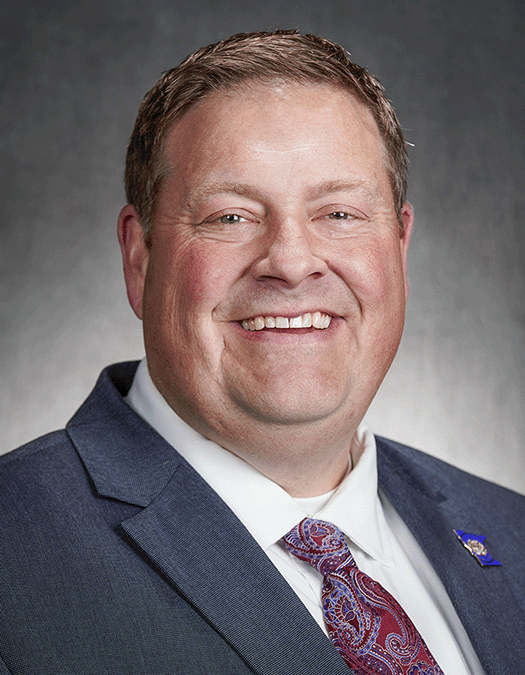
Rep. Keith Allen
Sponsored bills
Maddy summaryHF 1464 appropriates $1.2 million from the general fund in fiscal year 2026 to the Pollution Control Agency for a grant to Rice County, specifically to address water quality concerns at French Lake. Rice County may use these funds for water quality testing, infrastructure improvements, services, training, and maintenance related to the lake. The bill also extends the availability of an existing grant for the same French Lake project through June 30, 2027, under prior law. This legislation directly affects Rice County and French Lake residents by providing dedicated funding for water quality management.
Maddy summaryHF 1465 appropriates $2,962,000 from state bond proceeds to fund specific capital improvements at a downtown Faribault municipal park. The funds will cover construction and equipment for an outdoor skating rink, splash pad, trails, sidewalks, landscaping, lighting, seating, and parking areas. The state will issue bonds up to this amount to provide the funding, as authorized under Minnesota bond laws. This bill directly affects the city of Faribault by enabling these park enhancements.
Maddy summaryHF 1467 transfers management of the Minnesota Braille and Talking Book Library from the Department of Education to the Department of Employment and Economic Development. This bill changes who oversees the library's services for people with visual or physical disabilities, requiring the new department to provide these services through a cooperative plan with the National Library Service for the Blind. It also updates rules for the library's advisory committee, including how meetings can be held virtually while ensuring public access and proper voting procedures. The change directly affects library users and the state agencies responsible for delivering these specialized services.
Maddy summaryHF 2 requires state agency employees to immediately report suspected fraud to law enforcement and legislative committee leaders when they have reason to believe fraud exists in agency programs. It mandates that all state agencies post current organizational charts online with contact details for leadership and division heads. The bill strengthens grant management by requiring agencies to conduct unannounced monitoring visits before final payments for grants over $50,000 (and annually for grants over $250,000), perform financial reconciliations prior to disbursement, and withhold funds from grantees failing to submit required progress reports. Violating these grant management requirements constitutes a misdemeanor under the bill.
Maddy summaryHF 190 requires the Metropolitan Council to publish monthly ridership data for all transit routes (including original funding projections) and quarterly crime statistics broken down by transit mode and crime type. The bill mandates that these reports be posted on the Council's website within 60 days of each month and quarter, with each report remaining accessible for at least five years. This directly affects the Council's reporting obligations and provides the public with transparent, regularly updated information on transit usage and safety. The law does not change transit operations or funding but standardizes data disclosure for accountability.
Maddy summaryHF 164 exempts tip income from Minnesota's individual income tax and tax withholding requirements. The bill defines "tips" as amounts reported to employers under IRS rules (per Internal Revenue Code sections 6053(a) or 3121(q)) and excludes these amounts from taxable income. This directly affects Minnesota workers who earn tips, such as servers and bartenders, by reducing their taxable income. The change takes effect for taxable years beginning after December 31, 2024. The bill amends Minnesota Statutes sections 290.0132 and 290.92 to implement this tax exemption.
Maddy summaryHF 636 removes the requirement for a permit to carry a firearm in public places for eligible Minnesotans, while creating an optional permit system. The bill amends Minnesota Statutes 624.714 to state that anyone not prohibited by state or federal law (and at least 21 years old) may carry a firearm without a permit in public places - defined as government-owned property or private property open to the public, excluding homes, businesses, gun shops, and hunting areas. An optional permit, which requires proof of pistol safety training and background checks for disqualifying offenses, remains available for those who choose it. This change directly affects eligible residents who currently need permits to carry firearms in public, eliminating that barrier while preserving the option for a permit.
Maddy summaryHF 316 creates a new tax subtraction for Minnesota taxpayers receiving income from retirement savings plans, such as 401(k)s or IRAs. It allows a maximum subtraction of $12,000 for married couples filing jointly or surviving spouses, and $6,000 for other filers, subject to a 20% reduction for adjusted gross income over $32,000. The subtraction is unavailable to taxpayers claiming other specific subtractions under Minnesota law. This policy directly affects individuals receiving retirement income who file Minnesota tax returns, providing limited tax relief based on filing status and income level. The bill takes effect for tax years beginning after December 31, 2024.
Maddy summaryHF 426 provides $1 million in state funding for clean water infrastructure in Waseca, specifically for a new water tower project. The bill appropriates money from state bond proceeds to the city of Waseca for acquiring land, permanent easements, and designing the water tower, with no requirement for local matching funds. The state will issue bonds up to $1 million to cover this cost, following Minnesota's bond laws. This directly affects the city of Waseca by enabling a key water infrastructure upgrade. The funding is effective upon final enactment.