

Maddy summaryHF 20 clarified which data maintained by Minnesota's Attorney General's Office must be treated as "private data" under state law. It specifically designated five categories as private: disciplinary records (excluding public hearings), non-final administrative communications, consumer complaint data (excluding confidential data), inactive investigative files, and detailed home protection hotline information (like mortgage details and income). This change directly affects the Attorney General's Office by requiring them to handle these specific data types with privacy protections. The bill was introduced in 2025 but was not passed by the legislature and was laid on the table.
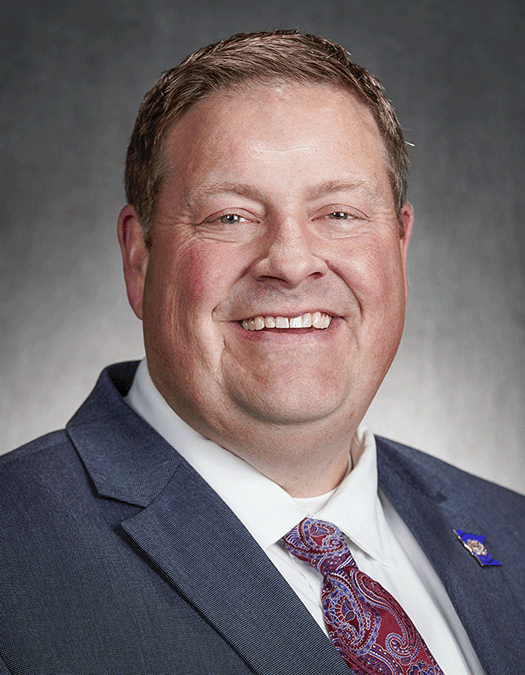
Rep. Keith Allen
Sponsored bills
Maddy summaryHF 8 streamlines Minnesota's environmental permitting process to improve efficiency and transparency. It sets specific timeframes (90 days for simpler permits, 150 days for complex ones), requires the Pollution Control Agency to issue separate construction and operation permits for certain facilities, and mandates that petitioners for environmental assessments must live in affected or neighboring counties. The bill also eliminates preliminary environmental assessment steps for projects requiring full environmental impact statements and requires the agency to publish annual reports tracking permitting progress. These changes directly affect developers, landowners, and the Pollution Control Agency in processing environmental permits.
Maddy summaryHF 3105 modifies how Minnesota distributes traffic fine proceeds between local governments and state highway funds. For fines issued by local law enforcement officers, the bill specifies that two-thirds of the proceeds must stay with the local unit of government (with at least half used for law enforcement), while one-third goes to the state highway user tax fund. For fines issued by Minnesota State Patrol troopers, one-third stays with the local government and two-thirds goes to the state highway fund. The bill amends multiple statutes (including 169.999, 299D.03, and 357.021) to implement these distribution changes, directly affecting cities and counties that collect traffic fines.
Maddy summaryHF 3106 increases fines for drivers operating vehicles without insurance in Minnesota. It raises the minimum fine for a first offense to $200 (up from lower amounts), $550 for a second offense within 10 years, and $850 for three or more offenses within 10 years. Drivers can avoid conviction by submitting proof of insurance to court before their first appearance. The bill also clarifies procedures for both vehicle owners and non-owners to provide insurance verification. It takes effect August 1, 2025, applying to violations occurring on or after that date.
Maddy summaryThis bill appropriates $75,000 for fiscal year 2026 and $75,000 for fiscal year 2027 from the general fund to support the Minnesota Agriculture and Rural Leadership program. The funds are allocated to the commissioner of agriculture for grants to the Southwest Minnesota State University Foundation. The program directly assists agricultural leaders and rural communities in Minnesota through leadership development training. This is a straightforward funding measure with no policy changes, solely providing financial support for an existing program.
Maddy summaryHF 2426 increases the maximum plant canopy area allowed for medical cannabis combination businesses in Minnesota from 60,000 to 90,000 square feet when growing cannabis for medical flower or medical cannabinoid products. This change directly affects licensed medical cannabis businesses that cultivate and process cannabis for patient use. The bill amends Minnesota Statutes section 342.515, subdivision 2, to update the cultivation limit without altering adult-use cannabis rules. The adjustment aims to accommodate business growth within existing regulatory frameworks for medical cannabis.
Maddy summaryHF 2566 establishes the "Minnesota Business Filing Fraud Prevention Act" to address unauthorized or deceptive business filings. It creates a process where a person connected to a business (a "complainant") can submit a formal declaration to the Secretary of State’s Office alleging that a business filing was made without authorization or to misrepresent ownership/identity. The Office reviews the declaration, notifies both the complainant and the alleged "filer," and gives the filer 21 days to respond. If the filer doesn’t respond, the Office deems the filing fraudulent and removes it; false claims in the process are punishable under Minnesota law. This directly affects business owners who file records and individuals reporting suspected fraud.
Maddy summaryHF 3038 appropriates $215,000 from the general fund for fiscal year 2026 and $215,000 for fiscal year 2027 to the Minnesota Historical Society. These funds are designated for grants to the Minnesota Agricultural Interpretive Center - Farmamerica. The bill directly provides financial support to this center, which likely focuses on agricultural history and education. This is a straightforward funding measure with no policy changes beyond the specified monetary allocation.
Maddy summaryHF 19 establishes education savings accounts (ESAs) for Minnesota students from low-income households, defined as families earning no more than four times the income threshold for free school meals. The bill allows parents to use state funds to pay for qualifying education expenses - including tuition at eligible nonpublic schools, tutoring, approved curriculum, and school supplies - at participating schools or providers. Participation is capped at 5% of public school enrollment in the first year, increasing by 3% annually, with priority given to kindergarten students and those who attended public school full-time the prior year. The program directly affects eligible students (ages 18 and under) and their families, with funds restricted to approved educational services and materials.
Maddy summaryHF 3041 requires Minnesota's Legislative Budget Office to create business impact notes for proposed bills upon request by committee leaders. These notes must detail the financial effects and regulatory changes (like fees, licenses, or reporting requirements) on small businesses - defined as entities with fewer than 100 employees. The bill appropriates $ for the Legislative Budget Office to cover the costs of preparing these analyses. The notes must clearly explain assumptions, estimate whether regulatory burdens increase or decrease, and identify less costly alternatives if possible. This process aims to provide transparency about how new laws might affect small businesses before they become law.