

Maddy summaryHF 2387 amends Minnesota Statutes § 124D.118 to establish a program allowing schools to provide free half-pint milk to students who do not participate in the full school lunch program. This directly affects public and nonpublic schools in Minnesota, enabling students to receive milk without needing to take a complete lunch, thereby reducing food waste from uneaten meals. The bill authorizes state reimbursement of 20 cents per milk serving for kindergarten students and up to 50 cents (or USDA rate) for lunch milk, with funding appropriated for fiscal years 2026 and 2027. Schools must follow commissioner-established guidelines to participate, focusing on daily milk access as a nutritional supplement.
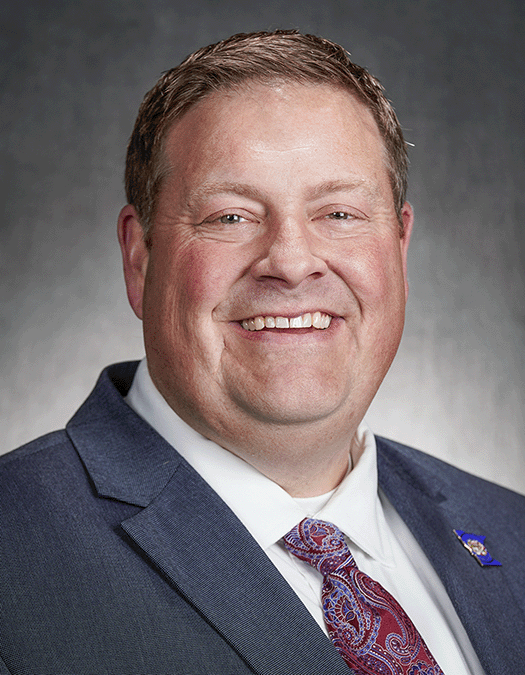
Rep. Keith Allen
Sponsored bills
Maddy summaryHF 363 establishes a $5 per acre property tax credit for agricultural land certified under Minnesota's agricultural water quality program in specific counties (Dodge, Fillmore, Goodhue, Houston, Mower, Olmsted, Wabasha, and Winona). This credit directly affects farmers who have land certified by the Department of Agriculture under the water quality program in those counties. The credit reduces property taxes payable to local governments, with the state reimbursing counties and school districts through annual appropriations from the general fund. Payments for the credit will begin for property taxes due in 2026.
Maddy summaryHF 2550 establishes a new Local Business Construction Impacts Assistance Program to support businesses affected by highway and street construction projects in Minnesota. It requires transportation authorities to appoint business liaisons and create communication plans for projects expected to cause "substantial business impacts" (like reduced access, parking, or visibility for at least one month). The program provides financial assistance to eligible businesses experiencing "extensive business impacts" (impairment for 60+ days) due to covered projects, such as highway work in cities or counties. This bill directly affects local businesses near construction zones and aims to mitigate economic disruption through proactive communication and financial support.
Maddy summaryThis bill modifies two key aspects of Minnesota's housing stabilization program. It requires the state commissioner to process provider applications within two weeks (up from previous timelines) and reduces payments to housing stabilization service providers by half over two years, with a one-year suspension of this reduction starting July 1, 2025. These changes directly affect housing stabilization service providers and the individuals receiving these services, particularly those also eligible for supplemental housing support under other programs. The bill aims to streamline provider enrollment while adjusting payment structures, with the rate reduction applying only to non-duplicative services.
Maddy summaryHF 128 increases criminal penalties for individuals engaging in prostitution with minors in Minnesota. The bill raises maximum sentences and fines based on the minor's age: up to 30 years or $40,000 for victims under 14, 20 years or $40,000 for those aged 14-15, 15 years or $30,000 for those aged 14-15 (for the act itself), and 10 years or $20,000 for victims aged 16-17. It also increases penalties for hiring minors for sexual acts across all age groups. The bill applies to crimes committed on or after its effective date of August 1, 2025.
Maddy summaryHF 2767 increases maximum grant amounts for Minnesota's Dual Training Competency Grant Program, doubling the annual cap from $6,000 to $12,000 per employee (capped at $24,000 total per employee). It appropriates $2 million for fiscal year 2026 and $2 million for fiscal year 2027 from the general fund to support this program. The bill directly affects training providers (including institutions under Minnesota Statutes §136A.103) and employees participating in eligible training programs. A key provision requires applicants to secure Pell and state grants before receiving program funds for employee training.
Maddy summaryHF 1957 appropriates $1 million for fiscal year 2026 and $1 million for fiscal year 2027 from the general fund to the Minnesota Technology Association. The funds support the SciTech internship program, which matches college students (including graduate students) in STEM fields with paid internships at small Minnesota tech companies (under 250 employees worldwide). The grant reimburses employers for 50% of intern wages, capped at $3,000 per intern, and requires efforts to increase participation from women and other underserved groups. This one-time funding directly supports students seeking STEM internships and small employers hiring them.
Maddy summaryHF 2192 eliminates Minnesota's North Star Promise scholarship program and redirects any unspent funds from its special revenue account to the state grant program. The bill repeals the program's funding statute (Minnesota Statutes §136A.1465) and requires transferring unencumbered balances to the state grant program by July 2025, with the account closed by August 2025. This affects future scholarship recipients who would have qualified for North Star Promise, as the program will no longer provide aid starting fall 2025. The state grant program will now receive these redirected funds, though the bill does not create new scholarship eligibility or funding.
Maddy summaryHF 837 requires Minnesota's commissioner of commerce to apply to the federal government by December 31, 2026, for a waiver continuation under federal law (42 U.S.C. § 18052). This waiver is needed to keep Minnesota's premium security health insurance plan operating after 2027, as its future depends on federal approval. The bill also directs a one-time transfer of $413 million from the state general fund to the premium security plan account in fiscal year 2026. This funding supports the state's health insurance program for qualifying residents. The bill directly affects Minnesota's health insurance program and state budget management.
Maddy summaryHF 2420 establishes the Commission on Government Efficiency and Ethics to investigate allegations of fraud in state-funded programs and undisclosed legislative conflicts of interest. The commission will maintain an anonymous hotline and website for reporting, offer up to $5,000 rewards for reports leading to convictions or expulsions, and conduct investigations or forensic audits of state agencies. It requires public officials and entities handling public funds to cooperate with investigations and must report credible fraud evidence to law enforcement or legislative committees. The commission also submits annual reports with recommendations to prevent fraud and conflicts of interest. This bill directly affects state program administrators, legislators, and any individuals reporting misconduct.