

Maddy summaryHF 1 establishes a centralized Office of Inspector General (OIG) for Minnesota state government, replacing existing agency-specific inspector general offices. The OIG will oversee state spending, require agencies to halt payments when fraud is suspected, and mandate a fraud reporting hotline for employees and contractors. It directly affects all state agencies and recipients of state funds (such as contractors and organizations administering state programs) by requiring them to report suspected fraud and prohibiting retaliation against whistleblowers. The bill also specifies the OIG must coordinate with the legislative auditor and amends statutes related to fraud detection, waste prevention, and oversight.
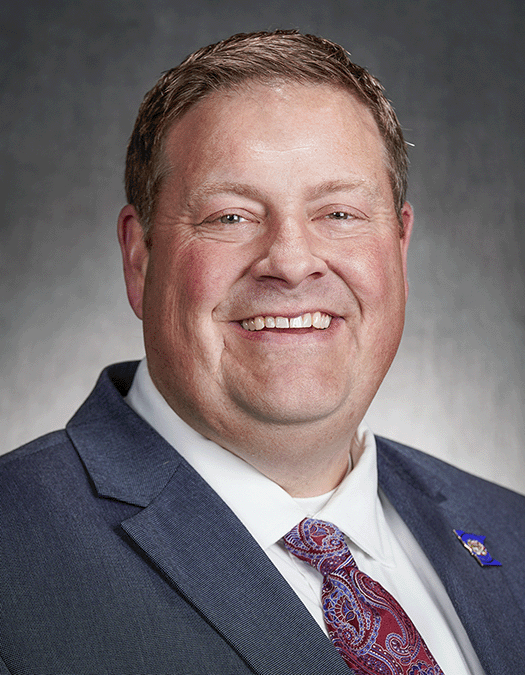
Rep. Keith Allen
Sponsored bills
Maddy summaryHF 3438 allocates $84 million from state bonds to fund a new campus center at the University of Minnesota's Saint Paul campus, covering approximately two-thirds of the project costs. The university must cover the remaining one-third from its own funds, with the state bond proceeds used for predesign, construction, and related infrastructure work. The bill authorizes the state to issue up to $84 million in bonds under Minnesota law to finance this appropriation. This directly affects the University of Minnesota Saint Paul campus and Minnesota taxpayers through the bond mechanism.
Maddy summaryHF 1766 appropriates $800,000 annually to the Minnesota Council on Economic Education to fund teacher training and classroom resources focused on economic and financial literacy. The bill directly supports K-12 teachers (especially those teaching grades 9-12 personal finance) by providing professional development, curricular materials, and direct student programs. It requires the Council to report annually on training participation, program content, and research results to the state education commissioner. This policy change aims to strengthen financial education standards across Minnesota public schools through targeted teacher support and measurable program evaluation.
Maddy summaryHF 1066 increases annual funding for soil and water conservation districts in Minnesota. It amends state law to raise the annual appropriation from $15 million (for 2023-2024) to $20 million starting in 2025, paid from the general fund to the commissioner of revenue. This funding directly supports local soil and water conservation districts that provide technical assistance and cost-share programs for landowners. The bill takes effect for payments made in 2025 and subsequent years.
Maddy summaryHF 3251 eliminates the requirement for a license to sell copper scrap metal in Minnesota. The bill repeals Minnesota Statutes 2024, section 325E.21, subdivision 2c, which previously mandated the license. This change means sellers of copper scrap metal no longer need to obtain or maintain a separate license. The bill directly affects copper scrap metal sellers and scrap metal dealers, who no longer need to verify a copper-specific license for transactions. The repeal removes the existing licensing requirement without introducing new rules for copper sales.
Maddy summaryHF 15, the "Safe Haven In Every Local District (SHIELD) Act," requires all Minnesota public school districts and charter schools to include specific student and staff safety measures in their long-term facility plans by August 2025. The bill creates new grants to fund comprehensive security systems, including features like bullet-resistant doors, emergency alert systems, and staff training, with priority given to schools serving the most students. School districts must apply for these grants through the Minnesota School Safety Center, which will rank applicants and provide lists of approved vendors. The law appropriates funds from the general fund for fiscal year 2026 to support these security upgrades and plan updates.
Maddy summaryHF 1372 allows Minnesota cities to create designated "social districts" where alcohol purchased at licensed bars or restaurants can be consumed in public areas adjacent to those venues. The bill requires cities to clearly mark district boundaries with signs showing permitted hours, include safety statements on containers (e.g., "Drink Responsibly - Be 21"), and restrict containers to non-glass, 16-ounce sizes with specific labeling. It mandates cities to report on community impact, safety concerns, and operational challenges within 24 months of implementation. This directly affects local governments, licensed businesses, and public safety management in areas where such districts are established.
Maddy summaryHF 1014 allows the Minnesota Insurance Guarantee Association (MIGA) board to request financial information from insureds to verify if their net worth exceeds $25 million on December 31 of the prior year. This specifically affects insureds whose combined net worth (including subsidiaries) meets or surpasses this threshold, as claims from such insureds would otherwise be excluded from MIGA coverage. The bill requires MIGA to inform insureds of consequences for failing to provide requested financial details within 60 days, after which their net worth is automatically deemed above $25 million. The key mechanism streamlines MIGA’s ability to assess claim eligibility by verifying high-net-worth status through direct financial requests. This change amends Minnesota Statutes section 60C.09, subdivision 2.
Maddy summaryHF 3144 appropriates $1 million for fiscal year 2026 and $1 million for fiscal year 2027 to support medical supply delivery to rural Minnesota communities using small drones. The bill directly affects rural residents who may face challenges accessing medical supplies, as well as state agencies implementing drone delivery systems. Key provisions include funding infrastructure for drone operations beyond visual line of sight, assisting with federal regulatory approvals, testing delivery systems, and public education on drone use. The commissioner of transportation must coordinate with the commissioner of health and the Board of Pharmacy on how these funds are used.
Maddy summaryThis bill appropriates $6,442,000 from state bond proceeds to fund design, renovation, and equipment for classroom and lab spaces at South Central College's North Mankato campus. The funds specifically target facilities supporting agribusiness, architectural drafting, civil engineering technology, dental assisting, emergency medical services, and geographic information systems programs. The state will issue bonds up to this amount to cover the costs, as authorized under Minnesota bonding statutes. The bill directly affects South Central College students and faculty in these specific academic programs by upgrading their learning environments.