

Maddy summaryHF 1726 appropriates $3.45 million from state bond proceeds to fund Blue Earth County's design, construction, and equipment for a dedicated recycling, reuse, and waste recovery customer service facility at its mixed municipal solid waste landfill. The bill authorizes the state to issue bonds to cover this cost, following Minnesota's bond procedures. This funding directly affects Blue Earth County residents by enhancing local waste management services at the landfill site. The legislation provides concrete financial support for facility development under Minnesota Statutes, section 115A.54.
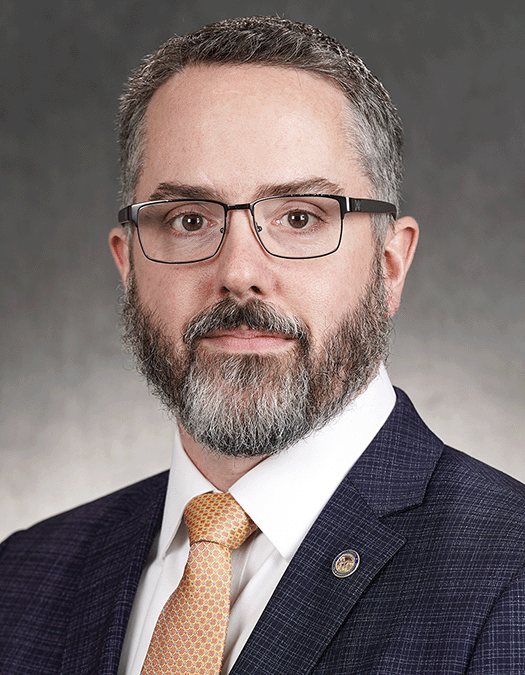
Rep. Luke Frederick
Sponsored bills
Maddy summaryHF 1725 appropriates $68,684,000 from state bond proceeds to fund the construction, furnishing, and equipping of a new Bureau of Criminal Apprehension (BCA) regional office and laboratory facility in Mankato. The bill authorizes the state to sell bonds up to this amount to cover the costs, following standard bond procedures under Minnesota law. This funding directly supports the BCA's operations by creating a new regional facility in Mankato, which will serve the southern Minnesota community and improve forensic and investigative capabilities. The bill establishes concrete infrastructure funding without altering existing laws or creating new regulations.
Maddy summaryHF 1095 requires Minnesota's human services commissioner to amend state waiver plans by December 2025 to allow providers of individualized home supports to bill for specific indirect services. These services include coordinating transportation, health care appointments, legal support, employment maintenance, basic needs access, independent living arrangements, and crisis management - without requiring direct recipient contact. The bill directly affects home support providers serving individuals who need assistance with daily living. It takes effect July 1, 2025, pending federal approval of the waiver plan changes.
Maddy summaryHF 1616 appropriates $12.75 million from state bond proceeds to fund the predesign, construction, and equipment of an indoor recreational facility at North Mankato's Caswell Regional Sporting Complex. The bill authorizes the state to issue bonds up to $12.75 million to cover this cost, as specified under Minnesota bonding laws. This funding directly supports the city of North Mankato in developing a new public recreational facility for community use. The bill becomes effective upon final enactment.
Maddy summaryHF 1626 eliminates maximum dollar limits on tax credits for Minnesota agricultural asset owners who sell or rent property to beginning farmers. Previously, credits were capped at $50,000 for sales and $7,000-$10,000 annually for rentals; this bill removes those caps, allowing credits to be calculated based on actual qualifying transaction values (8%, 10%, or 15% of sale price or rental income). The change applies to credits under Minnesota Statutes sections 41B.0391 and 290.06, effective for tax years beginning after December 31, 2024. It directly affects agricultural landowners and beginning farmers participating in Minnesota’s tax credit program.
Maddy summaryHF 981 appropriates $500,000 for fiscal year 2026 and $500,000 for fiscal year 2027 from the general fund to the Minnesota Commissioner of Health. This funding is directed to the nonprofit organization "Change the Outcome" to implement opioid prevention and education programs. The bill requires these programs to provide data-driven school and community education on opioid dangers, prevention strategies, overdose recognition, emerging drug trends (like fentanyl and xylazine), and access to substance use disorder support resources. The primary beneficiaries are Minnesota middle and high school students, communities, and individuals struggling with substance use disorders.
Maddy summaryHF 98 modifies supervision and training rules for mental health professionals in Minnesota. It requires case managers with less experience to complete 40 hours of approved training and receive 38 hours of annual supervision (including monthly clinical sessions), while case management associates must meet specific education or experience criteria and complete 40 hours of preservice training. The bill also exempts intensive residential mental health treatment providers from certain client rights requirements and updates critical incident reporting timelines for residential programs. These changes directly affect mental health service providers, case managers, behavioral aides, and residential treatment facilities.
Maddy summaryHF 1326 appropriates $7,011,000 from the general fund for each of fiscal years 2026 and 2027 to provide grants to Centers for Independent Living (CILs) in Minnesota. These grants will support existing CILs operating under Minnesota Statutes section 268A.11, which provide community-based services and advocacy for people with disabilities. The funding directly affects CILs that help individuals with disabilities achieve greater independence in daily living, employment, and community integration. This is a funding measure with no new policy requirements, solely providing financial support for established services.
Maddy summaryHF 1132 appropriates $200,000 for fiscal year 2026 and $200,000 for fiscal year 2027 from the general fund to GreenSeam, a state agency, to provide grants for agriculture-related businesses. The grants support business retention, development, creation, talent attraction, and regional branding efforts. GreenSeam must report by December 1 each year on new businesses supported, jobs created, educational partnerships, and promotional activities. This is a one-time funding allocation with specific reporting requirements for the program's outcomes.
Maddy summaryHF 1047 allocates $500,000 for fiscal year 2026 and $500,000 for fiscal year 2027 from the general fund to the Minnesota Department of Health. This funding is specifically directed to the nonprofit organization Change the Outcome to implement opioid prevention and education programs. The programs will provide data-centered learning in Minnesota middle and high schools and communities, teach prevention strategies and overdose recognition, share information on emerging drugs like fentanyl and xylazine, and connect individuals with substance use disorder resources. The bill directly affects schools, community groups, and Minnesotans at risk of opioid misuse.