

Maddy summaryHF 2032 establishes mental health case management and community support services specifically for adults with complex post-traumatic stress disorder (C-PTSD). It directly affects individuals meeting defined C-PTSD criteria, including significant PTSD symptoms interfering with daily life due to intergenerational, racial, or historical trauma, plus documentation from a mental health professional. The bill requires providers of emergency, outpatient, or residential mental health services to refer eligible clients to case management upon consent, documenting these referrals. Key provisions include mandating culturally sensitive assessments and written professional opinions verifying eligibility and the need for ongoing support to prevent worsening symptoms.
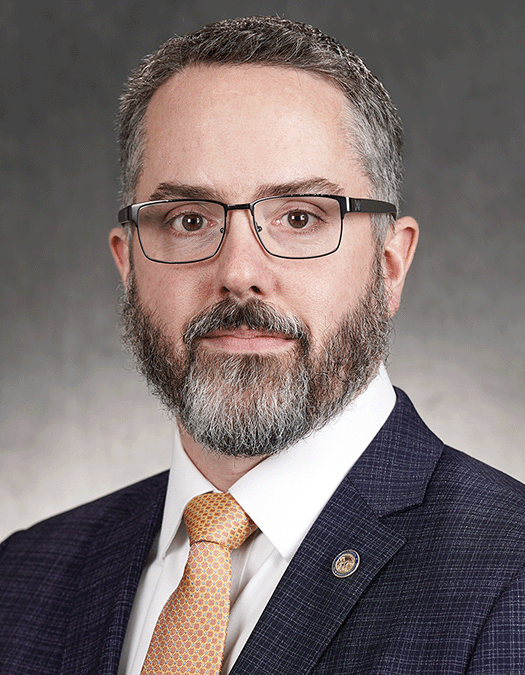
Rep. Luke Frederick
Sponsored bills
Maddy summaryHF 770 appropriates $30 million from state bond proceeds to fund specific agricultural loan programs administered by Minnesota's Rural Finance Authority. It directly affects Minnesota farmers by financing beginning farmer loans, seller-sponsored loans, agricultural improvement loans, and livestock expansion loans under Minnesota Statutes, chapter 41B. The bill authorizes the state to issue up to $50.05 million in bonds, with debt service repaid by the Authority, and prioritizes funding first for beginning farmers, then seller-sponsored loans, and finally agricultural improvement loans.
Maddy summaryHF 1963 modifies key timelines for healthcare billing and service delivery in Minnesota. It extends the standard 6-month deadline for health providers to submit medical claims to 12 months when operational disruptions occur, and adds a further 6-month extension if health plans adjust payments. The bill also requires peer recovery support providers (community organizations helping people with substance use disorders) to create formal closure plans if they stop operating. These changes directly affect hospitals, clinics, health insurance plans, counties managing services, and peer recovery organizations.
Maddy summaryHF 1953 modifies how Minnesota calculates reimbursement rates for community-based human services providers, including personal care aides, CFSS workers, and qualified professionals. It requires using Minnesota-specific median wages from 2021 Bureau of Labor Statistics data to set base rates, with biennial adjustments to the competitive workforce factor based on wage comparisons between personal care aides and similar occupations. The bill establishes fixed percentages for costs like employee benefits (12.04%) and administrative expenses (13.25%), which will be applied to the adjusted base rates. These changes take effect January 1, 2026, and directly affect service providers receiving state funding through Medicaid waivers.
Maddy summaryHF 1983 allocates $5 million from the general fund for grants to Minnesota organizations developing early-stage commercial markets for continuous living cover crops and related systems (like Kernza grain, elderberry, and regenerative poultry systems). The grants, administered jointly by the employment and agriculture commissioners, must support new enterprises and supply chains without duplicating funding from other agencies in the same year. By January 15, 2027, the commissioner must submit a report detailing grant usage, including administrative costs. This one-time appropriation directly affects agricultural innovators and businesses working to scale these specific crop systems in Minnesota.
Maddy summaryHF 1994 establishes standardized daily payment rates for various levels of substance use disorder (SUD) treatment services funded through Minnesota’s behavioral health fund. It directly affects treatment providers (such as clinics, residential facilities, and hospitals) that bill this fund for services like outpatient care, residential treatment, and medication-assisted therapy. The bill sets specific rates - for example, $79.84 per day for low-intensity outpatient services and $224.06 per day for high-intensity residential care - while recodifying which providers qualify for payments. It also creates enhanced rates for programs serving parents with children (requiring on-site or documented off-site childcare) and culturally specific SUD services.
Maddy summaryHF 1762 proposes adding a new constitutional amendment to Minnesota's state constitution. If approved by voters, it would guarantee all persons equal rights under state law and prohibit discrimination based on race, color, national origin, ancestry, disability, or sex - including protections for pregnancy decisions, gender identity, gender expression, and sexual orientation. The amendment would apply to all state actions and agencies, requiring any discriminatory state action to be the "least restrictive means" of achieving a "compelling governmental interest." The proposed amendment must be submitted to voters in the 2026 general election, with implementation starting January 1, 2027, if ratified.
Maddy summaryHF 1709 appropriates $4 million from the bond proceeds fund to the Minnesota Housing Finance Agency for the Greater Minnesota Housing Infrastructure grant program, which supports housing infrastructure projects in rural and non-metro areas of Minnesota. The bill authorizes the state to issue up to $4 million in bonds to fund this appropriation, with the money specifically allocated for fiscal year 2026. This program directly affects communities outside Minnesota's major urban centers by providing grants for housing-related infrastructure improvements. The legislation establishes a clear funding mechanism through bond sales and fund transfers without creating new regulatory requirements.
Maddy summaryHF 1805 increases reimbursement rates for residential substance use disorder (SUD) treatment providers in Minnesota. It adds a new provision that raises payment rates by 50% for specific residential SUD services starting July 1, 2025, compared to rates effective January 1, 2025. This directly affects licensed residential SUD treatment providers who meet state requirements under section 254B.05. The change applies only to certain residential services listed in the statute, not all SUD treatments. The bill aims to improve provider compensation for these specific care settings.
Maddy summaryHF 1796 modifies Minnesota's Livestock Investment Grant Program to change how grants are calculated. Instead of awarding 10% of the first $500,000 in qualifying expenditures, the bill establishes a tiered system: 50% of the first $20,000 plus 20% of the next $220,000. The bill expands eligible expenses to include specific items like pasture development (fencing, watering systems), livestock housing equipment (freestall barns, milking parlors), and waste management facilities (digesters, manure storage). This directly affects Minnesota livestock producers raising eligible animals (beef cattle, dairy, swine, poultry, goats, etc.) who make qualifying capital investments in their operations.