

Maddy summaryHF 417 modifies Minnesota's individual income tax code to exclude tips (gratuities paid to employees) from taxable income. This change directly affects service industry workers, such as restaurant staff, who receive tips as part of their earnings. The bill amends Minnesota Statutes section 290.0132 by adding a new provision stating that tip amounts are a subtraction from taxable income, meaning these earnings will not be subject to state income tax. The provision takes effect for tax years beginning after December 31, 2024.
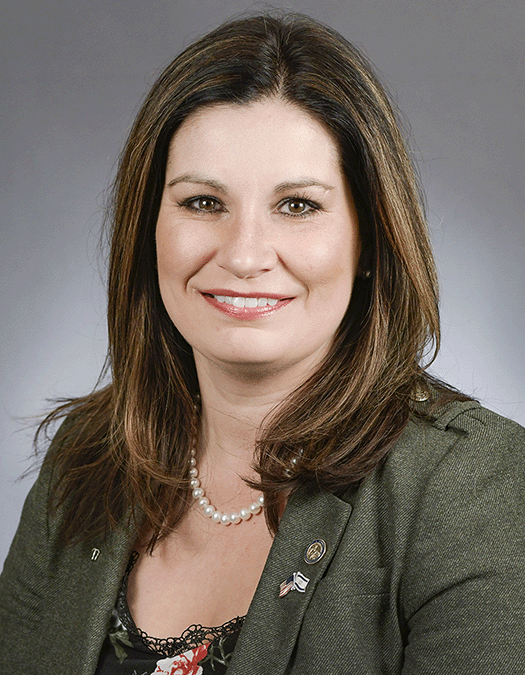
Rep. Mary Franson
Sponsored bills
Maddy summaryHF 724 modifies Minnesota's water infrastructure funding programs to increase support for local governments. It raises the maximum grant amount for wastewater and drinking water projects from $5 million to $10 million per project (or $20,000 per connection), while adding a new "emerging contaminants grant program" to address newer water quality threats. The bill authorizes the sale of state bonds to fund these clean water initiatives and adjusts eligibility rules to help communities where system costs exceed 1.4% of median household income for wastewater or 1.2% for drinking water. These changes directly affect cities, counties, and water utilities seeking funding for infrastructure upgrades under existing revolving fund programs.
Maddy summaryHF 3136 establishes a Minnesota task force to prevent female genital mutilation (FGM), directly affecting communities where FGM is practiced as a tradition or religious custom, as well as health and law enforcement agencies. The task force, appointed by the health commissioner by November 2025, must develop public education strategies, coordinate law enforcement efforts, improve data collection, and create resources to protect children from FGM. It requires annual reports to state leaders on outreach activities, including school-based education and partnerships with healthcare providers. The bill appropriates funds for the task force’s operations in fiscal years 2026 and 2027.
Maddy summaryHF 1502 establishes a new process to determine disability for Minnesota medical assistance (Medicaid) eligibility, creating a specific pathway for applicants under 65 who are blind or claim disability but haven’t been formally determined disabled by the Social Security Administration. The bill requires that such applicants be referred to the state medical review team for a disability determination if they don’t qualify under other eligibility categories. This change, effective July 1, 2025, directly affects Minnesotans applying for medical assistance who fall into this category. The bill amends Minnesota Statutes sections 256B.055 and 256B.056 to implement these provisions.
Maddy summaryHF 3206 appropriates $5 million from the state transportation fund to reconstruct 210th Avenue in Pope County between Trunk Highway 28 and Pope County State-Aid Highway 28. The funds, financed through state bonds, will support the city of Glenwood, Glenwood Township, or Leven Township for acquiring land, designing, and rebuilding the road. This bill directly affects local governments in Pope County by providing capital for infrastructure improvements. The project covers all phases from initial planning to final construction. The funding mechanism relies on issuing state bonds under Minnesota Statutes, as outlined in the bill.
Maddy summaryHF 500 repeals Minnesota's Nursing Home Workforce Standards Board and related statutes (sections 181.211-181.217) that previously established requirements for nursing home staffing and worker protections. This bill directly affects nursing home employers in Minnesota by removing these specific regulatory standards. The key mechanism is the complete repeal of the board and its associated provisions, eliminating the legal framework that required nursing homes to comply with workforce standards and penalties for noncompliance.
Maddy summaryHF 3170 would require Minnesota public elementary and secondary schools to restrict participation on female sports teams to students identified as female at birth. The bill mandates that students must provide a physician's statement verifying their sex based on reproductive anatomy, natural testosterone levels, and chromosomes if a dispute arises about their sex. This policy applies to all school-level athletic teams designated for women or girls and takes effect July 1, 2025. The bill directly affects student-athletes seeking to participate on female teams and school administrators managing athletic eligibility.
Maddy summaryHF 2057 requires hospitals participating in Minnesota's medical assistance program to pay an assessment based on their net inpatient and outpatient revenue (as reported in Medicare cost data). The funds collected must cover the nonfederal share of "directed payments" to these hospitals under the medical assistance program. The bill includes exemptions for critical access hospitals, children's hospitals, Indian Health Service facilities, and rural hospitals, plus a cap preventing any single hospital system from paying more than a specified percentage of total assessments. Assessments are due quarterly starting January 1, 2026, pending federal approval of the funding mechanism.
Maddy summaryHF 2147 exempts hot tubs or whirlpools on houseboats and single-unit rental properties from most public pool safety requirements in Minnesota. It requires property owners to ensure water temperature stays below 106°F, test chlorine/bromine, pH, and alkalinity before each rental, and provide renters with a specific notice about the exemption. The bill mandates a posted warning: "NOTICE: This spa is exempt from certain state and local sanitary requirements... USE AT YOUR OWN RISK." It directly affects rental property owners, resorts, and renters of these properties, while prohibiting local governments from adding extra requirements for qualifying hot water pools.
Maddy summaryHF 97 modifies coverage for chiropractic services under MinnesotaCare and medical assistance programs. It specifies that covered services - including spinal manipulation, manual therapy, and therapeutic exercises for spinal conditions - must be provided by a licensed professional using accepted standards. The bill limits non-x-ray services to one annual evaluation and 24 visits per year, requiring prior authorization for more visits. It also restricts x-ray coverage to full spine or specific spinal area exams necessary for diagnosing subluxation. The bill repeals the previous coverage description in Minnesota Statutes 2024, section 256L.03, subdivision 3b.