

Maddy summaryThis bill authorizes the state to issue up to $15 million in bonds to fund capital improvements at the Alexandria Lake Area Sanitary District. The funds will be used to construct and equip Phase Two upgrades to the district's regional water reclamation facility. The Public Facilities Authority will receive the grant money from bond proceeds to implement these improvements. The legislation takes effect the day after it is enacted.
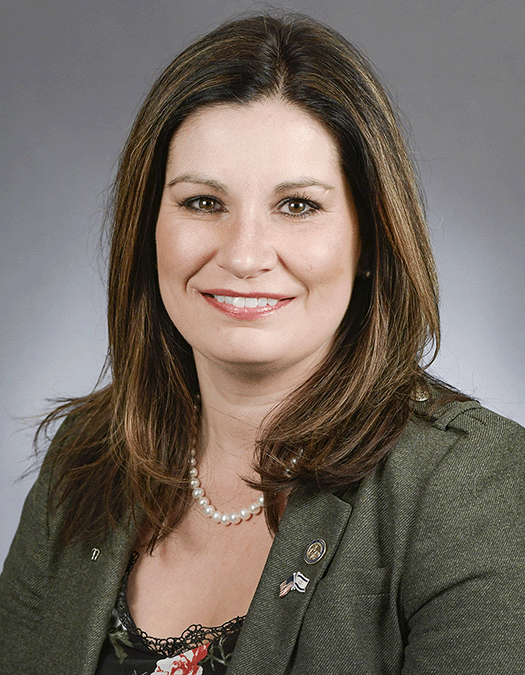
Rep. Mary Franson
Sponsored bills
Maddy summaryThis bill authorizes Douglas County, Minnesota, to collect a local sales tax of up to 0.25% to fund a new library project. The tax requires voter approval through a special election and must be used to cover collection costs and finance up to $18.5 million for library construction, including related bond expenses. Douglas County can issue bonds to pay for the project without going through standard debt approval processes, and the tax will expire after ten years or once the project costs are fully covered.
Maddy summaryHF 3346 creates a commission to evaluate all campuses in the Minnesota State Colleges and Universities system for potential closure or consolidation, directly affecting those campuses and their students, faculty, and staff. The commission must base recommendations on factors like operating costs, enrollment trends, graduation rates, and program reputation, while seeking input from faculty and staff unions. It must submit a report with specific recommendations by December 1, 2026, and the governor must approve or reject the entire package by December 31, 2026, with approved changes becoming part of the state budget. The commission expires on October 1, 2026, ending the evaluation process.
Maddy summaryHF 1908 amends Minnesota's child custody laws to remove barriers that previously limited courts' jurisdiction when a child is in the state for gender-affirming care. The bill adds that a child's presence in Minnesota for gender-affirming health care meets the "significant connection" requirement for initial custody jurisdiction under statute 518D.201, and it allows temporary emergency custody orders if a child cannot access such care (statute 518D.204). These changes directly affect children and families navigating custody cases when traveling to Minnesota for gender-affirming medical treatment. The bill repeals prior restrictive language (including sections 543.23 and 260.925) that had limited these protections.
Maddy summaryThis bill directs $15 million from Minnesota's transportation advancement account to fund suicide prevention measures on Minneapolis's Washington Avenue Bridge. Specifically, it requires Hennepin County to award a grant to the University of Minnesota for designing and building physical barriers and providing suicide diversion resources on the bridge. The funds are allocated to address safety concerns at this specific location, where bridge-related suicide attempts have occurred. The measure changes how existing transportation funds are used, prioritizing mental health interventions at a high-risk location.
Maddy summaryThe provided context does not include the text, purpose, or specific provisions of HF 17 ("General fund cash bonding bill"). Without details on what the bill authorizes, how it would operate, or who it would impact, a factual summary cannot be created. The recent author additions (McDonald, Murphy, Fogelman, Koznick, Gander, Altendorf, Gillman, Van Binsbergen) indicate growing support but do not describe the bill's content. To provide an accurate summary, the bill's actual language or official description would be required.
Maddy summaryHF 18 is a general obligation bonding bill that authorizes the state to issue government bonds for capital projects. It does not specify particular projects but provides funding authority for infrastructure or public facilities. The bill is currently in committee, having been referred to Ways and Means after a committee report on February 13, 2025. Multiple legislators have been added as authors, including McDonald, Rymer, Koznick, Schwartz, Altendorf, Gillman, and Sexton. As a procedural bonding bill, it focuses on funding mechanisms rather than direct policy changes affecting specific groups.
Maddy summaryHF 1090 renames Minnesota's existing Library Construction Grant Program to the "Mary C. Murphy Library Construction Grants Program" in Minnesota Statutes 2024, section 134.45. The bill makes no changes to the program's eligibility, funding levels ($450,000 for accessibility projects or $1,000,000 for renovations/new buildings), or requirements - public libraries, regional systems, cities, and counties still qualify. It preserves all current provisions, including the 50% local funding match, accessibility focus, and prohibitions on using funds for new building accessibility compliance. The name change honors Mary C. Murphy but does not alter how the program operates or who benefits.
Maddy summaryHF 3347 modifies Minnesota liquor licensing rules to authorize specific venues to sell alcohol without usual zoning restrictions. It allows St. Paul to issue on-sale licenses to the Fitzgerald Theatre, Science Museum of Minnesota, and Union Depot, bypassing typical distance requirements from schools or churches. The bill also updates rules for the University of Minnesota Board of Regents, permitting licenses for Northrop Auditorium, football stadiums (like TCF Huntington Bank Stadium), and up to seven other campus locations for events. These changes directly affect those specific venues and the Board of Regents by removing barriers to alcohol sales during permitted events.
Maddy summaryThis bill requires Minnesota's Commissioner of Public Safety to investigate and negotiate driver's license reciprocity agreements with foreign jurisdictions (outside U.S. territories) that already have agreements with at least ten U.S. states. By October 1, 2025, the Commissioner must begin negotiations with these jurisdictions unless public safety concerns prevent it, in which case they must notify relevant legislative committees. The bill directly affects Minnesota's Public Safety Commissioner and the state's process for expanding driver's license recognition internationally. It does not change current driver requirements for Minnesota residents but establishes a timeline and criteria for future agreements with foreign countries.