

Maddy summaryThis bill appropriates $2,950,000 for fiscal year 2026 and another $2,950,000 for fiscal year 2027 from the general fund to support Minnesota's county feedlot program. The funds are provided to delegated counties (those authorized to administer the program) through grants managed by the Pollution Control Agency. These grants will help counties oversee feedlot operations under Minnesota Statutes section 116.0711, focusing on environmental compliance and oversight. Any unspent funds from 2026 may be carried over to 2027.
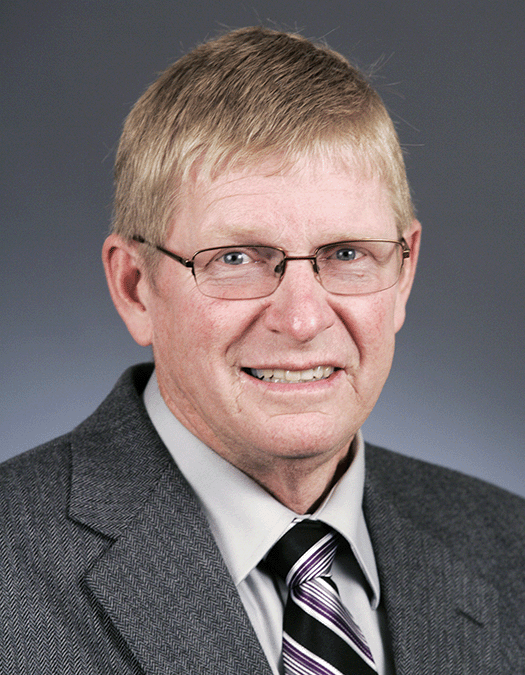
Rep. Paul Anderson
Sponsored bills
Maddy summaryThis bill modifies Minnesota's renewable energy standards by expanding which hydroelectric projects count toward clean energy goals (including facilities over 100 megawatts if operating since 2023). It allows electric utilities to request delays in meeting renewable, solar, or carbon-free energy requirements if the commission determines it serves the public interest, considering factors like cost impacts and system reliability. The bill also expands sales tax exemptions for residential heating fuels and electricity, and prohibits demolition of fossil-fuel power plants under specific conditions. Additional provisions include supporting carbon capture technology and removing barriers to new nuclear power plants.
Maddy summaryHF 1523 exempts certain agricultural workers from Minnesota's Paid Leave Law. Specifically, it excludes workers employed by a farmer, family farm, or family farm corporation who either work for a farm with five or fewer total employees, or work on the farm for 28 days or fewer each year. This amendment to Minnesota Statutes 2024, section 268B.01, directly affects small-scale farm workers who meet these criteria. The bill clarifies that these workers are not covered by the state's paid leave requirements, while other agricultural workers remain subject to the law.
Maddy summaryHF 289 establishes the SAVI (State Agency Value Initiative) program, allowing all Minnesota state agencies - including Minnesota State Colleges and Universities - to retain 50% of unspent operational funds from cost-saving innovations or efficiency measures. Agencies must use these retained funds only for mission-related projects, after a peer review panel (composed of employees and managers) recommends the project and the commissioner of management and budget approves it. The program requires agencies to publicly post project spending plans for 30 days and undergo review by the Legislative Advisory Commission before funding. This policy directly affects state agencies by creating a structured way to reinvest savings into new initiatives without creating future financial obligations.
Maddy summaryHF 1749 appropriates $6 million for fiscal year 2026 and $6 million for fiscal year 2027 from the renewable development account to fund research and development of green ammonia power generation technology. The University of Minnesota's Board of Regents will lead this effort, focusing on creating energy systems that use renewable hydrogen and ammonia to store and generate electricity. The funding supports research, development, outreach, and demonstration projects, with the goal of advancing clean energy storage solutions. The appropriations are one-time and available until June 30, 2028.
Maddy summaryHF 434 amends Minnesota law to allow the importation of live Cervidae (deer, elk, moose, etc.) into the state for certain accredited facilities. Specifically, it permits importation by facilities accredited by the Association of Zoos and Aquariums (AZA), provided animals come from herds in certified chronic wasting disease (CWD) programs and meet testing requirements. The bill maintains existing CWD prevention rules but creates a specific exception for AZA-accredited institutions, including allowing importation of semen from certified herds and orphaned non-CWD-susceptible animals after risk assessment. This directly affects AZA-accredited zoos and aquariums seeking to import live Cervidae for conservation or display. The change modifies Minnesota Statutes § 35.155, subdivision 12, without altering broader CWD testing or seizure provisions.
Maddy summaryHF 1796 modifies Minnesota's Livestock Investment Grant Program to change how grants are calculated. Instead of awarding 10% of the first $500,000 in qualifying expenditures, the bill establishes a tiered system: 50% of the first $20,000 plus 20% of the next $220,000. The bill expands eligible expenses to include specific items like pasture development (fencing, watering systems), livestock housing equipment (freestall barns, milking parlors), and waste management facilities (digesters, manure storage). This directly affects Minnesota livestock producers raising eligible animals (beef cattle, dairy, swine, poultry, goats, etc.) who make qualifying capital investments in their operations.
Maddy summaryHF 1702 allocates $100,000 for fiscal year 2026 and $100,000 for fiscal year 2027 from the state general fund to support mental health outreach and farm safety programs for Minnesota farmers, ranchers, and agricultural workers. The funding will cover services like 24-hour hotlines, stigma reduction efforts, and educational programs under existing law (Minnesota Statutes §17.1195). Unused funds from 2026 will carry over and remain available until June 30, 2027, per the bill’s provisions. This bill directly affects agricultural communities by expanding access to mental health and safety resources.
Maddy summaryHF 1707 requires all solar energy projects in Minnesota to obtain written approval from every local government (like cities or counties) and Minnesota Tribal government with jurisdiction over the project site before construction can begin. This applies to every solar project, regardless of size, including those previously exempt from commission permitting under 50 megawatts. The bill amends state law to mandate this approval step during the preapplication phase, requiring developers to provide notice and seek feedback from affected local and Tribal entities at least 30 days before submitting formal applications. This directly affects solar developers, local governments, and Tribal governments by adding a mandatory approval requirement to the project development process.
Maddy summaryHF 1699 exempts specific accredited zoos from Minnesota's fur farm regulations. The bill amends Minnesota Statutes 2024, section 97A.106, to add a new exemption for zoos that are USDA-licensed exhibitors, hold AZA accreditation, and participate in the AZA Species Survival Plan. This change directly affects zoos meeting all three criteria, removing their requirement to comply with fur farm regulations. The exemption applies to the specific regulatory provisions referenced in the statute, not to other zoo operations or regulations.