

Maddy summaryHF 1311 modifies Minnesota's rules for how public utilities recover costs for electric generation and transmission assets. It requires utilities to submit detailed assessments showing how new assets contribute to system reliability during peak demand, including seasonal load calculations, before adding them to customer bills. For retiring assets, utilities must prove the action won't impair reliability, with the Public Utilities Commission required to explain impacts in its decisions. The bill directly affects Minnesota's electric utilities (like Xcel Energy) and the commission that reviews their rate requests. These changes apply to new filings after enactment, focusing on ensuring reliability while determining which costs can be passed to ratepayers.
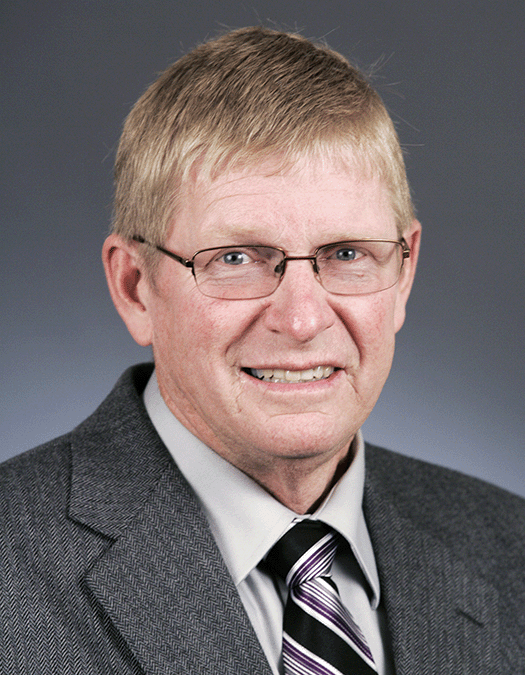
Rep. Paul Anderson
Sponsored bills
Maddy summaryHF 1701 establishes a grant program to support Minnesota-based fertilizer manufacturers. The commissioner of agriculture will award grants to businesses operating in Minnesota for manufacturing, processing, and handling fertilizer, with priority given to those supplying fertilizer to agricultural producers for crop years starting in 2026. The bill appropriates state funds for fiscal years 2026 and 2027 to support these grants. This policy directly affects Minnesota fertilizer producers and aims to increase the local supply of fertilizer made within the state.
Maddy summaryHF 1626 eliminates maximum dollar limits on tax credits for Minnesota agricultural asset owners who sell or rent property to beginning farmers. Previously, credits were capped at $50,000 for sales and $7,000-$10,000 annually for rentals; this bill removes those caps, allowing credits to be calculated based on actual qualifying transaction values (8%, 10%, or 15% of sale price or rental income). The change applies to credits under Minnesota Statutes sections 41B.0391 and 290.06, effective for tax years beginning after December 31, 2024. It directly affects agricultural landowners and beginning farmers participating in Minnesota’s tax credit program.
Maddy summaryHF 1700 increases the maximum number of shareholders, members, or partners allowed in certain agricultural business entities from 12 to 20. This change directly affects family farm corporations, joint family farm ventures, limited liability companies, and partnerships that own agricultural property and qualify for special homestead tax classifications. The bill modifies Minnesota Statutes section 273.124 to allow these entities to include up to 20 qualifying individuals under the tax classification rules, rather than the previous limit of 12. The policy change takes effect for homestead applications in 2025 and later.
Maddy summaryHF 1622 appropriates $10 million from Minnesota's general fund for one-time grants to support the development of PFAS-free alternatives. The grants target Minnesota-based companies that can demonstrate expertise in material science and the use of agricultural waste streams (like crop byproducts) to create packaging or products without PFAS chemicals, while prioritizing local sourcing and renewable energy. Grant awards range from $2 million to $5 million per project, with funds available until July 2027. This program directly affects manufacturers in Minnesota aiming to replace PFAS-containing products using local agricultural resources.
Maddy summaryHF 1706 requires the Minnesota Department of Agriculture to move its principal offices outside metropolitan counties by June 1, 2028. This affects the Department of Agriculture directly, mandating a physical relocation of its main offices away from the Minneapolis-St. Paul metropolitan area as defined in Minnesota Statute 473.121, subdivision 4. The bill amends Minnesota Statutes section 17.01 to establish this specific deadline for the office location change. It does not alter agricultural policies or regulations, only the geographic location of the department's primary operations. The requirement applies to all principal offices, not just the commissioner's office.
Maddy summaryThis bill increases funding for career and technical education (CTE) programs in Minnesota school districts by raising the reimbursement rate from 35% to 50% of eligible program costs. It establishes new annual funding caps ($17.85 million for 2012, $15.52 million for 2013, $20.66 million for 2014) and creates a revenue guarantee ensuring districts receive at least the previous year's funding or 100% of approved costs. For fiscal year 2026 and later, it sets a fixed $46.46 million annual funding target for CTE programs. The bill directly affects school districts operating approved CTE programs, ensuring stable funding for staff salaries, instructional supplies, and program development.
Maddy summaryHF 1500 modifies Minnesota's advanced biofuel production incentive program. It requires facilities to source at least 80% of raw materials from Minnesota (or 100 miles from the border for near-border sites) and produce at least 23,750 MMbtu of advanced biofuel quarterly. The program applies only to new or expanded facilities starting production between April 2023 and June 2025, excludes conventional corn ethanol and biodiesel, and ends payments after June 2035. This directly affects Minnesota-based advanced biofuel producers seeking state financial incentives.
Maddy summaryHF 1457 prohibits the construction of new public and charter schools within one-quarter mile of specific contaminated sites, including closed landfills listed by Minnesota's Pollution Control Agency or identified dump sites from historical records. The bill directly affects school districts and developers planning new educational facilities by requiring them to avoid these locations. Key provisions define "closed landfill" as sites on the Pollution Control Agency's contamination list and "dump site" as unpermitted waste disposal areas documented in a 2001 study or identified by county officials. The law takes effect July 1, 2025, aiming to prevent new schools from being built on potentially hazardous land.
Maddy summaryThis bill expands Minnesota's sales tax exemption to include additional baby products, directly affecting parents and caregivers who purchase these items. It adds baby wipes, cribs and bassinets (including mattresses and sheets), changing tables and pads, strollers, car seats and bases, baby swings, bottle sterilizers, and infant eating utensils to the list of tax-exempt items. The exemption applies to sales and purchases made after June 30, 2025. This change removes sales tax from these specific baby products, aligning with the existing exemption for items like breast pumps and baby bottles.