

Maddy summaryThis bill strengthens penalties for misconduct by public officers and employees in Minnesota by increasing potential fines and prison sentences. It directly affects government officials and employees who fail to perform required duties, exceed their legal authority, harm others under false pretenses, or knowingly submit false official documents. Under the new provisions, first-time offenders could face up to one year in prison or a $5,000 fine, while repeat offenders could be sentenced to up to five years in prison or a $10,000 fine. The changes take effect on August 1, 2026, and apply to crimes committed on or after that date.
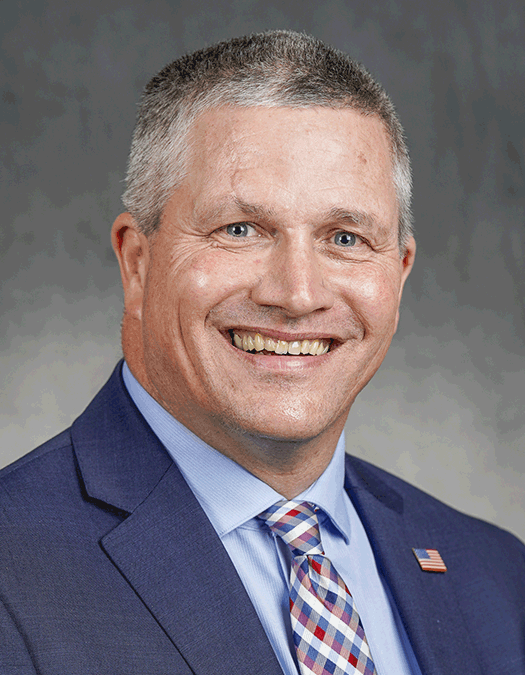
Rep. Jeff Dotseth
Sponsored bills
Maddy summaryHF 3604 modifies Minnesota's exemption rules for bulk deliveries of nonoxygenated gasoline. It requires that such deliveries (500 gallons or less) must be made directly into either: (1) the attached fuel tank of a vehicle listed as exempt under existing rules, or (2) a bulk tank on the premises. This bill affects fuel suppliers delivering nonoxygenated gasoline to exempt vehicles, such as classic cars or certain machinery. The key change clarifies where the fuel must be delivered, replacing previous ambiguous language with specific requirements. The bill is currently in committee for review.
Maddy summaryHF 400 requires Minnesota's Commissioner of Commerce to pay health insurance companies to offset costs when new state-mandated health benefits increase premiums for consumers. This applies to health plans sold in individual, small group, and large group markets. The Commissioner must make these payments within 60 days of receiving a cost statement from the company, using the federal process for cost calculation to ensure accurate measurements. The bill takes effect January 1, 2026, for all new mandated health benefit proposals enacted after that date.
Maddy summaryThis bill amends Minnesota's fishing regulations to allow anglers with a valid walleye stamp license to use two fishing lines in open water and four lines when fishing through the ice. It directly affects Minnesota anglers who purchase the walleye stamp, which is required for fishing for walleye in certain waters. The change modifies existing rules (Minnesota Statutes §97C.315) by expanding line limits specifically for these license holders, while other anglers remain restricted to one line in open water. The bill does not change general fishing rules for non-walleye stamp holders.
Maddy summaryHF 7 modifies multiple public safety laws in Minnesota. It requires law enforcement agencies to make bail/bond information public and mandates county attorneys to publicly report reasons for dismissing charges. The bill establishes mandatory minimum sentences for certain sex trafficking offenses and requires individuals subject to stays in sexual conduct cases to register as predatory offenders. It also increases penalties for assaulting police officers, obstructing highway/airport traffic, and expands law enforcement's use of tracking devices on fleeing vehicles. These changes apply directly to law enforcement agencies, prosecutors, and individuals involved in criminal cases.
Maddy summaryThis bill modifies Minnesota's "Read Act" to require literacy instruction based on "science of reading" research, emphasizing evidence-based methods like phonics and decoding while explicitly excluding the three-cueing system. It establishes a new Office of Achievement and Innovation within the Department of Education to support literacy implementation and creates a statewide school performance reporting system. The bill also allows school boards to opt out of complying with certain recently enacted state education laws or rules and authorizes fund transfers for education programs through fiscal year 2029. These changes directly affect all Minnesota public school districts, educators, and students by reshaping literacy instruction requirements and school accountability systems.
Maddy summaryHF 3758 prohibits state and local registrars from issuing replacement birth records that change the sex designation for minors under 18 years old, unless the original record contained an error. The bill amends Minnesota Statutes 144.218 and 144.2181 to require that sex changes on birth records for minors can only occur to correct an error in the original recording. This directly affects minors under 18 and their families seeking to update birth records, as registrars must deny requests to change the sex marker except in documented error cases. The law focuses on maintaining the sex designation from the original birth record for minors, with no exceptions for gender identity changes.
Maddy summaryHF 3759 prohibits most changes to the sex designation on birth records in Minnesota, requiring that replacement records match the sex originally recorded. It specifically prevents registrars from issuing new birth records showing a different sex unless the original record contained an error that needs correction. The bill amends Minnesota Statutes to clarify that sex changes are only permitted when the original entry was incorrect, not to align with a person's gender identity. This affects individuals seeking to update their birth records and state/local registrars responsible for processing such requests.
Maddy summaryHF 21 would require a three-fifths supermajority vote in both the Minnesota House and Senate to extend a peacetime emergency declaration beyond 14 days. Currently, such extensions beyond 14 days could be approved by the Executive Council, but this bill would shift that authority to the legislature. The bill directly affects governors seeking to prolong emergency powers and the legislative process for reviewing those requests. It does not change the initial 14-day emergency declaration period or the governor's authority to declare emergencies under existing criteria. Note: This bill was introduced but not passed during the 2025 legislative session.
Maddy summaryHF 2809 establishes a new crime for protesting directly in front of or about a person's home (excluding homes used as businesses). It makes this a misdemeanor, escalating to a gross misdemeanor if the person has a prior conviction under this law or ignores court orders like protection orders. The bill specifically allows peaceful protests about community meetings or assemblies held at locations commonly used for public discussion. This law applies to residential properties only and takes effect August 1, 2025.