

Maddy summaryHF 13 would amend Minnesota Statutes section 609.06 to eliminate the requirement that individuals must attempt to retreat before using reasonable force in self-defense or defense of others. The bill specifically removes the "duty to retreat" provision, allowing people to use force without first trying to avoid confrontation if they reasonably believe it is necessary. This change would directly affect Minnesotans using force to defend themselves or others in situations where they perceive an immediate threat. The bill was introduced but not passed, as it was laid on the table during the 2025 legislative session.
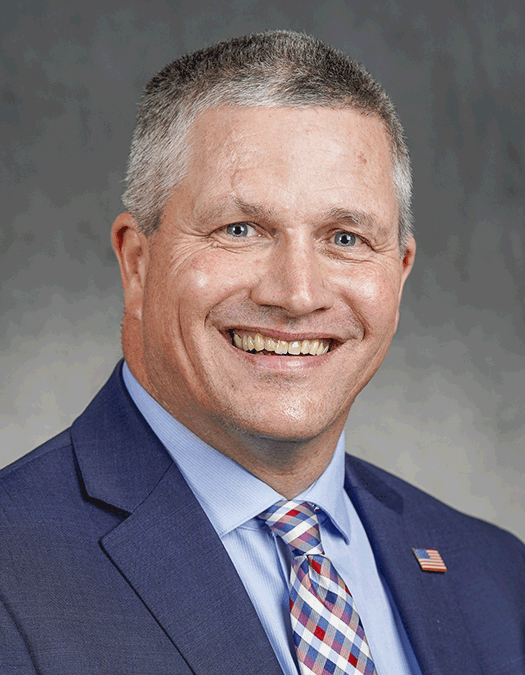
Rep. Jeff Dotseth
Sponsored bills
Maddy summaryThis bill extends funding availability for a grant designed to expand Minnesota's wild elk population and range, specifically benefiting the Fond du Lac Band of Lake Superior Chippewa. The legislation authorizes $2,300,000 for the first year to support elk reintroduction efforts, including moving elk from existing herds in northwest Minnesota to the Fond du Lac State Forest and Reservation area. Funds must be used for thorough planning with the Department of Natural Resources to develop capture and handling protocols, disease management strategies, and postrelease comanagement plans between state and Tribal authorities. The appropriation is a one-time funding allocation available until June 30, 2029.
Maddy summaryHF 100 would amend Minnesota tax law to allow taxpayers to subtract the full amount of their Social Security benefits from their state taxable income, removing previous limits. Currently, Minnesota caps this subtraction at $5,840 for joint filers, $4,560 for singles, and lower amounts for separate filers. The bill eliminates these maximums, meaning eligible taxpayers could deduct all their Social Security benefits without reduction. It directly affects Minnesota residents receiving Social Security income who file state tax returns. The change takes effect for taxable years beginning after December 31, 2024.
Maddy summaryThis bill creates a new crime called disruption of worship services in Minnesota, targeting individuals who enter religious buildings with the intent to disrupt scheduled services by committing a crime. The law defines a religious establishment as a building used for worship that is clearly marked with a sign or other identifier. First-time offenders face gross misdemeanor charges, while repeat offenders could be charged with a felony punishable by up to five years in prison or a fine of $10,000 or both. The provisions take effect on August 1, 2026, and apply only to crimes committed on or after that date.
Maddy summaryThis bill requires publicly funded state and local correctional facilities in Minnesota to check the immigration status of certain noncitizens and notify U.S. Immigration and Customs Enforcement when they are housed there. The law applies to individuals in pretrial confinement, those convicted of felonies, and people committed to mental health institutions, mandating that facility officers immediately report nationality, conviction details, commitment duration, citizenship country, and last entry information to federal immigration authorities. Additionally, the bill requires a one-time review of all felony inmates in public facilities by July 1, 2026, to identify any noncitizens and report their status to federal officials. This policy change directly affects correctional facilities, sheriffs, and county officials who manage public institutions, while requiring them to share specific inmate information with U.S. immigration officers.
Maddy summaryThis bill prohibits individuals convicted of a crime of violence from receiving Minnesota's major public assistance programs, including MFIP, medical assistance, food support, and MinnesotaCare. It achieves this by adding new disqualification clauses to existing state statutes that specifically target those with violent crime convictions, while maintaining eligibility rules for other offenses. The law applies to convictions under Minnesota law or equivalent statutes from other states or the federal government, and it removes a previous provision that allowed certain drug-related benefits to continue under specific conditions.
Maddy summaryHF 3562 modifies Minnesota's motor vehicle registration tax for passenger cars and hearses. It reduces the tax rate from 1.54-1.575% to 1.25-1.285% of a vehicle's manufacturer's suggested retail price (MSRP), depending on whether the vehicle was first registered in Minnesota before or on/after November 16, 2020. The tax amount decreases each year based on the vehicle's age (e.g., 100% of MSRP in year one, dropping to 10% in year ten), then becomes a flat $20 annually after the 10th year. This bill directly affects Minnesota vehicle owners paying registration fees for passenger cars and hearses, effective for registrations starting January 1, 2027.
Maddy summaryThis bill exempts Beltrami County from paying its usual 25% cost-share for state disaster assistance related to the severe storm event covered under Emergency Executive Order 25-06. It requires the commissioner of public safety to reimburse the county 100% of eligible costs instead of the standard partial reimbursement. The exemption applies retroactively from June 21, 2025, and directly affects only Beltrami County's disaster recovery funding.
Maddy summaryThis bill authorizes the Cloquet Area Fire District in Minnesota to collect a local sales tax of up to 0.5% in the cities of Cloquet and Scanlon, with voter approval required before implementation. The tax revenue would be used to fund the construction of a new ambulance and fire station, with up to $31 million available for the project and related bond debt service. The tax would expire after 20 years or once the project is fully funded, whichever comes first, and any remaining funds would go to the district's general fund.
Maddy summaryThis bill modifies Minnesota's Right to Try Act to allow patients with life-threatening or severely debilitating conditions to access individualized investigational treatments, such as gene therapies or neoantigen vaccines, that are tailored to their specific genetic profiles. It requires physicians to document that patients have explored all FDA-approved treatment options and have received a recommendation for the personalized therapy before providing informed consent. The legislation permits manufacturers to voluntarily offer these treatments without requiring them to make them available, allows patients to pay for manufacturing costs, and includes protections against liability for healthcare providers who follow the law's requirements.