

Maddy summaryHF 3598 requires larger Minnesota cities (home rule charter or statutory cities of the first, second, or third class) to accept electronic applications, certifications, and documentation for building projects covered by the State Building Code. The bill mandates that cities must use electronic methods like email, PDF files, and digital signatures instead of paper submissions for these projects. This modernizes documentation procedures without changing building safety standards or code requirements. The law takes effect on July 1, 2026, and directly affects city offices handling building permits and inspections.
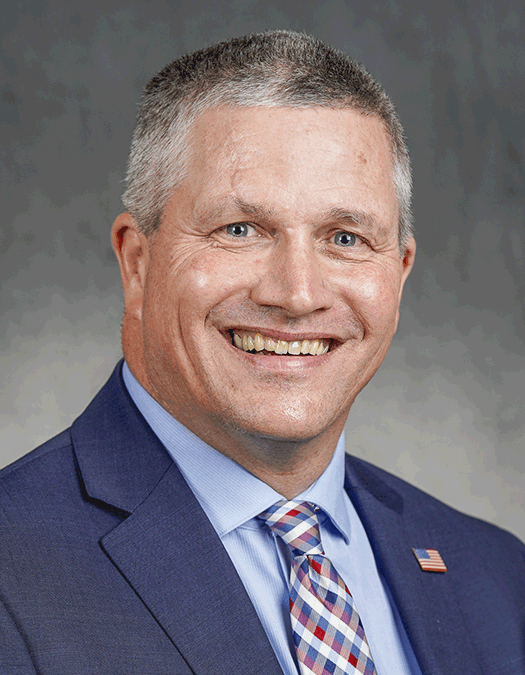
Rep. Jeff Dotseth
Sponsored bills
Maddy summaryHF 3545 repeals a requirement for Minnesota to adopt new residential energy codes with specific efficiency targets. It removes Section 326B.106, subdivision 1(g), which would have mandated the commissioner to adopt updated residential energy codes starting in 2026, aiming for a 70% reduction in energy use by 2038. This repeal eliminates the obligation to implement these incremental code changes and the associated reporting requirements for residential construction. The bill directly affects residential builders, developers, and local building officials who would have been required to comply with future energy code standards. The repeal does not impact existing energy codes or commercial energy code requirements.
Maddy summaryHF 3442 removes a licensing requirement for manufacturers selling scrap metal copper in Minnesota. The bill specifically excludes "manufacturers" (defined as persons who create products or affix their brand to products) from needing a $250 license to sell scrap copper, which applies to other sellers. This change modifies Minnesota Statutes section 325E.21, meaning manufacturers selling scrap copper from their production process no longer need to apply for or renew a license. The bill does not alter other licensing rules for non-manufacturer scrap dealers or the $250 fee structure.
Maddy summaryHF 2698 appropriates $20 million from state bond proceeds to fund a new wastewater filtration system at the Western Lake Superior Sanitary District's treatment facility in Duluth. The bill authorizes the state to issue bonds up to $20 million to cover this cost, with the funds provided as a grant to the sanitary district. This directly affects the Western Lake Superior Sanitary District and the residents of Duluth who rely on its wastewater services. The key mechanism is the bond issuance and appropriation specifically for constructing the new filtration system at the Duluth facility.
Maddy summaryHF 1066 increases annual funding for soil and water conservation districts in Minnesota. It amends state law to raise the annual appropriation from $15 million (for 2023-2024) to $20 million starting in 2025, paid from the general fund to the commissioner of revenue. This funding directly supports local soil and water conservation districts that provide technical assistance and cost-share programs for landowners. The bill takes effect for payments made in 2025 and subsequent years.
Maddy summaryHF 81 exempts off-highway vehicles, snowmobiles, and electric-assisted bicycles from Minnesota's PFAS (chemicals) restrictions that apply to juvenile products. The bill amends Minnesota Statutes § 116.943 by adding these vehicles to the list of items excluded from the definition of "juvenile product" (which otherwise covers items like cribs, strollers, and baby pillows). This means manufacturers of these vehicles are not subject to PFAS prohibitions that apply to other juvenile products. The change clarifies that PFAS rules for consumer goods do not extend to these specific recreational vehicles. The bill was referred to the Environment and Natural Resources Committee.
Maddy summaryHF 568 appropriates $6.5 million from state bonds to fund construction and renovation of education learning centers for two specific special education cooperatives in Minnesota: Northern Lights Special Education Cooperative No. 6096-52 and Area Special Education Cooperative No. 997. The funds will support centers housing regional programs for students with autism, cognitive disabilities, emotional/behavioral disorders, and other specific educational needs, including Level IV special education services. The money comes directly from state bond proceeds without requiring local matching funds. This bill provides concrete funding for physical infrastructure to expand specialized educational services for these student populations.
Maddy summaryHF 1052 modifies Minnesota's student discipline laws to protect younger students. It prohibits school dismissals (including suspensions) for preschool/pre-K programs and kindergarten through grade 3 students, limiting K-3 dismissals to no more than three school days. The bill requires schools to first use alternative disciplinary approaches and provide educational services before considering dismissal, and mandates districts to track student progress during any dismissal period. These changes apply to all Minnesota public schools and take effect July 1, 2025. The bill repeals outdated sections related to student discipline (121A.425 subd. 2 and 121A.611).
Maddy summaryHF 1014 allows the Minnesota Insurance Guarantee Association (MIGA) board to request financial information from insureds to verify if their net worth exceeds $25 million on December 31 of the prior year. This specifically affects insureds whose combined net worth (including subsidiaries) meets or surpasses this threshold, as claims from such insureds would otherwise be excluded from MIGA coverage. The bill requires MIGA to inform insureds of consequences for failing to provide requested financial details within 60 days, after which their net worth is automatically deemed above $25 million. The key mechanism streamlines MIGA’s ability to assess claim eligibility by verifying high-net-worth status through direct financial requests. This change amends Minnesota Statutes section 60C.09, subdivision 2.
Maddy summaryHF 200 appropriates $35 million in state funds for Minnesota towns' road and bridge maintenance, with $25 million specifically for roads and $10 million for bridges. The funds will come from bonds issued by the state under Minnesota law, to be distributed by the commissioner of transportation according to existing rules (Minnesota Statutes §162.081). This bill directly affects Minnesota towns needing infrastructure repairs by providing dedicated funding for local road and bridge projects. The bond sales and fund distribution follow established procedures outlined in Minnesota Statutes and the state constitution.