

Maddy summaryHF 1258 allows Minnesota school districts to form cooperation agreements to jointly operate and maintain ice arenas, sharing expenses across multiple districts. It amends state law to permit two or more districts to create formal agreements for apportioning costs and levies, requiring them to report these arrangements to the Department of Education. The bill also mandates that any district operating an ice arena must demonstrate equal access to ice time and team support for male and female athletes, particularly for girls' ice sports programs. This law takes effect for taxes payable in 2026 and later.
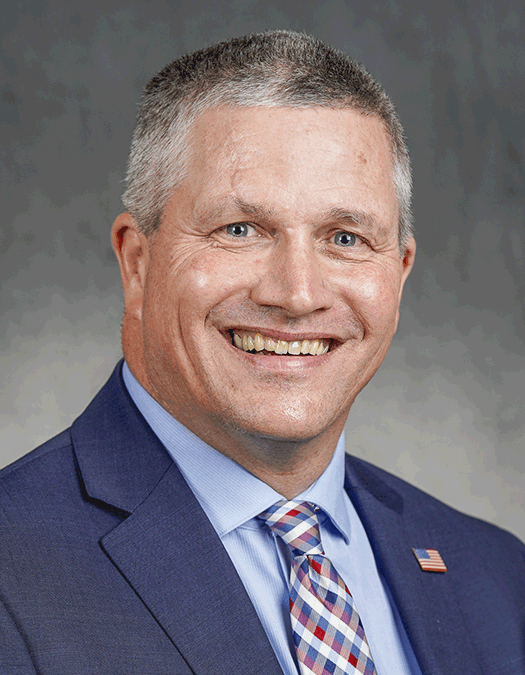
Rep. Jeff Dotseth
Sponsored bills
Maddy summaryHF 1548 authorizes housing and redevelopment authorities in Minnesota to establish local housing trust funds using dedicated public revenue. These funds, defined in the bill, would support housing initiatives like affordable housing development and tenant assistance. The legislation amends Minnesota Statutes section 462C.16 to clarify that local governments (including cities, counties, and authorities) can create such funds with dedicated revenue streams. This change expands options for communities to locally fund housing programs without requiring new state-level funding.
Maddy summaryHF 1661 appropriates $3.5 million from state bond proceeds to fund infrastructure improvements in Thomson township. The bill directly affects Thomson residents by providing funds for the design, construction, and equipment of replacements for aging water distribution systems, sanitary sewer infrastructure, and street reconstruction. Key provisions authorize the state to issue up to $3.5 million in bonds under Minnesota statutes to cover these costs, with the Public Facilities Authority administering the grant. This is a funding measure targeting specific physical infrastructure repairs in Thomson, not a broader policy change.
Maddy summaryHF 946 allows approved third-party programs (such as driving schools) to conduct the behind-the-wheel road test for class D driver's licenses (standard driver's licenses) in Minnesota. It establishes requirements for these programs and testers, mandates regular audits of third-party programs, and permits applicants to appeal decisions made by the Commissioner of Public Safety. The bill also updates website rules to show real-time appointment availability, display next available dates/times by location, and allow address-based searches without requiring personal information. This directly affects driver's license applicants and third-party testing programs seeking to administer road tests.
Maddy summaryHF 2 requires state agency employees to immediately report suspected fraud to law enforcement and legislative committee leaders when they have reason to believe fraud exists in agency programs. It mandates that all state agencies post current organizational charts online with contact details for leadership and division heads. The bill strengthens grant management by requiring agencies to conduct unannounced monitoring visits before final payments for grants over $50,000 (and annually for grants over $250,000), perform financial reconciliations prior to disbursement, and withhold funds from grantees failing to submit required progress reports. Violating these grant management requirements constitutes a misdemeanor under the bill.
Maddy summaryHF 768 prohibits Minnesota's Department of Human Rights from maintaining any database or collection of incidents involving protected speech. The bill amends Minnesota Statutes 363A.06 to explicitly state the department cannot collect or store data about protected speech - defined as speech protected under the U.S. or Minnesota Constitutions (including free speech, press, assembly, and association). This restriction applies directly to the Department of Human Rights' operations, preventing it from creating or using such databases for any purpose. The bill does not affect other data collection or reporting duties, such as the department's required biennial report on civil rights trends.
Maddy summaryHF 1331 requires the commissioner of natural resources to conduct an annual statewide survey to estimate Minnesota's wolf population. The survey must cover the entire state - not just historic wolf habitats - and be completed each year. This amendment to Minnesota Statutes section 97B.646 (wolf management) adds this requirement to the existing framework, which already includes a wolf management plan and quarterly mortality reporting. The bill directly affects state wildlife management practices under the Department of Natural Resources.
Maddy summaryHF 1067 modifies Minnesota's housing tax credit program to allow exceptions to income limits for specific workforce housing projects and adjusts matching requirements for the workforce housing development program. The bill amends statutes to permit higher-income projects (above standard limits) to qualify for tax credit grants and loans, while also revising the 1:2 local matching requirement to allow project-specific tax credit contributions to count toward the match. This primarily affects developers of workforce housing projects seeking state funding under the Minnesota Housing Finance Agency's programs. The changes aim to increase housing options for working residents by expanding eligibility and simplifying funding requirements.
Maddy summaryHF 271 appropriates funding from the general fund for compensation payments to Minnesota farmers and ranchers who suffer livestock losses or property damage from wolves or elk. Specifically, it allocates money for fiscal years 2026 and 2027 to cover livestock destroyed by wolves (under Minn. Stat. § 3.737) and crop or fence damage caused by elk (under Minn. Stat. § 3.7371). The bill includes a provision allowing up to $5,000 annually to reimburse university extension agents for determining fair market values of damaged livestock. If claims exceed expected levels, funds can be shifted between the wolf and elk programs to ensure payments remain available.
Maddy summaryHF 767 increases penalties for arson committed against political organizations or motivated by political reasons. It amends Minnesota Statutes 609.561, 609.563, 609.5631, and 609.5632 to add specific circumstances that elevate penalties. For example, arson targeting a building housing a political organization (under §609.561) carries a maximum 25-year prison sentence, while lesser offenses with political motivation face enhanced fines and jail terms. The law applies to crimes committed on or after August 1, 2025, and directly affects individuals who commit arson against political organizations or for political statements.