

Maddy summaryHF 1253 modifies Minnesota's absentee ballot procedures for certain voters. It shortens the timeline for mailing absentee ballots from 46 days to 28 days before elections (Minnesota Statutes 2024, § 203B.06, subd. 3) and moves the deadline for returning ballots from 8:00 p.m. to 3:00 p.m. on election day (§ 203B.08, subd. 1). The bill also prohibits correctional facilities from receiving absentee ballots, requiring county auditors to reject applications with correctional facility addresses (§ 203B.06, subd. 2). These changes directly affect absentee voters, election officials managing ballot distribution, and correctional facilities.
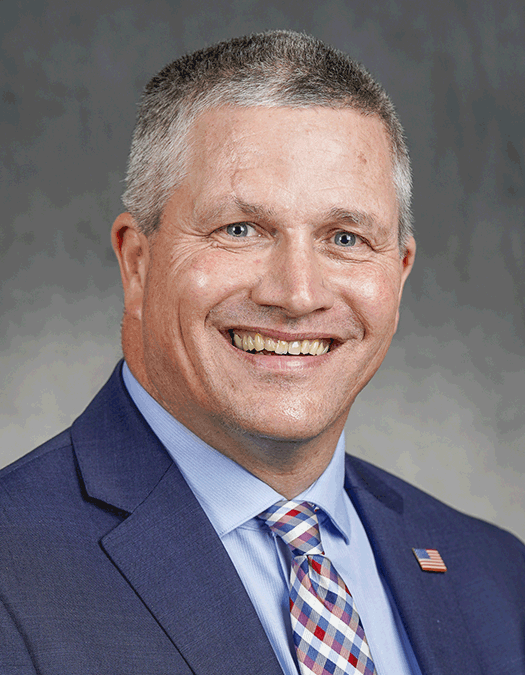
Rep. Jeff Dotseth
Sponsored bills
Maddy summaryHF 2119, the Minnesota Elections Integrity Act, requires voters to present photo ID when registering to vote and when casting ballots at polling places. It establishes a free voter identification card program (with no fees for those needing it for voting) and creates provisional ballots for voters who lack ID but can verify their identity. The bill also mandates ID checks for people assisting voters or acting as agents for absentee ballots, increases criminal penalties for election fraud, and adds reporting requirements for election officials. These changes directly affect all Minnesota voters participating in elections, particularly those who previously used non-photo ID or lacked a current photo ID.
Maddy summaryHF 2069 creates new Minnesota license plates specifically for veterans of each U.S. military branch (Army, Navy, Air Force, Marines, Coast Guard, and Merchant Marine). Eligible veterans who meet existing criteria (including having discharge papers) can apply for a free plate featuring "VETERAN" and their branch's emblem. The plates must be the same size as standard plates for the vehicle type (e.g., motorcycle) and can be transferred to another vehicle owned by the same veteran for a $5 fee. This bill, effective January 1, 2026, expands Minnesota’s existing veterans' plate program by adding branch-specific designs.
Maddy summaryHF 11 delays the implementation of Minnesota's Paid Leave Law from 2026 to 2027, affecting employers, employees, and state agencies responsible for administering the program. The bill amends multiple statute sections to adjust key dates, including the start of employer premium payments (now January 1, 2027) and administrative requirements like public outreach and annual reporting. This one-year delay provides additional time for businesses to prepare for the new paid leave program without changing the law's core requirements. The law's substance - such as premium rates and fund management - remains unchanged, only the rollout timeline is extended.
Maddy summaryHF 1241 repeals Minnesota's Paid Leave Law, which previously provided state-funded family and medical leave benefits. The bill transfers any unspent funds from the family medical leave account to the general state fund, effective July 1, 2025. It specifically repeals all provisions of Minnesota Statutes 2024, sections 268B.001 through 268B.30, which governed the paid leave program. This action eliminates the state's paid leave law and redirects unused program funds to the general state budget.
Maddy summaryHF 3 requires Minnesota's legislative auditor to annually report to the legislature by February 1 on whether state agencies have implemented audit recommendations from the prior five years. The bill mandates that agencies' commissioners must also submit detailed reports by September 1 each year, specifically itemizing unaddressed recommendations and explaining why they weren't implemented. This directly affects all state agencies subject to legislative auditor reviews and their commissioners, who must now document progress on audit findings. The law creates a structured process for tracking accountability without altering agency funding or creating new programs.
Maddy summaryHF 1277 modifies Minnesota's sales and use tax exemption for data centers, providing a tax break on purchases of qualifying equipment and software. It creates three categories of qualifying data centers (standard, refurbished, and large-scale) with specific size, investment, and operational requirements - such as a minimum 25,000 square feet, $30 million in investments within 48 months, and features like backup power and security systems. The bill requires tax to be collected at standard rates but refunded later, applying to equipment like servers, cooling systems, and power infrastructure used in these facilities. This directly benefits data center operators investing in Minnesota facilities that meet the defined thresholds.
Maddy summaryThis bill appropriates $238,000 for fiscal year 2026 and $238,000 for fiscal year 2027 from the workforce development fund to support the Minnesota Helmets to Hardhats program. The funds will help Building Strong Communities connect National Guard members, military reservists, active duty personnel, and veterans to construction industry apprenticeships and career training through the Department of Labor and Industry. The program must not discriminate based on protected characteristics like race, religion, or gender. It directly affects military-connected individuals seeking careers in building and construction trades.
Maddy summaryHF 1922 requires Minnesota's commissioner of natural resources to submit a report by December 1, 2026, analyzing the state's payment in lieu of taxes (PILT) system for natural resource lands. The report must examine current payment rates, whether payments adequately compensate local governments for lost tax revenue (compared to private land ownership), and the funding impact of acquiring additional land. It directly affects local governments that rely on PILT payments to offset revenue loss from natural resource lands. The report will inform potential changes to Minnesota Statutes sections 477A.11-477A.14, which govern PILT payments. This is a procedural bill focused on analysis, not immediate policy change.
Maddy summaryHF 17 amends Minnesota's handgun permit law to create lifetime permits for carrying concealed handguns, replacing the previous temporary permits. It also reduces the application fee for these permits, capping it at $100 or the actual processing cost (whichever is lower), with $10 of each fee deposited into the general fund. The bill maintains existing requirements, including proof of firearm safety training (via certified courses or peace officer employment) and in-person application submissions with specific documents like training certificates and photo ID. This directly affects Minnesotans seeking or renewing concealed carry permits, streamlining the process by eliminating renewal fees and duration limits.