

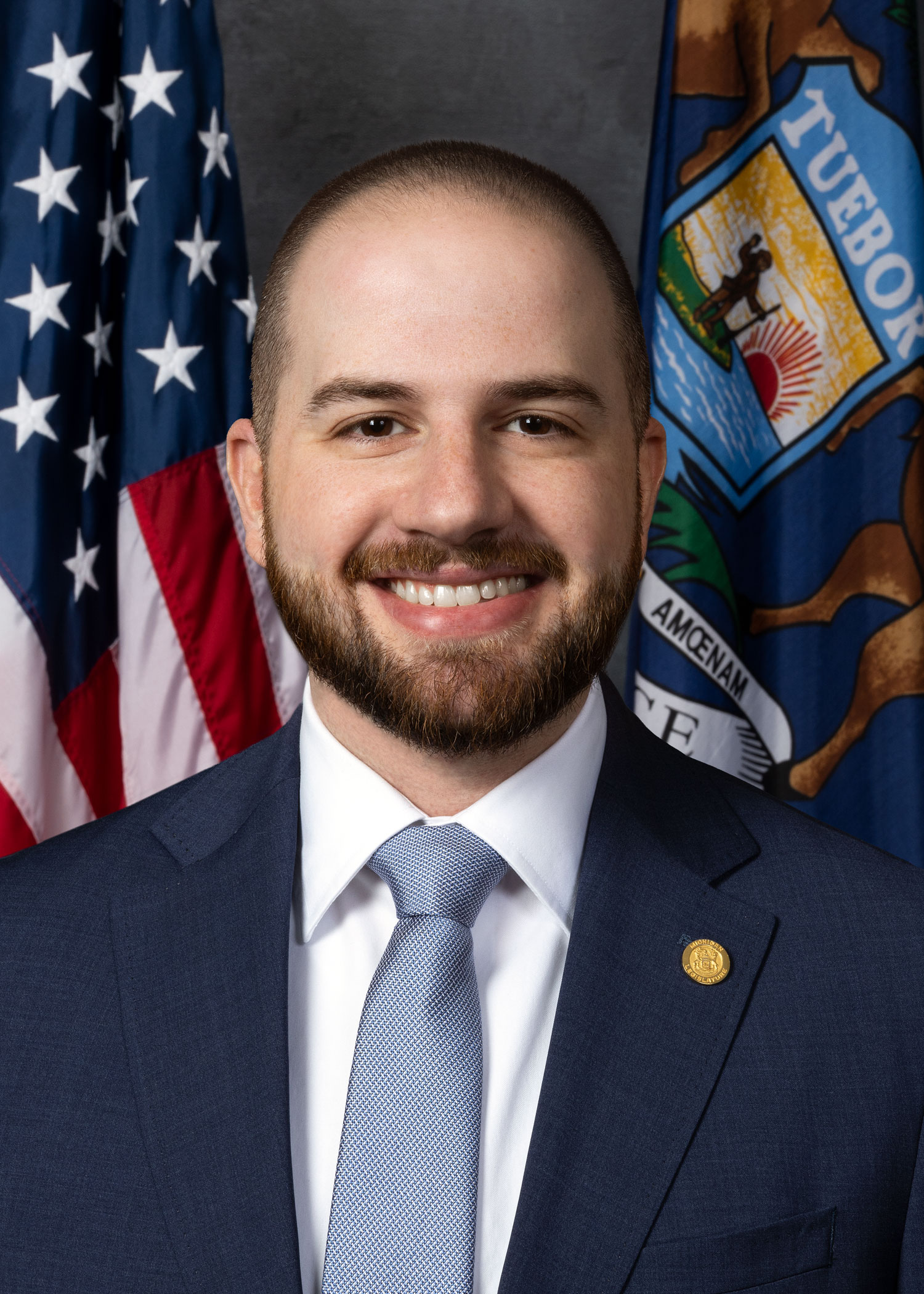
Photo of Jeremy Moss
D Michigan Senate · District 7

Sen. Jeremy Moss

Compare
Total votes
4,165
all sessions
Attendance
100%
7 missed
Near the chamber average
With party
98%
of cast votes
Near the chamber average
Bipartisan score
1%
crosses aisle rarely
Near the chamber average
Sponsored
1,745
bills & resolutions
Near the chamber average
Committees
6
assignments
1,745 bills and resolutions

Sponsored bills

Total
1,745
Primary
124
Co-sponsor
1,621
This page
1,745
matching current filters
Co-sponsor SB 51
Passed · Michigan Senate · Co-sponsor
State agencies (proposed): boards and commissions; Black leadership advisory council; establish. Creates new act.

Maddy summarySB 51 establishes the Black Leadership Advisory Council to address racial inequity in Michigan. The council, composed of 15 governor-appointed members (including representation from specific fields like health and education, an immigrant expert, and a member aged 18-35), must develop policies to eliminate discrimination in areas like housing, employment, and healthcare. It is required to identify discriminatory state laws, collaborate with the governor on equitable legislation, and submit annual reports. The council operates independently but receives department staff support, with no compensation for members beyond expense reimbursement.

Passed Mar 19, 2025 1 co-sponsor
Co-sponsor SB 88
Passed · Michigan Senate · Co-sponsor
Liquor: other; payment of administrative fee to wholesaler for a payment dishonored by a financial institution; require. Amends sec. 903b of 1998 PA 58 (MCL 436.1903b).

Maddy summarySB 88 requires liquor retailers to pay administrative fees to wholesalers when payments are bounced due to insufficient funds. It directly affects liquor retailers who make dishonored payments and wholesalers who collect these fees. The bill establishes a progressive fee structure: $50 for the first bounced payment, increasing to $250 for the fifth or subsequent bounced payments within a 12-month period. Wholesalers must charge these fees for each bounced payment, with higher fees applying for repeated offenses within the same 12-month window. This changes the existing law by adding specific fee amounts and requiring wholesalers to enforce them.

Passed Mar 12, 2025 1 co-sponsor
Co-sponsor SB 87
Passed · Michigan Senate · Co-sponsor
Liquor: liquor control commission; suspension of retailer license for dishonored payments under certain conditions; provide for. Amends 1998 PA 58 (MCL 436.1101 - 436.2303) by adding sec. 804.

Maddy summarySB 87 amends Michigan's liquor control code to require the Liquor Control Commission to suspend a liquor retailer's license for 14 days if the retailer has six or more payments to a wholesaler dishonored by a bank (due to insufficient funds) on different dates within 12 consecutive months. This directly affects licensed liquor retailers who repeatedly fail to cover payments to wholesalers. The key provision establishes a clear, automatic suspension trigger based on the frequency of bounced payments. The bill creates a specific enforcement mechanism to address payment issues between retailers and wholesalers under the existing code.

Passed Mar 12, 2025 1 co-sponsor
Co-sponsor SB 101
In committee · Michigan Senate · Co-sponsor
Public employees and officers: ethics; definition of gift; modify. Amends secs. 3 & 4 of 1978 PA 472 (MCL 4.413 & 4.414) & adds sec. 8a.

Maddy summarySB 101 amends Michigan's ethics law to clarify what constitutes a "gift" to public officials, directly affecting lobbyists and those interacting with government employees. It defines a gift as anything exceeding $25 in value within a month (adjusted annually) unless equal value is received, while listing specific exclusions like campaign contributions, family gifts, or charity event tickets. The bill adds Section 8a, requiring lobbyists to determine fair market value using primary/secondary market prices and provide evidence within 9 days if requested. These changes aim to standardize gift reporting and prevent misuse of the ethics rules.

In committee Mar 5, 2025 1 co-sponsor
Co-sponsor SR 10
Passed · Michigan Senate · Co-sponsor
A resolution to recognize February 2025 as Black History Month.

Maddy summaryThis is a symbolic resolution (not a law) introduced by Senator Santana to formally recognize February 2025 as Black History Month in Michigan. It does not create new policies or affect specific groups; instead, it affirms the legislature's support for the annual observance of Black History Month. The resolution cites historical context, honors African-American contributions, and encourages public awareness of both achievements and ongoing efforts toward racial equality. It was introduced and adopted by the Senate on February 12-13, 2025, with no further legislative action required.

Passed Feb 13, 2025 1 co-sponsor
Co-sponsor SR 6
Passed · Michigan Senate · Co-sponsor
A resolution condemning the attack on the United States Capitol on January 6, 2021, including the assault on the courageous members of the Capitol Police, and denouncing the use of presidential pardon power to absolve those who participated in the dangerous and anti-democratic riots.

Maddy summaryThis Senate resolution (SR 6) formally condemns the January 6, 2021, Capitol attack and specifically denounces President Trump's 2025 pardons of 1,500 individuals involved in the riots, including those convicted of assaulting police officers. It highlights the 140+ law enforcement injuries sustained during the attack and cites police unions' criticism of the pardons as undermining accountability. The resolution serves as a symbolic statement expressing disapproval to federal leaders, not a policy change. It directly addresses the federal executive branch's use of pardon power regarding Capitol riot participants.

Passed Jan 30, 2025 1 co-sponsor
Co-sponsor SR 5
Passed · Michigan Senate · Co-sponsor
A resolution to recognize January 2025 as Muslim American Heritage Month.

Maddy summaryThis Senate Resolution (SR 5) symbolically recognizes January 2025 as "Muslim American Heritage Month" in Michigan. It does not create new laws or affect any individuals or policies; instead, it formally acknowledges the contributions of Michigan's Muslim American community (approximately 273,734 residents) to the state's cultural, economic, and social life. The resolution highlights their diverse heritage and roles in fields like STEM, business, and community leadership, particularly in cities like Dearborn and Detroit. It encourages Michiganders to learn about and celebrate this community's history and achievements. The resolution was introduced and adopted by the Senate on January 30, 2025.

Passed Jan 30, 2025 1 co-sponsor
Co-sponsor SR 3
Passed · Michigan Senate · Co-sponsor
A resolution to authorize the Senate Majority Leader to commence legal action, on behalf of the Senate, to compel the House of Representatives to fulfill its constitutional duty to present to the Governor the nine remaining bills passed by both houses during the One Hundred Second Legislature.

Maddy summaryThis resolution (SR 3) authorizes the Senate Majority Leader to take legal action against the House of Representatives to compel it to present nine specific bills to the Governor. The bills - passed by both chambers during the 2023-2024 legislative session - were returned to the House on December 20, 2024, but the House has refused to present them to the Governor despite a constitutional requirement under Michigan’s Article IV, Section 33. The Senate seeks to enforce this duty through court action, targeting House Bills 4177 and 4665-4667 (2023) and 4900-4901, 5817-5818, and 6058 (2024). The resolution focuses solely on procedural compliance, not policy content.

Passed Jan 22, 2025 1 co-sponsor
Co-sponsor SB 207
Signed into law · Michigan Senate · Co-sponsor
Civil rights: housing discrimination; housing discrimination based on source of income; prohibit. Amends sec. 502 of 1976 PA 453 (MCL 37.2502).

Maddy summaryThis bill amends Michigan's Elliott-Larsen Civil Rights Act to explicitly prohibit housing discrimination based on a person's source of income. It directly affects landlords, real estate brokers, and anyone involved in property transactions by banning them from refusing to rent or sell homes to individuals using government assistance, veterans benefits, Social Security, or other legal income sources. The law clarifies that these protections apply to all forms of discrimination, including refusing to negotiate, making false claims about property availability, or publishing advertisements that exclude people based on how they pay rent. By adding "source of income" to the list of protected categories, the legislation ensures that housing opportunities cannot be denied solely because a tenant relies on subsidies or retirement funds.

Signed into law Dec 31, 2024 1 co-sponsor
Showing 201 to 210 of 1,745 bills
Previous 1 … 20 21 22 … 175 Next