

Maddy summaryThis resolution symbolically designates March 9-15, 2025, as Multiple Sclerosis Awareness Week in Michigan. It recognizes the impact of multiple sclerosis on Michiganders (affecting nearly 1 million people nationwide) and encourages public awareness and support for those living with the disease. The resolution does not create new policies or allocate funds - it is a formal declaration by the Michigan House to highlight the work of the National MS Society and its local support groups.
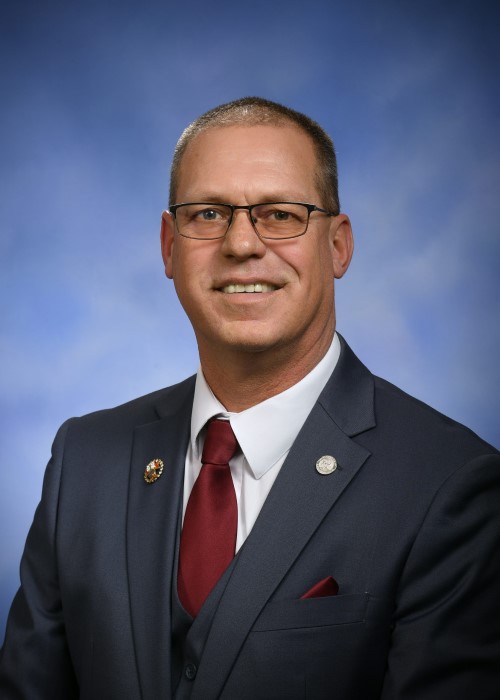
Rep. Greg Alexander
Sponsored bills
Maddy summaryHB 4176 amends Michigan's Natural Resources and Environmental Protection Act (MCL 324.73102) to allow property owners to use purple paint marks as a legal alternative to posted signs for marking "no trespassing" areas. Specifically, it requires purple paint marks to be vertical lines 8 inches long, placed 3-5 feet high on trees or posts, spaced no more than 100 feet apart, and visible from all approaches. This change directly affects property owners who can now use this method to legally prohibit recreational activities or trapping on their land without physical signs. The bill does not alter existing exceptions for farm property, fishing, or retrieving lost dogs, and it requires companion bill HB 4177 to also pass for full implementation.
Maddy summaryHB 4177 amends Michigan's Natural Resources and Environmental Protection Act to strengthen rules about purple paint marks used to indicate no-trespassing areas for recreation. It prohibits removing, defacing, or destroying existing purple paint marks (Sec. 73104) and bans placing new marks on others' property without written permission from the owner, lessee, or agent (Sec. 73105). The bill directly affects property owners, recreational users (like hunters or anglers), and land managers who use these marks to restrict access. It creates a clear legal requirement for written authorization before marking private property, ensuring property rights are respected during recreational activities.
Maddy summaryHB 4188 amends Michigan's Vehicle Code to clarify that operating a vehicle "in a careless or negligent manner likely to endanger any person or property, but without wantonness or recklessness" would be classified as a civil infraction. This change directly affects drivers whose behavior meets this specific standard - non-reckless, careless driving - by treating it as a civil matter rather than a criminal offense. The bill modifies Section 626b of the Michigan Vehicle Code (MCL 257.626b) to explicitly exclude cases involving "wantonness or recklessness," which would remain subject to more severe penalties. The amendment is procedural and aims to refine the legal definition of the infraction. The bill was introduced on March 6, 2025, and referred to the Judiciary Committee.
Maddy summaryHB 4169 creates a Rare Disease Advisory Council within Michigan's Department of Health to advise on research, diagnosis, and treatment of rare diseases. The council, composed of 12-18 members including physicians, patients, caregivers, insurers, researchers, and industry representatives, must identify policy priorities to improve access to care and reduce discrimination for individuals with rare diseases (defined as affecting fewer than 200,000 people in the U.S.). Key duties include researching cost-effective treatments, sharing best practices from other states, and developing a public webpage with rare disease resources by March 2026. The bill establishes a formal advisory body but does not change existing laws or funding.
Maddy summaryHR 37 is a symbolic resolution passed by the Michigan House of Representatives to officially recognize March 2025 as Women’s History Month within the state. It does not create new laws or policies but formally declares the month to honor women’s historical contributions to Michigan and the nation. The resolution encourages community participation in events celebrating women’s achievements in fields like science, politics, and education. It directly affects Michigan residents by promoting statewide awareness and reflection on women’s roles in society, without imposing any legal requirements or funding changes.
Maddy summaryHB 4164 adds new definitions to Michigan's military law to clarify when the Michigan National Guard can be deployed into active combat. It defines "active duty combat" as participating in armed conflict, hazardous service related to conflict abroad, or war-related duties, and specifies that an "official declaration of war" requires a formal act by the U.S. Congress under the Constitution. This bill directly affects Michigan National Guard deployments by requiring state officials to confirm Congress has declared war before sending troops into combat roles. The definitions would guide state officials in determining whether a deployment complies with the law, preventing unilateral state decisions for combat missions.
Maddy summaryThis resolution symbolically designates March 2025 as Athletic Trainer Month in Michigan to recognize the work of licensed athletic trainers. It directly affects over 1,700 athletic trainers in Michigan who provide healthcare services like injury prevention, rehabilitation, and clinical evaluation under physician collaboration. The resolution aims to raise public awareness of the profession's role in healthcare across settings like schools, hospitals, and sports organizations. As a commemorative resolution, it does not create new laws or funding but honors the profession's contributions.
Maddy summaryThis resolution declares March 2025 as Agriculture Appreciation Month in Michigan. It encourages all citizens to recognize the state's agricultural sector, which contributes over $125 billion annually to Michigan's economy and supports 805,000 jobs. The resolution is purely ceremonial and does not create new laws, funding, or policy changes.
Maddy summaryThis resolution urges Congress to freeze the Adverse Effect Wage Rate (AEWR) for H-2A agricultural workers at the 2023 level ($15.10/hour) through 2025. It directly affects Michigan farmers who rely on the H-2A program, as the current 2025 AEWR in Michigan is $18.15/hour - a 34% increase since 2019. The resolution seeks to prevent further wage hikes for temporary farm workers, aiming to reduce rising labor costs amid broader farm expense increases. It does not change existing law but calls on Congress to pass legislation implementing this freeze.