

Maddy summaryHB 4186 increases Michigan's business income tax rate from 4.95% to 30% for all business activity occurring on or after January 1, 2025. This rate change directly affects businesses operating within Michigan that are subject to the state's business tax, including those previously filing under the corporate income tax act. The bill amends sections 201 and 500 of the Michigan Business Tax Act (2007 PA 36) to implement this rate increase and adjust the tax base calculations for businesses. The change represents a significant policy shift in how Michigan taxes business income, effective in 2025.
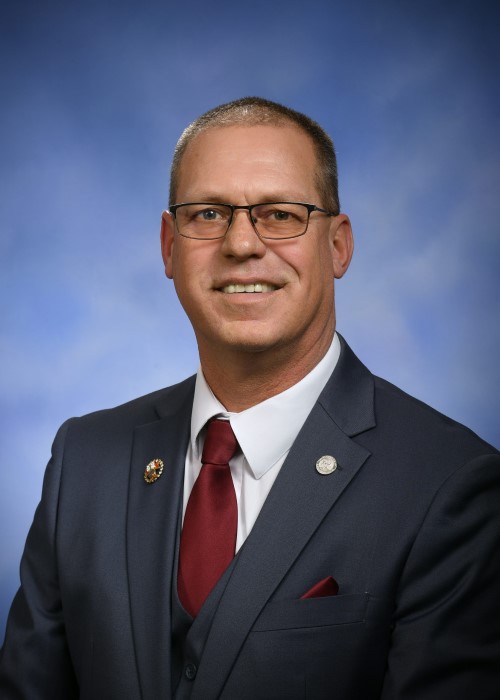
Rep. Greg Alexander
Sponsored bills
Maddy summaryHB 4286 requires Michigan public schools to update health education curriculum standards by the 2026-2027 school year. It mandates specific content about human development, including an overview of pregnancy biology, fetal development inside the uterus, a 3-minute high-definition ultrasound video of early fetal organ development, and a computer-generated animation showing fertilization through birth. The bill directly affects Michigan public schools and the state Department of Education, which must revise curriculum standards to include these requirements. This is a concrete policy change to the health education curriculum, not a procedural or commemorative measure.
Maddy summaryHB 4278 designates the state of Michigan as the "Purple Heart State" to symbolically honor military service members wounded or killed while serving in the U.S. Armed Forces. It does not create new laws or affect any policies, programs, or individuals through concrete action - it is purely a symbolic gesture expressing gratitude. The bill’s sole mechanism is renaming the state for this purpose, as stated in its text: "This state is designated as a purple heart state to express gratitude and respect." The bill was introduced on March 20, 2025, and referred to committee, with no further action taken.
Maddy summaryHB 4266 amends Michigan's Consumer Protection Act to add Section 3p, targeting deceptive practices in third-party ticket sales. It requires sellers offering prizes (e.g., "free tickets") as incentives to purchase tickets to provide clear, written disclosures in bold 10-point font before the sale. These disclosures must include the prize's cash value, full terms, and a statement that a sales presentation is required to claim it. The law directly affects third-party ticket sellers (like resellers) and protects consumers from being misled into attending sales pitches under false promises of free offers. This is a specific policy change to prevent deceptive sales tactics, not a broader ticket pricing rule.
Maddy summaryHJR G is a proposed constitutional amendment (not a law) that seeks to remove three education governance bodies from Michigan's state constitution. It would eliminate the state board of education, the superintendent of public instruction, and the state board for public community/junior colleges by amending Article VIII, Sections 3 and 7. If approved by voters, these positions and boards would be abolished, shifting oversight of public education away from state-level governance. This is a procedural constitutional change requiring voter approval at the next general election.
Maddy summaryHB 4237 prohibits Michigan local governments (like cities, counties, and school districts) from awarding or renewing contracts that give contractors access to personal data if the contractor is a "controlled entity" tied to specific foreign countries of concern (China, Russia, Iran, North Korea, Cuba, Venezuela, or Syria). It requires contractors to submit sworn affidavits confirming they are not controlled entities, with violations subject to fines up to twice the contract value or a 5-year contract ban. The bill also restricts local governments from using information technology or services designed, developed, or supplied by companies owned by those foreign countries, aligning with federal security lists. These rules take effect July 1, 2026, for contract renewals and extensions.
Maddy summaryHB 4236 amends Michigan's state contracting rules to limit foreign influence in projects involving personal data. It directly affects state contractors working on facilities (like buildings or infrastructure) where personal identifying information is handled. The bill requires contractors to provide a sworn affidavit confirming they are not "controlled entities" tied to specific foreign governments (including China, Russia, Iran, and others). Starting July 1, 2025, the state cannot renew or extend such contracts without this verification.
Maddy summaryHR 40 is a non-binding resolution urging the Michigan High School Athletic Association (MHSAA) to update its eligibility rules for female athletes to comply with Executive Order 14201. The resolution states that MHSAA’s current rules, which allow biological males to compete in women’s sports, conflict with the federal executive order prioritizing female-only competition. It argues this noncompliance risks jeopardizing federal funding for Michigan school districts and compromises the safety and fairness of women’s athletic competitions. The resolution was adopted by the Michigan House with 66 yeas, 43 nays, and 1 excused vote on March 12, 2025.
Maddy summaryHB 4032 permanently extends Michigan's participation in the Interstate Medical Licensure Compact by removing a scheduled expiration date (sunset) from the law. This change directly affects physicians in Michigan who use the compact to practice medicine across state lines, as it eliminates the need for periodic legislative renewal. The bill's key provision amends Michigan's Public Health Code to make the compact's terms permanent, ensuring uninterrupted eligibility for physicians seeking multi-state licensure. The compact allows doctors to obtain licenses in multiple participating states more efficiently, reducing administrative barriers for cross-state medical practice.
Maddy summaryThis resolution (HR 38) designates March 11, 2025, as "Community Volunteer Day" in Michigan to recognize local volunteers who support community well-being. It specifically acknowledges volunteers assisting families with children who have lost parents, providing guidance, stability, and financial aid. The resolution does not create new policies or funding but formally honors these volunteer efforts through a designated day of appreciation. It was introduced and adopted by the Michigan House on March 11, 2025.