

Maddy summaryHB 4915 prohibits Michigan health licensing boards from requiring implicit bias training as a condition for obtaining or renewing a health professional license (such as for nurses, doctors, or therapists). It directly affects licensed health professionals who would otherwise need to complete such training to maintain their credentials. The bill achieves this by adding a new section to the Public Health Code that blocks the department or boards from enforcing rules mandating this training, while also rescinding an existing administrative code section (MCL 338.7004) related to the requirement. This is a concrete policy change removing a potential licensure condition, not a new mandate.
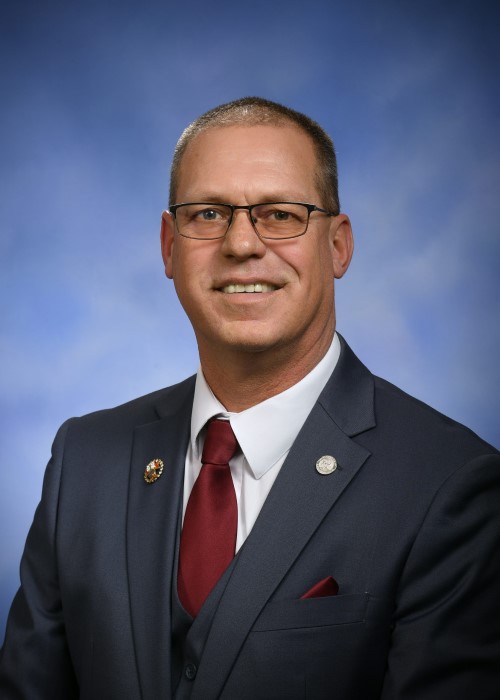
Rep. Greg Alexander
Sponsored bills
Maddy summaryHB 4882 repeals a 1964 law (1964 PA 158) that required potato dealers in Michigan to obtain a license. This bill eliminates the licensing requirement and associated provisions for potato dealers by removing the repealed statute (MCL 290.451-290.466). The repeal affects no current entities, as the law being removed was outdated and no longer enforced. No new rules or requirements are created by this bill.
Maddy summaryThis resolution symbolically recognizes December 13, 2025, as "National Wreaths Across America Day" in Michigan. It does not create new laws or policies but formally honors Michigan's participation in the non-profit Wreaths Across America's annual event, where volunteers place wreaths on veterans' graves. The resolution acknowledges that Michigan will host 96 locations across the state, with approximately 60,000 wreaths laid to honor fallen veterans, active-duty military, and their families. It serves as a ceremonial declaration of the state's support for this existing national observance.
Maddy summaryHB 4822 requires the Natural Resources Commission to live stream all its meetings publicly online. This bill amends Michigan's natural resources law (MCL 324.501) to mandate real-time video streaming of Commission sessions. The change directly affects the Commission's operations and ensures public access to its proceedings without requiring physical attendance. The bill is currently pending in committee review after being referred for second reading.
Maddy summaryHB 5201 requires healthcare professionals performing abortions in Michigan to submit detailed, anonymized reports to the state health department within 7 days. The reports must include specific data points like patient age, gestation period, reason for the abortion (e.g., health risks, rape, economic factors), facility details, and medical method, but exclude all personal identifiers. Strict confidentiality rules prohibit disclosing any information that could identify individuals or facilities, with reports destroyed after 5 years and only aggregated statistical data published annually. This policy applies directly to abortion providers and the state health department, focusing solely on data collection for public health monitoring, not individual records or enforcement.
Maddy summaryHB 5203 amends Michigan's sentencing guidelines (MCL 777.13k) to establish specific penalties for disclosing private medical information related to abortions. It directly affects healthcare providers, clinics, or others who share confidential abortion-related details without authorization. The bill creates new sentencing parameters for such disclosures within the criminal code, requiring judges to consider these guidelines when determining penalties. The legislation is currently under review by the Health Policy Committee after its November 2025 introduction.
Maddy summaryHB 5202 requires healthcare professionals to submit written reports to Michigan's Department of Health for any patient experiencing a physical complication or death directly linked to an abortion. The reports must be anonymized (removing patient identifiers), aggregated into the state's annual abortion statistics, and destroyed after five years. The bill mandates the department to create a standardized reporting form for urgent care facilities and emergency departments, which must be distributed and posted online. This bill, tied to companion legislation HB 5201, focuses solely on data collection requirements without changing abortion access or medical standards.
Maddy summaryHB 5304 requires applicants for dredging permits under Michigan's environmental law to either use dredged material for beach nourishment (if suitable) or pay a $25 per cubic yard fee. The fee funds a new Beach Nourishment Fund administered by the Department of Environment, Great Lakes, and Energy. This applies to projects under Parts 301, 303, and 325 of Michigan's Natural Resources and Environmental Protection Act. The bill amends sections 30106b, 30311b, and 32515a and adds sections 1306 (fee requirements) and 33709 (fund creation).
Maddy summaryHB 4301 expands Michigan's definition of "authorized emergency vehicle" in the Vehicle Code (MCL 257.2 and 257.698) to include specific new categories. It adds vehicles owned by the Michigan Mutual Aid Box Alarm System during emergencies, clarifies that road service vehicles (like tow trucks) may use flashing amber lights while assisting disabled vehicles, and allows federally recognized nonprofits to use emergency lights during disaster response. The bill also clarifies when certain colored lights (red, blue, amber, green) may be used on emergency vehicles, including for snow removal, spill response, and funeral processions. This directly affects emergency responders, road service providers, and nonprofit organizations during crisis operations.
Maddy summaryHB 4302 creates an exception to Michigan's commercial driver license (CDL) requirements for authorized emergency vehicles operated by the Michigan Mutual Aid Box Alarm System. This means drivers operating these specific emergency vehicles do not need to obtain the standard CDL or related endorsements required for commercial vehicles. The bill amends Michigan's Vehicle Code (MCL 257.312e) to explicitly exempt these vehicles from the general CDL rules. The exception directly affects personnel operating emergency vehicles under the Michigan Mutual Aid Box Alarm System, allowing them to operate without meeting standard CDL qualifications.