

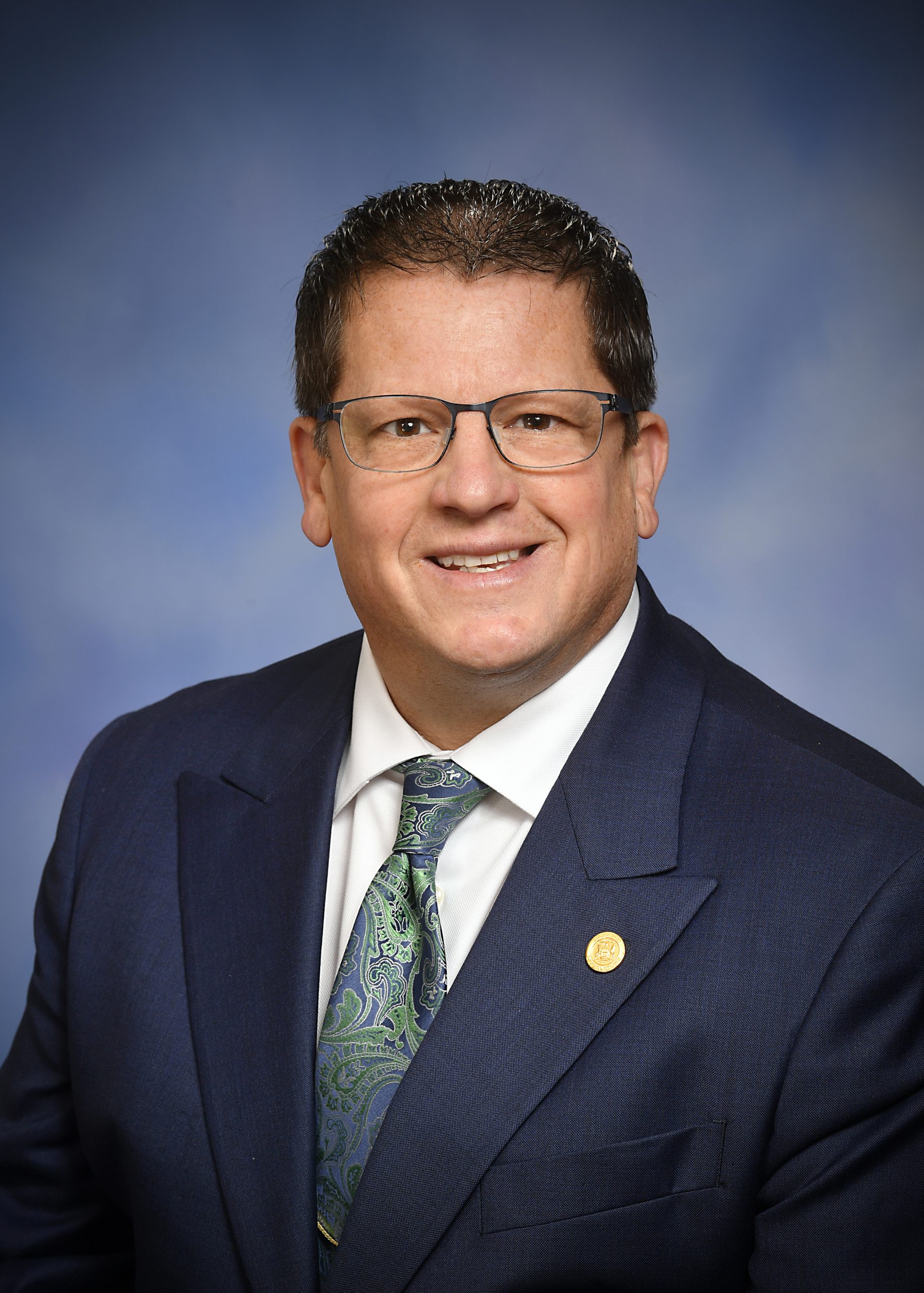
Photo of Brian BeGole
R Michigan House · District 71 On the 2026 ballot

Rep. Brian BeGole

Compare
Total votes
1,773
all sessions
Attendance
100%
1 missed
Higher than 83% of chamber peers
With party
94%
of cast votes
Higher than 94% of chamber peers
Bipartisan score
3%
crosses aisle rarely
Lower than 95% of chamber peers
Sponsored
622
bills & resolutions
Near the chamber average
Committees
4
assignments
622 bills and resolutions

Sponsored bills

Total
622
Primary
25
Co-sponsor
597
This page
622
matching current filters
Co-sponsor HB 4309
Signed into law · Michigan House · Co-sponsor
Health occupations: physician's assistants; physician's assistants licensure compact; provide for. Amends secs. 16337 & 18001 of 1978 PA 368 (MCL 333.16337 & 333.18001) & adds secs. 16187d, 17011b, 17061a, 17511b & 18011b.

Maddy summaryHB 4309 establishes a licensure compact for physician's assistants, allowing them licensed in one participating state to practice in other participating states without needing separate licenses. This directly affects physician's assistants seeking to work across state lines and patients in states participating in the compact. The bill creates legal mechanisms by amending existing law to enable reciprocal licensing agreements between states, removing barriers for PAs to provide care in multiple jurisdictions. It provides the framework for states to join the compact through mutual recognition of licenses, streamlining practice for qualified professionals.

Signed into law Jul 29, 2026 1 co-sponsor
Co-sponsor HB 5707
Passed · Michigan House · Co-sponsor
Environmental protection: permits; exemption to permitting requirements for construction of certain residential ponds; provide for. Amends secs. 30103 & 30305 of 1994 PA 451 (MCL 324.30103 & 324.30305).

Maddy summaryThis bill amends Michigan's Natural Resources and Environmental Protection Act to exempt the construction and maintenance of certain residential ponds from state permitting requirements. It directly affects homeowners and property owners who wish to build small, noncommercial ponds on residential or agricultural land. The key provision allows for the excavation or construction of ponds under one acre in surface area, provided they are used for residential purposes and meet specific conditions outlined in the legislation. This change removes the need for a permit for these specific residential pond projects, simplifying the process for property owners while maintaining oversight for larger or commercial water structures.

Passed Jul 1, 2026 1 co-sponsor
Co-sponsor HB 4408
Passed · Michigan House · Co-sponsor
Probate: trusts; powers of appointment; revise. Amends secs. 5a & 14 of 1967 PA 224 (MCL 556.115a & 556.124).

Maddy summaryHB 4408 revises Michigan's "Powers of appointment act of 1967," primarily affecting how trustees manage irrevocable trusts. It allows a trustee with discretionary power to distribute assets from an existing irrevocable trust to transfer those assets into a newly created second trust. This "decanting" is permitted only if specific conditions are met, such as ensuring beneficiaries remain largely the same and protecting certain financial interests like marital or charitable deductions. Additionally, the bill clarifies when the time period for future interests in a trust begins when a power of appointment is exercised.

Passed Jul 1, 2026 1 co-sponsor
Primary HB 5045
Passed · Michigan House · Lead sponsor
Housing: other; redemption of premises; modify. Amends secs. 48g & 48i of 1966 PA 346 (MCL 125.1448g & 125.1448i).

Maddy summaryHB 5045 amends Michigan's Housing Development Authority Act to clarify procedures for redeeming foreclosed properties. It requires sellers to record deeds within 20 days of a sale, specifying redemption timelines and interest accrual starting from the recording date (not the sale date). Property owners or their heirs can redeem land within six months by paying the bid amount plus interest, with the register of deeds handling redemption documentation and fees. The bill directly affects property owners seeking redemption, purchasers of foreclosed properties, and county registers of deeds managing these transactions. These changes aim to streamline redemption processes and reduce confusion in housing foreclosure cases.

Passed Jul 1, 2026 0 co-sponsors
Co-sponsor HB 6072
Passed · Michigan House · Co-sponsor
Health facilities: hospitals; certain hospital financial assistance policies; make subject to the hospital financial assistance act. Amends sec. 17 of 1913 PA 350 (MCL 331.167). TIE BAR WITH: HB 6071'26

Maddy summaryHB 6072 requires hospital boards in Michigan to follow the existing Hospital Financial Assistance Act when deciding how to provide financial help to patients. This change ensures that the rules for determining who qualifies for charity care and setting fees are consistent with state standards rather than being set solely by individual hospital boards. The bill only becomes active if a companion bill, HB 6071, is also passed into law. It directly affects public hospital trustees and the patients they serve by standardizing assistance policies.

Passed Jun 25, 2026 1 co-sponsor
Co-sponsor HCR 8
Passed · Michigan House · Co-sponsor
A concurrent resolution to approve an extension of the state of energy emergency declared on April 2, 2026.

Maddy summaryThis bill extends the state of energy emergency in Michigan by an additional 77 days, effective July 1, 2026. The measure allows the sale of E15 fuel in several counties where current regulations previously restricted it to lower vapor pressure gasoline. By suspending these fuel requirements, the extension aims to increase fuel supply options and help manage rising gas prices for consumers and businesses. The resolution requires approval from both the House and Senate before being sent to the Governor.

Passed Jun 25, 2026 1 co-sponsor
Co-sponsor HB 6071
Passed · Michigan House · Co-sponsor
Health facilities: hospitals; hospital financial assistance act; enact. Creates new act.

Maddy summaryThis bill establishes the Hospital Financial Assistance Act, which requires hospitals in Michigan to create and enforce financial aid programs for patients by January 1, 2027. The law mandates that these programs use federal poverty guidelines to determine eligibility, offering up to a full discount on medical bills for uninsured individuals earning at or below 350% of the poverty line. Hospitals must also publish clear information about these programs on their websites and in billing statements, and they are required to submit annual reports detailing the number of applications and the amount of debt forgiven or collected. To ensure compliance, the state Department of Health and Human Services will oversee the process, investigate complaints, and impose civil fines of up to $10,000 on hospitals that fail to follow the new rules.

Passed Jun 25, 2026 1 co-sponsor
Co-sponsor HB 6128
In committee · Michigan House · Co-sponsor
State agencies (existing): generally; use of open fields doctrine by law enforcement officers and state agencies; prohibit. Creates new act.

Maddy summaryThis bill prohibits law enforcement officers and state agency employees in Michigan from using the "open fields doctrine" during searches. The open fields doctrine is a legal rule that currently allows police to search open areas without a warrant, but this legislation would remove that exception for state-level searches. As a result, any search conducted by these officials in open fields would require a warrant or another valid legal justification. The law directly affects state departments, boards, and commissions, as well as the officers and agents who work for them.

In committee Jun 25, 2026 1 co-sponsor
Co-sponsor HB 6073
Passed · Michigan House · Co-sponsor
Consumer credit: credit reports and reporting agencies; collection and reporting of medical debt information; regulate. Creates new act.

Maddy summaryThis bill, known as the Medical Debt Act, prohibits consumer reporting agencies from including medical debt in credit reports and bars creditors from reporting such debts to these agencies. It also prevents lenders from using unpaid medical bills as a negative factor when making credit decisions, with the exception of large mortgage loans exceeding federal limits. Additionally, the law restricts collection agencies from falsely claiming that medical debt will be reported on a consumer's credit file. These measures aim to protect individuals from having their medical financial obligations negatively impact their creditworthiness and future borrowing opportunities.

Passed Jun 25, 2026 1 co-sponsor
Co-sponsor HB 5145
Passed · Michigan House · Co-sponsor
Human services: food assistance; documentation requirements for certain assistance programs; provide for. Amends 1939 PA 280 (MCL 400.1 - 400.119b) by adding sec. 10h.

Maddy summaryHB 5145 changes documentation requirements for Michigan's public assistance programs, including food assistance. It replaces self-attestation with verifiable documents for applicants to prove identity (e.g., driver's license, birth certificate), income (e.g., pay stub, tax return), and Michigan residency (e.g., utility bill, lease). The bill requires applicants to upload these documents via the MI Bridges online portal before eligibility is determined. It also mandates that the department use alternative verification methods if documents are missing, rather than automatically denying benefits. This bill directly affects individuals applying for or renewing public assistance benefits in Michigan.

Passed Jun 25, 2026 1 co-sponsor
Showing 21 to 30 of 622 bills
Previous 1 2 3 4 63 Next