

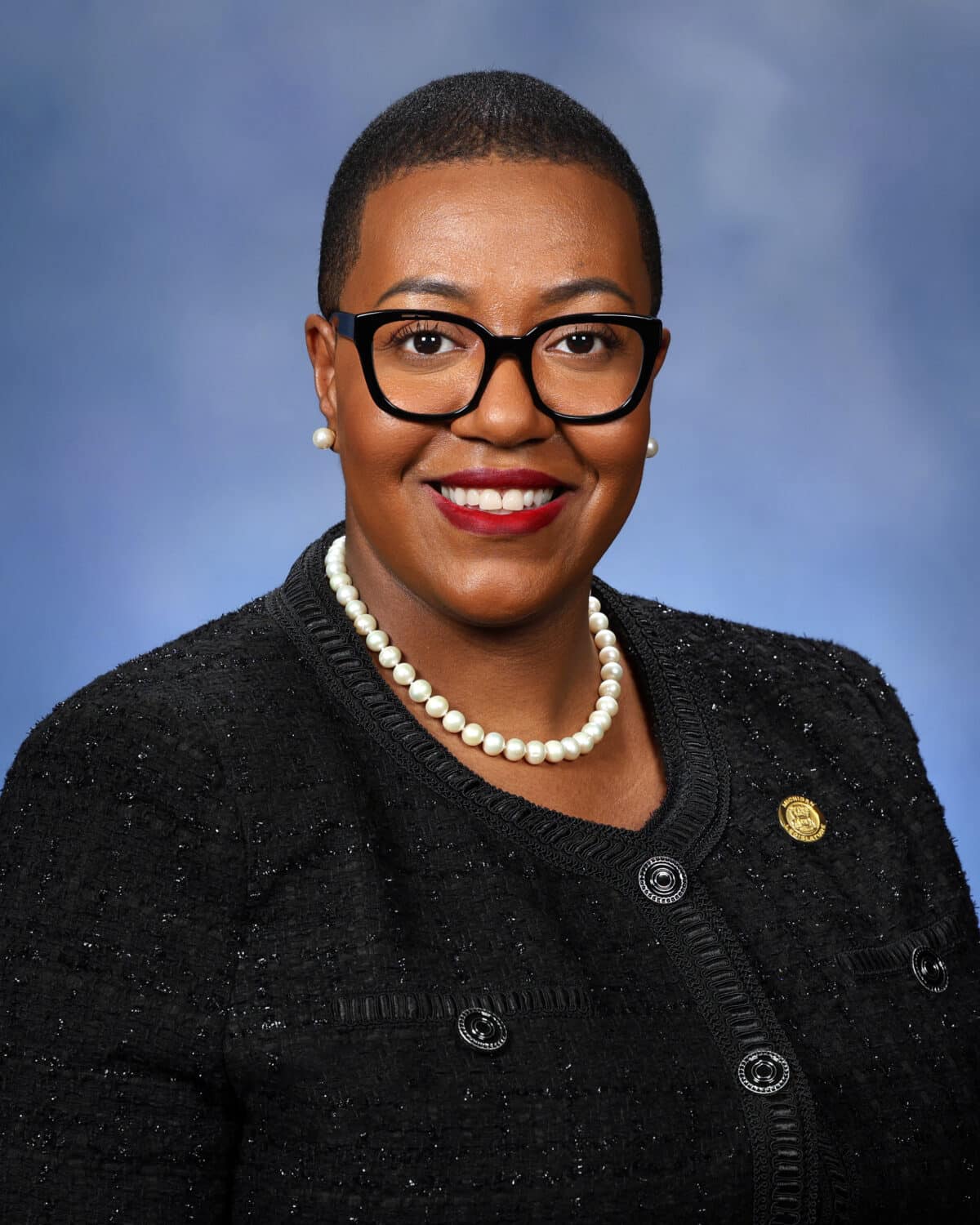
Photo of Morgan Foreman
D Michigan House · District 33 On the 2026 ballot

Rep. Morgan Foreman

Compare
Total votes
652
all sessions
Attendance
89%
80 missed
Lower than 88% of chamber peers
With party
91%
of cast votes
Lower than 78% of chamber peers
Bipartisan score
5%
crosses aisle rarely
Higher than 77% of chamber peers
Sponsored
393
bills & resolutions
Near the chamber average
Committees
2
assignments
393 bills and resolutions

Sponsored bills

Total
393
Primary
20
Co-sponsor
373
This page
393
matching current filters
Co-sponsor HB 6020
Passed · Michigan House · Co-sponsor
Health: research; participation in ibogaine clinical trials; provide for. Amends sec. 7212 of 1978 PA 368 (MCL 333.7212) & adds secs. 2222, 2222a & 2222b.

Maddy summaryThis bill amends Michigan's Public Health Code to create a legal framework for clinical trials involving ibogaine, a substance used to treat substance use disorders. It directly affects researchers, healthcare providers, and participants by establishing specific rules for how these studies can be conducted within the state. The legislation adds new sections to the code that define the requirements for obtaining approval, ensuring participant safety, and reporting data for these trials. By updating existing laws and adding new provisions, the bill aims to facilitate regulated medical research on ibogaine while maintaining oversight by state health authorities.

Passed Jun 9, 2026 1 co-sponsor
Co-sponsor HR 329
In committee · Michigan House · Co-sponsor
A resolution to declare June 2026 as Lesbian, Gay, Bisexual, Transgender, and Queer Pride Month in the state of Michigan.

Maddy summaryThis bill proposes declaring June 2026 as Lesbian, Gay, Bisexual, Transgender, and Queer Pride Month throughout the state of Michigan. It aims to recognize the history, culture, and contributions of LGBTQ+ residents while commemorating the 1969 Stonewall Uprising. The resolution encourages all Michiganders to acknowledge the value of diversity and the specific roles LGBTQ+ individuals play in the state's economy and communities.

In committee Jun 4, 2026 1 co-sponsor
Co-sponsor HB 5802
In committee · Michigan House · Co-sponsor
Natural resources: fishing; allowable catch per species and percentage quota for commercial fishing; provide for. Amends secs. 47324, 47326, 47328, 47329, & 48724 of 1994 PA 451 (MCL 324.47324 et seq.) & adds sec 47363. TIE BAR WITH: HB 5801'26

Maddy summaryThis bill amends Michigan's natural resources laws to update regulations on commercial fishing, including allowable catch limits and quota percentages for various fish species. It establishes stricter record-keeping requirements for fish dealers and mandates that commercial fishers report their catch immediately after each fishing season ends. The legislation also introduces new financial penalties for illegal fishing, requiring offenders to pay fines based on the weight of the fish taken, and sets a rule that commercial licenses will be permanently revoked if a fisher commits five specific violations within a five-year period. Additionally, the bill rescinds several outdated administrative rules related to commercial fishing operations.

In committee Jun 4, 2026 1 co-sponsor
Co-sponsor HB 6031
In committee · Michigan House · Co-sponsor
Human services: medical services; certified community behavioral health clinics; provide certification and funding for. Amends 1939 PA 280 (MCL 400.1 - 400.119b) by adding secs. 109w & 109x. TIE BAR WITH: HB 6032'26

Maddy summaryThis bill directs the Michigan Department of Health and Human Services to create a new payment system that funds certified community behavioral health clinics based on anticipated costs rather than individual service bills. The legislation requires the department to set fair payment rates, establish rules to prevent conflicts of interest, and create a process for resolving disputes between clinics and managed care organizations. Starting in 2028, the bill also mandates that any new clinic sites receive state approval to ensure services are distributed evenly and to avoid oversaturation in specific areas. Additionally, the law prioritizes applications from existing community mental health programs and requires that new sites be operated directly by or under the governance of these programs. The bill includes provisions for penalties against clinics that violate rules and notes that implementation depends on the legislature appropriating sufficient funds.

In committee Jun 3, 2026 1 co-sponsor
Co-sponsor HB 6032
In committee · Michigan House · Co-sponsor
Human services: medical services; certified community behavioral health clinics; provide certification and funding for. Amends 1939 PA 280 (MCL 400.1 - 400.119b) by adding sec. 109v. TIE BAR WITH: HB 6031'26

Maddy summaryThis bill directs Michigan state agencies to align their policies with federal requirements for certified community behavioral health clinics, preventing any state rules from conflicting with federal standards. It also establishes a process to identify new clinic locations in specific areas to prevent overlapping service regions while maintaining cooperation with the federal government. The legislation includes a provision that allows the state legislature to vote on whether to stop participating in the federal program, with a mandatory 12-month waiting period before clinics can be shut down if such a vote occurs.

In committee Jun 3, 2026 1 co-sponsor
Co-sponsor HB 6021
In committee · Michigan House · Co-sponsor
Occupations: individual licensing and registration; licensure of sprinkler fitter; provide for under the skilled trades regulation act, and make other amendments to the act. Amends & adds (See bill)

Maddy summaryHB 6021 amends Michigan's Skilled Trades Regulation Act to update rules for licensing, fees, and enforcement across various trades. The bill clarifies that the state department must set specific fees for licenses and permits and introduces a mechanism for issuing license verification documents upon request. It also establishes stricter penalties for unlicensed practice, including higher fines and potential jail time for repeat offenders, while adding provisions to stop illegal construction immediately. Additionally, the legislation increases application fees to three times the standard amount for individuals previously convicted of license violations and imposes a three-year ban on reapplying for those who fraudulently use license cards.

In committee Jun 2, 2026 1 co-sponsor
Co-sponsor HB 6011
In committee · Michigan House · Co-sponsor
Businesses: other; cybersecurity requirements for large-scale solar energy facilities; provide for. Amends 2008 PA 295 (MCL 460.1001 - 460.1232) by adding sec. 112a.

Maddy summaryThis bill requires operators of large-scale solar energy facilities in Michigan, defined as those with 50 megawatts or more of capacity, to implement cybersecurity measures to protect safety-critical systems. The law mandates that these facilities follow a risk-based security program aligned with national standards and report material cyber incidents to state and local authorities within 24 to 72 hours. Operators must also maintain incident response plans for coordinating with emergency responders, while specific security details remain confidential and are exempt from public disclosure. The legislation does not regulate facility siting, create new regulatory oversight, or impose additional costs on local governments, and it allows facilities to use existing staff to meet compliance requirements.

In committee Jun 2, 2026 1 co-sponsor
Co-sponsor HB 6019
In committee · Michigan House · Co-sponsor
Insurance: health insurers; closure or removal of a health system considered a qualifying event for a special enrollment period; provide for. Amends 1956 PA 218 (MCL 500.100 - 500.8302) by adding sec. 3406ww.

Maddy summaryThis bill requires health insurers in Michigan to treat the closure or removal of a health system from their network as a qualifying event for a special enrollment period. Under this rule, individuals who lose access to their current doctors or hospitals due to these changes would be allowed to sign up for new health insurance plans outside of the usual annual open enrollment window. The legislation defines a "health system" broadly to include hospitals, physician practices, and other related care facilities that operate under common ownership or control. By codifying this requirement, the bill aims to ensure that people can maintain continuous coverage when their existing healthcare options are no longer available.

In committee Jun 2, 2026 1 co-sponsor
Co-sponsor HR 325
In committee · Michigan House · Co-sponsor
A resolution urging President Trump, the Internal Revenue Service, and all parties to the settlement agreement creating the “Anti-Weaponization Fund” to rescind the agreement.

Maddy summaryThis House resolution urges President Trump, the IRS, and other parties to cancel a settlement agreement that established the "Anti-Weaponization Fund." The bill directly addresses the use of taxpayer money to fund individuals convicted of crimes related to the January 6 Capitol attack, including those linked to extremist groups. It calls for the rescission of the agreement, arguing that public funds should not support those who engaged in political violence or attempted to overturn election results. The resolution is a formal statement of opposition rather than a law that immediately changes policy.

In committee May 21, 2026 1 co-sponsor
Co-sponsor HB 5988
In committee · Michigan House · Co-sponsor
Insurance: health insurers; coverage for step therapy; modify. Amends sec. 3406t of 1956 PA 218 (MCL 500.3406t).

Maddy summaryThis bill requires Michigan health insurers and health maintenance organizations to offer a program that synchronizes multiple maintenance prescription drugs for patients with chronic long-term conditions, provided the patient, physician, and pharmacist agree it is in the patient's best interest. The law mandates that if a step therapy protocol is used to restrict drug coverage, the criteria for these protocols must be based on high-quality clinical practice guidelines developed by an unbiased, multidisciplinary panel that includes public review opportunities. Additionally, the bill establishes specific conditions under which a step therapy exception must be granted quickly, such as when a drug is contraindicated, ineffective, or causes harm, and it ensures that all relevant clinical review criteria are transparently available to patients and healthcare providers.

In committee May 20, 2026 1 co-sponsor
Showing 61 to 70 of 393 bills
Previous 1 6 7 8 40 Next