

Maddy summaryThis bill creates new criminal penalties for individuals who intentionally injure, intimidate, or interfere with people seeking or providing reproductive health services at licensed health facilities. It specifically prohibits physical obstruction that blocks entry or exit and distinguishes between violent acts, which carry heavier felony charges, and nonviolent obstruction, which results in misdemeanor penalties. The legislation also establishes a civil remedy allowing aggrieved parties or government officials to sue for damages and fines, while explicitly preserving constitutional rights to peaceful picketing and demonstrations outside the facility. Additionally, the act clarifies that parents are not penalized for directing these prohibited activities at their minor children and does not override local ordinances regarding reproductive health services.
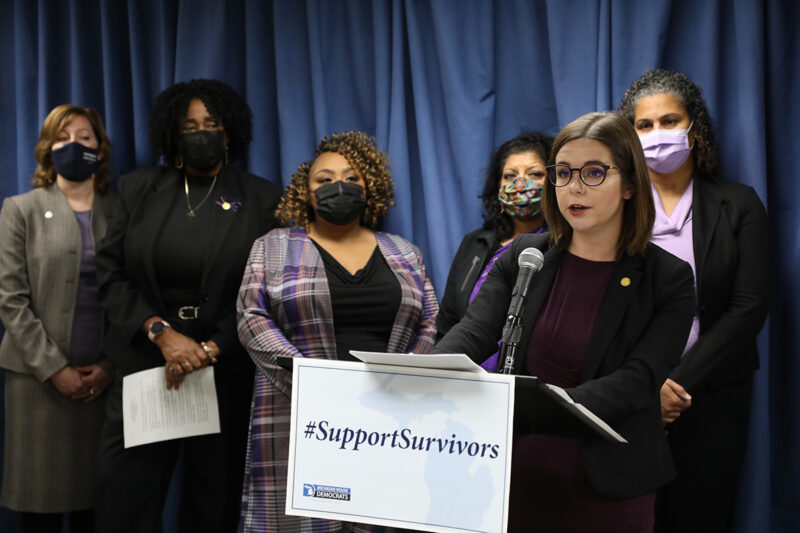
Rep. Laurie Pohutsky
Sponsored bills
Maddy summaryThis bill modifies Michigan's no-fault insurance laws to allow health care providers to charge rates established as "payment in full" on June 10, 2019, based on existing contracts with insurers or preferred provider organizations. It also introduces a penalty provision where injured persons can recover twice the amount of overdue benefits if an insurer fails to pay within 120 days of receiving notice of the injury. The legislation clarifies that these penalty amounts do not count toward court jurisdiction limits and prevents insurers from claiming that benefits have been exhausted when a penalty is owed. Ultimately, the bill aims to streamline reimbursement processes and provide stronger financial recourse for medical providers and injured individuals under the state's personal protection insurance system.
Maddy summaryThis bill amends Michigan's no-fault insurance law to allow physical therapy services to be covered when provided under the supervision of an advanced practice registered nurse. Currently, reimbursement for such services is only required when a licensed physical therapist or their assistant performs the work under a physical therapist's supervision. The change expands the list of qualified supervisors to include nurses with advanced clinical training, provided they hold a valid state license or an equivalent license from another state. This update directly affects personal protection insurance policies and the healthcare professionals who deliver physical therapy to patients.
Maddy summaryThis bill amends the Natural Resources and Environmental Protection Act to clarify the Department of Environment Quality's responsibilities regarding water resources and pollution control. It explicitly states that the department must protect and conserve Michigan's surface and underground waters, including the Great Lakes, and manage waste disposal impacts. The legislation also outlines the department's role in assisting flood control districts and complying with federal water pollution laws using appropriated funds. A key provision notes that existing rules created before January 1, 2007, will remain in effect unless officially rescinded, while limiting the creation of new rules under specific sections.
Maddy summaryThis bill requires law enforcement to make time-stamped, audiovisual recordings of interrogations involving juveniles who are treated as adults for major felonies. It mandates that an attorney must be present during these custodial interrogations and establishes that any self-incriminating response from a juvenile is presumed inadmissible if it is not electronically recorded. The legislation also specifies that prosecutors must provide copies of recorded statements to defense counsel and instructs juries to consider the absence of a recording when evaluating evidence if one was not made. These changes aim to ensure transparency and legal representation for young suspects facing serious charges.
Maddy summaryThis bill requires that a juvenile have an attorney present during any interrogation while in custodial detention, and it prohibits these minors from waiving their right to legal representation. Additionally, the law states that any self-incriminating statements made by a juvenile during such an interrogation are inadmissible as evidence if they were not represented by counsel at the time. These provisions directly affect juveniles under the age of 18 who are subject to delinquency petitions and law enforcement questioning in a detention setting.
Maddy summaryThis bill modifies the state laws governing the Underground Storage Tank Corrective Action Fund to update definitions and financial limits for cleanup claims. It directly affects owners and operators of underground storage tanks holding refined petroleum products by adjusting the maximum amount of money the state authority can pay for environmental releases. The key change involves increasing the claim limit for facilities with more than 100 tanks from $1 million to $2 million while keeping the limit at $1 million for smaller facilities. Additionally, the legislation clarifies various terms related to claims, bulk transfers, and financial responsibilities to ensure the fund operates effectively.
Maddy summaryThis bill requires Michigan correctional facilities to give every prisoner forms that let them choose who can receive their medical records and who should be notified in a medical emergency. Prisoners must sign these forms to designate specific people as authorized recipients for their health information and as emergency contacts for critical situations. If a prisoner faces a serious medical emergency requiring hospital care, the department must immediately contact the designated emergency contact and may share the prisoner's location if necessary. The law also allows authorized recipients to request specific medical details about the prisoner, while the department must provide clear instructions and brochures explaining how these designations work.
Maddy summaryHB 6182 updates Michigan's vehicle code to clarify the responsibilities of lenders who refuse to finance a car loan after they have been assigned a security interest in the vehicle. Specifically, the bill requires these lenders to notify the seller, buyer, and state department of Motor Vehicles on the same day they decline to purchase the contract, and it mandates that they immediately reassign the security interest back to the original seller. Additionally, the legislation reinforces existing rules regarding how security interests are assigned, how titles are issued when liens exist, and the timelines for releasing liens once a loan is paid off. The bill also authorizes the state to require electronic processing for vehicle title liens and allows for the use of electronic receipts to transfer ownership when a loan is satisfied.
Maddy summaryThis bill updates Michigan's veterinary laws to formally require a veterinarian-client-patient relationship before a veterinarian can treat an animal. To establish this relationship, a veterinarian must assume responsibility for clinical judgments, obtain the owner's agreement to follow instructions, and have current knowledge of the animal through an in-person exam, a specific telehealth visit, or a visit to the animal's location. The legislation explicitly allows veterinarians to conduct telehealth exams for companion animals using real-time audio and video, provided they have the necessary equipment and are available for emergencies. However, it restricts telehealth by prohibiting remote exams for non-companion animals, forbidding the issuance of interstate health certificates remotely, and limiting remote prescriptions to a 14-day supply without refills. Additionally, the bill mandates that controlled substances can only be prescribed after an in-person examination or a visit to the animal's premises.