

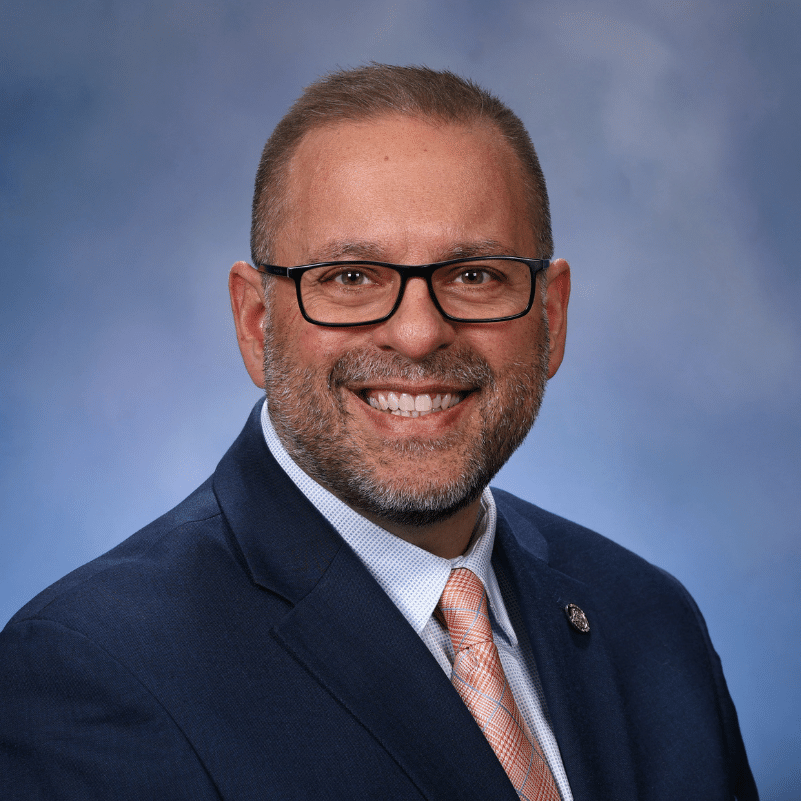
Photo of Mike McFall
D Michigan House · District 14 On the 2026 ballot

Rep. Mike McFall

Compare
Total votes
1,765
all sessions
Attendance
96%
71 missed
Lower than 82% of chamber peers
With party
97%
of cast votes
Near the chamber average
Bipartisan score
2%
crosses aisle rarely
Near the chamber average
Sponsored
1,078
bills & resolutions
Higher than 91% of chamber peers
Committees
2
assignments
1,078 bills and resolutions

Sponsored bills

Total
1,078
Primary
59
Co-sponsor
1,019
This page
1,078
matching current filters
Co-sponsor HB 6094
In committee · Michigan House · Co-sponsor
Public utilities: public service commission; filing of rate cases for recovery of certain costs; prohibit. Amends 1939 PA 3 (MCL 460.1 - 460.11) by adding sec. 6bb.

Maddy summaryThis bill prohibits electric and natural gas utilities in Michigan from including specific administrative and political expenses in the rates charged to customers. It explicitly bans the recovery of costs related to executive compensation, fines, lobbying, advertising, charitable donations, and trade association memberships. If the Public Service Commission determines that a utility has improperly collected these fees, it must order a refund to customers with interest and impose escalating fines based on the number of violations. Any fines levied under this new rule would be directed toward a fund designed to assist low-income individuals with energy costs.

In committee Jun 17, 2026 1 co-sponsor
Co-sponsor HB 6079
In committee · Michigan House · Co-sponsor
Sales tax: distribution; reporting and earmark of auto-related sales tax for the comprehensive transportation fund; provide for. Amends secs. 6 & 25 of 1933 PA 167 (MCL 205.56 & 205.75) & adds sec. 18a.

Maddy summaryThis bill requires Michigan businesses selling car parts and accessories to separately report and pay sales tax on those specific items starting October 1, 2027. To prepare for this change, the state Department of Treasury must define which products count as car parts by March 31, 2027, and create a new form for businesses to use. Companies will need to set up systems to identify these items at the point of sale and submit distinct payments for them alongside their regular monthly tax returns. The bill amends existing state tax laws to establish these new reporting and payment procedures without changing how the tax revenue is currently distributed.

In committee Jun 16, 2026 1 co-sponsor
Co-sponsor HB 5511
Passed · Michigan House · Co-sponsor
Criminal procedure: sentencing; delayed entry of judgment of conviction when sentencing is delayed; allow with exceptions. Amends 1927 PA 175 (MCL 760.1 - 777.69) by adding sec. 1a to ch. XI. TIE BAR WITH: HB 5510'26

Maddy summaryHB 5511 would allow courts to delay officially recording a conviction (entry of judgment) until sentencing occurs, under specific conditions. This applies when the prosecutor agrees after consulting the victim, and either the court finds good cause to delay or the defendant enters a specialty rehabilitation program. The bill does not apply to certain traffic offenses involving vehicle operation (even if felony/misdemeanor) or convictions already eligible for delayed sentencing under other laws. The delay mechanism aims to support rehabilitation efforts while ensuring victims are consulted, but the bill requires another related bill (HB 5510) to pass first.

Passed Jun 16, 2026 1 co-sponsor
Co-sponsor HB 5510
Passed · Michigan House · Co-sponsor
Criminal procedure: sentencing; time period allowed for delayed sentencing; modify. Amends sec. 1, ch. XI of 1927 PA 175 (MCL 771.1). TIE BAR WITH: HB 5511'26

Maddy summaryHB 5510 allows Michigan courts to delay final sentencing for up to one year (or longer for specific cases) for certain non-violent offenses, giving defendants time to participate in rehabilitation programs like drug court. It requires courts to collect supervision fees ($30-$60 per month, depending on electronic monitoring) during the delay period, with maximum limits of 12 months for most cases or 60 months for child support violations. The bill exempts juveniles in specific cases and permits courts to waive fees for indigent defendants. This modifies existing sentencing procedures to prioritize rehabilitation while adding structured financial obligations during the delay.

Passed Jun 16, 2026 1 co-sponsor
Co-sponsor HB 6057
In committee · Michigan House · Co-sponsor
Labor: working conditions; suitable seats; require employers to provide to employees under certain circumstances. Creates new act.

Maddy summaryThis bill requires employers in Michigan to provide suitable seats with back support to employees working at locations they own, lease, or control, provided it is reasonable for the employee to sit while performing their duties. The law mandates that if sitting is not reasonable during active work, the employer must still keep a seat nearby and cannot prevent its use unless the employee is actively working. Employers who fail to comply face civil fines of $250 for each affected employee for every two-week period the violation continues, with penalties collected by county prosecutors or the state attorney general. Additionally, the Department of Labor and Economic Opportunity is authorized to create specific rules to implement these requirements, and the law applies to existing contracts that conflict with its provisions once those agreements expire or are renewed.

In committee Jun 10, 2026 1 co-sponsor
Co-sponsor HB 6065
In committee · Michigan House · Co-sponsor
Individual income tax: credit; make it in Michigan tax credit program; create. Amends 1967 PA 281 (MCL 206.1 - 206.847) by adding sec. 279. TIE BAR WITH: HB 6061'26, HB 6062'26, HB 6063'26, HB 6064'26

Maddy summaryThis bill creates a new "Make It In Michigan" tax credit program designed to encourage recent college graduates to live and work in the state. To qualify, individuals must be Michigan residents employed by local businesses and must have earned a bachelor's degree or higher from an accredited institution after the law takes effect. The legislation defines specific terms for eligible employees, students, and loans, while also renaming existing tax credits under sections 279a, 279b, 679, and 679a to reflect this new program name. Crucially, the bill will not become effective unless four companion bills regarding the program's funding and administration are also passed into law.

In committee Jun 10, 2026 1 co-sponsor
Co-sponsor HB 6061
In committee · Michigan House · Co-sponsor
Individual income tax: credit; credit for student loan payments made by certain taxpayers who remained in or returned to this state for employment; provide for. Amends 1967 PA 281 (MCL 206.1 - 206.847) by adding sec. 279a. TIE BAR WITH: HB 6062'26, HB 6063'26, HB 6064'26, HB 6065'26

Maddy summaryThis bill creates a tax credit for Michigan residents who earned a degree in the state and subsequently stayed or returned to Michigan for a job. Eligible individuals can claim a credit equal to 50% of their student loan payments for a specific tax year, but the total credit cannot exceed 20% of the average annual tuition at a public Michigan university. To receive the benefit, taxpayers must provide proof of their degree, employment within the state, and student loan payments, and they must apply within 10 years of graduating. If the calculated credit is larger than the taxpayer's total tax liability for that year, the difference will be refunded to them. The legislation will only take effect if four companion bills are also passed into law.

In committee Jun 10, 2026 1 co-sponsor
Co-sponsor HB 6063
In committee · Michigan House · Co-sponsor
Corporate income tax: credits; credit for student loan payments made by employer on behalf of a qualified employee who received a diploma or degree from an institution located in this state; provide for. Amends 1967 PA 281 (MCL 206.1 - 206.847) by adding sec. 679. TIE BAR WITH: HB 6061'26, HB 6062'26, HB 6064'26, HB 6065'26

Maddy summaryThis bill allows Michigan employers to claim a tax credit equal to 50% of student loan payments they make on behalf of employees who graduated from in-state schools and work for the company. The credit is limited to 20% of the average yearly tuition at a public university in the state for each employee per year. To receive the benefit, employers must submit detailed proof of payments and employee information to the state tax department. The bill also requires that any unused portion of the credit be refunded to the employer rather than carried forward. It is part of a package of related bills that must all pass together to take effect.

In committee Jun 10, 2026 1 co-sponsor
Co-sponsor HB 6064
In committee · Michigan House · Co-sponsor
Corporate income tax: credits; credit for student loan payments made by employer on behalf of a qualified employee who did not receive a diploma or degree from an institution located in this state; provide for. Amends 1967 PA 281 (MCL 206.1 - 206.847) by adding sec. 679a. TIE BAR WITH: HB 6061'26, HB 6062'26, HB 6063'26, HB 6065'26

Maddy summaryThis bill creates a new tax credit for Michigan employers who pay student loans for employees who did not graduate from an in-state high school or earn a degree from an in-state college. To qualify, the employee must have moved to Michigan to work for the employer after obtaining a bachelor's degree or higher from an out-of-state institution, and the employer can claim a credit equal to 25% of the loan payments made, up to a limit of 20% of the average yearly tuition at a public Michigan university. Employers must submit specific documentation to the state department to prove the payments and employee details, and any unused portion of the credit can be refunded to the employer. This measure is part of a larger package of related bills aimed at encouraging companies to hire graduates from outside the state.

In committee Jun 10, 2026 1 co-sponsor
Co-sponsor HB 6056
In committee · Michigan House · Co-sponsor
Labor: collective bargaining; poster of collective bargaining rights; require certain employers to display at work sites and provide to employees. Amends 1939 PA 176 (MCL 423.1 - 423.30) by adding sec. 8.

Maddy summaryThis bill requires employers in Michigan to display a poster outlining employee collective bargaining rights at every work site and provide a digital version to staff. The Department of Labor and Economic Opportunity will create this poster using materials from the National Labor Relations Board and ensure it is available in English and any other language requested by the employer or a labor organization. Employers who fail to comply face civil fines of $5,000 for a first violation and $10,000 for subsequent violations, which are collected by county prosecutors or the attorney general and deposited into the state general fund.

In committee Jun 10, 2026 1 co-sponsor
Showing 61 to 70 of 1,078 bills
Previous 1 6 7 8 108 Next