

Maddy summaryHouse Bill 4424 proposes a new corporate income tax credit for businesses that produce or blend sustainable aviation fuel (SAF) within Michigan. Qualified taxpayers can claim a credit of $1.50 per gallon for SAF produced or blended in the state and sold for use in aircraft departing from Michigan airports. This credit can increase up to $2.00 per gallon based on the SAF's life-cycle greenhouse gas emission reductions. If the credit amount exceeds a company's tax liability, the difference will be refunded.
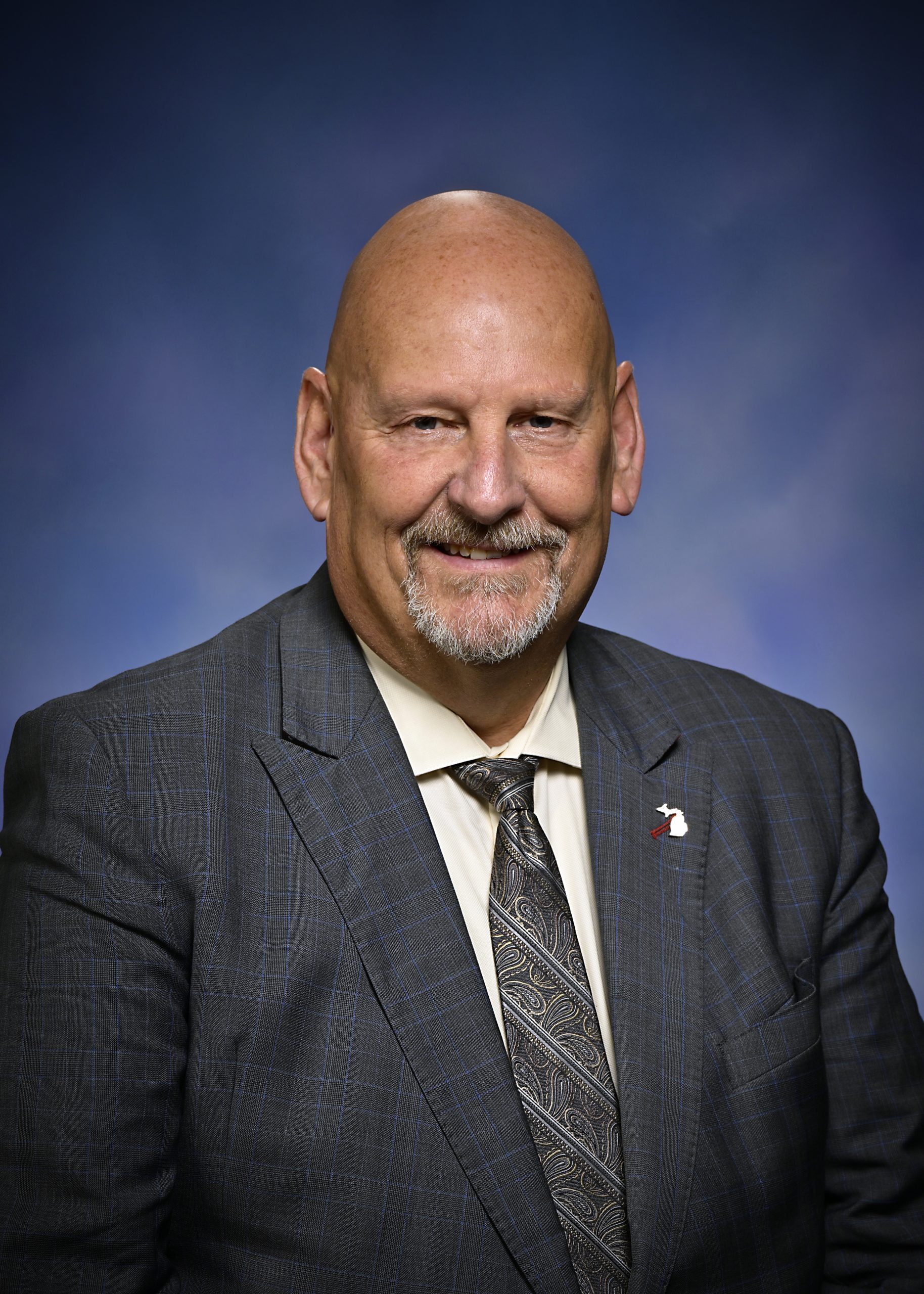
Rep. Curt VanderWall
Sponsored bills
Maddy summaryHB 4314 amends Michigan's environmental law to allow property owners and communities to remove free-floating debris and uprooted vegetation from shorelines without a permit. Specifically, it permits mechanical or manual removal between the ordinary high-water mark and the water's edge, as long as the activity doesn't impact the lakebed. This change directly affects residents, shoreline property managers, and local groups maintaining areas along Great Lakes and Lake St. Clair shorelines. The exemption does not apply to the St. Clair River delta area in Clay Township, St. Clair County, as defined in 1899 PA 175.
Maddy summaryHB 4470 amends Michigan's penal code to designate specific portions of the Mackinac Bridge (those not open to or intended for public use) as a "key facility" under existing law. This means unauthorized entry onto these bridge sections - when enclosed by barriers like water and properly posted with signage - would become a felony punishable by up to 4 years in prison or a $2,500 fine. The bill adds the Mackinac Bridge to a list of protected critical infrastructure, including power plants, water facilities, and chemical plants, all requiring physical barriers and visible signage to enforce entry restrictions. It does not change current penalties or posting requirements but extends them specifically to the Mackinac Bridge's restricted areas.
Maddy summaryHB 4822 requires the Natural Resources Commission to live stream all its meetings publicly online. This bill amends Michigan's natural resources law (MCL 324.501) to mandate real-time video streaming of Commission sessions. The change directly affects the Commission's operations and ensures public access to its proceedings without requiring physical attendance. The bill is currently pending in committee review after being referred for second reading.
Maddy summaryHB 5304 requires applicants for dredging permits under Michigan's environmental law to either use dredged material for beach nourishment (if suitable) or pay a $25 per cubic yard fee. The fee funds a new Beach Nourishment Fund administered by the Department of Environment, Great Lakes, and Energy. This applies to projects under Parts 301, 303, and 325 of Michigan's Natural Resources and Environmental Protection Act. The bill amends sections 30106b, 30311b, and 32515a and adds sections 1306 (fee requirements) and 33709 (fund creation).
Maddy summaryHB 5309 amends Michigan's Child Custody Act to clarify custody presumptions in specific disputes. It establishes that courts generally presume custody should go to parents unless a parent has been absent for 3 years (with exceptions for military service, incarceration, or medical reasons), and shifts the burden of proof to the party opposing parental custody. The bill also specifically prohibits awarding custody to a biological parent convicted of criminal sexual conduct against the child, unless the child (if old enough) consents, and clarifies that this does not affect the parent's child support obligations. These changes directly affect parents, guardians, and third parties involved in child custody cases where sexual offenses are alleged or proven.
Maddy summaryHB 4301 expands Michigan's definition of "authorized emergency vehicle" in the Vehicle Code (MCL 257.2 and 257.698) to include specific new categories. It adds vehicles owned by the Michigan Mutual Aid Box Alarm System during emergencies, clarifies that road service vehicles (like tow trucks) may use flashing amber lights while assisting disabled vehicles, and allows federally recognized nonprofits to use emergency lights during disaster response. The bill also clarifies when certain colored lights (red, blue, amber, green) may be used on emergency vehicles, including for snow removal, spill response, and funeral processions. This directly affects emergency responders, road service providers, and nonprofit organizations during crisis operations.
Maddy summaryHB 4302 creates an exception to Michigan's commercial driver license (CDL) requirements for authorized emergency vehicles operated by the Michigan Mutual Aid Box Alarm System. This means drivers operating these specific emergency vehicles do not need to obtain the standard CDL or related endorsements required for commercial vehicles. The bill amends Michigan's Vehicle Code (MCL 257.312e) to explicitly exempt these vehicles from the general CDL rules. The exception directly affects personnel operating emergency vehicles under the Michigan Mutual Aid Box Alarm System, allowing them to operate without meeting standard CDL qualifications.
Maddy summaryHB 4108 amends Michigan's tort law to grant legal immunity to individuals who provide emergency bleeding control during medical crises. It directly protects ordinary citizens (not just professionals) who act in good faith to stop severe bleeding, such as at accident scenes or public events. The key provision shields these helpers from lawsuits for unintentional harm caused while applying bleeding control techniques, like using tourniquets or pressure dressings. This change applies specifically to bleeding control efforts during emergencies, not general emergency assistance.
Maddy summaryHB 5291 creates a new limited license for certain individuals practicing applied behavior analysis (ABA) in Michigan. It amends specific sections of the Public Health Code (MCL 333.16343a, 333.18253, and 333.18257) to establish this licensing pathway. The bill directly affects ABA practitioners who qualify for this limited scope but do not meet full licensure requirements. Key provisions add this new license category to the existing regulatory framework, allowing qualified individuals to practice under defined conditions.