

Maddy summaryThis bill expands Massachusetts' existing bottle deposit law to include a wider range of drinkable liquids, such as water and sports drinks, while explicitly excluding items like milk, infant formula, and small-scale juice producers. Under the new rules, the refundable deposit on beverage containers would increase from five cents to ten cents, applying to most prepackaged containers up to 2.5 liters for non-carbonated drinks and 3 liters for carbonated ones. The legislation also adjusts the size requirement for businesses to qualify for exemptions from refunding requirements, raising the threshold from 1,000 to 2,000 square feet. Additionally, it clarifies that redemption centers and reverse vending machines must pay the refund immediately unless a customer opts into an account system.
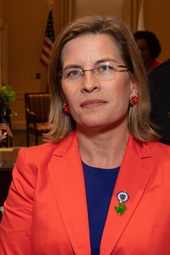
Rep. Marjorie Decker
Sponsored bills
By Representatives Moran of Lawrence and Decker of Cambridge, a petition (accompanied by bill, House, No. 3194) of Frank A. Moran, Marjorie C. Decker and others relative to the use of contractors for repairing or performing work on public utility infrastructure. Telecommunications, Utilities and Energy.
By Representative Decker of Cambridge, a petition (accompanied by bill, House, No. 2497) of Marjorie C. Decker, Lindsay N. Sabadosa and William C. Galvin relative to the retirement benefits of bargaining unit 8 employees within the Department of Mental Health. Public Service.
By Representative Vargas of Haverhill, a petition (accompanied by bill, House, No. 3232) of Andres X. Vargas and others for legislation to establish a zero carbon renovation fund to provide for the costs associated with energy efficiency renovations of certain existing buildings. Telecommunications, Utilities and Energy.
Maddy summaryThis bill requires the chief medical examiner in Massachusetts to review and approve autopsy reports for children under the age of two before they are finalized. The law mandates that the chief examiner must verify both the initial findings regarding the cause of death and any subsequent changes made to the report. By adding this oversight step, the legislation aims to increase public safety and provide greater certainty in determining how young children die. It applies specifically to medical examiners and their offices when handling cases involving infants and toddlers.
Maddy summaryThis bill ensures that children involved with state agencies have better access to behavioral health services by clarifying the Department of Mental Health's role in providing specialized care and allowing it to offer non-mental health services as needed. It requires the creation of a model emergency response plan for group care settings that prioritizes behavioral health interventions and limits police involvement to situations involving imminent danger. Additionally, the legislation mandates that group homes implement these plans, provide staff with behavioral health training, and guarantee that children can return to their homes after medical or non-medical leave without the facility refusing readmission.
Maddy summaryThis bill establishes a 23-member task force to study and recommend a statewide framework for social emotional learning and mental health support for students from birth through higher education. The committee includes representatives from various educational, health, and advocacy organizations, and it must meet regularly to address topics such as suicide prevention, the impact of social media on youth, and strategies for integrating these supports into school curricula. Within two years of passing, the task force will submit its findings to state officials, who are then required to publish guidance for school districts on how to implement these mental health and behavioral health strategies by December 2026. Additionally, the bill amends existing laws to mandate that school safety plans include partnerships with community health organizations to help refer students needing extra support.
By Representative Chan of Quincy, a petition (accompanied by bill, House, No. 2735) of Tackey Chan relative to the senior circuit breaker tax credit. Revenue.
By Representatives Decker of Cambridge and Vargas of Haverhill, a petition (accompanied by bill, House, No. 2761) of Marjorie C. Decker, Andres X. Vargas and others relative to establishing a child and family tax credit. Revenue.
Maddy summaryThis bill updates Massachusetts law to require all public meetings to be physically open and accessible to the public via remote technology. It defines remote access as allowing citizens to view meetings online and remote participation as enabling elected officials to join via video conferencing. The legislation mandates that meeting notices be posted at least 48 hours in advance on official websites and requires that at least one-third of public body members be physically present while permitting remote members to vote and count toward a quorum.