

Maddy summaryThis bill directs the Massachusetts Executive Office of Labor and Workforce Development to investigate industries affected by the pandemic that could benefit from the WorkShare program, a state initiative designed to help businesses retain employees during economic downturns by reducing hours rather than laying off staff. The legislation requires the agency to produce a report within six months detailing current usage, identifying potential new participants, and suggesting ways to increase employer awareness. Additionally, the bill mandates the creation of a marketing strategy to be implemented within 12 months, which will include distributing promotional materials and running advertisements to encourage more companies to utilize the program.
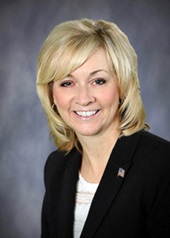
Rep. Kim Ferguson
Sponsored bills
Maddy summaryThis bill requires all schools in Massachusetts to keep a supply of emergency epinephrine auto-injectors available for students experiencing anaphylactic reactions. It mandates that these supplies be stored in unlocked, easily accessible locations, with the specific number of injectors determined by the school's population. The legislation also establishes that school staff who administer the medication in good faith are protected from civil liability for negligence, while the Department of Public Health will create rules to ensure proper training and inventory checks. Additionally, the bill directs state departments to seek federal funding and inquire about free epinephrine from pharmaceutical companies to help cover implementation costs.
Maddy summaryThis bill requires every school district in Massachusetts to create and submit an annual literacy strategic plan that outlines how they will teach reading using scientifically proven methods. The law mandates that these plans cover professional training for teachers, the selection of approved reading curricula, and support systems for parents to help their children learn to read. Districts must use programs from a state-approved list, and those with low reading test scores will be required to include their literacy plans in broader long-term improvement strategies. Additionally, the state department of education will develop resources to help districts train staff and will convene a group of experts to recommend ways to spread best practices across the educator workforce.
Maddy summaryThis bill defines rural school districts in Massachusetts as those with low student density and below-average income to ensure they receive targeted support. It requires a state center to annually review these districts' health insurance plans and provide cost-saving recommendations, such as joining purchasing groups, while offering assistance to implement those changes. Additionally, the bill creates a new office of shared services to help rural districts form regional unions and manage shared resources, and it gives special education paraprofessionals priority for certain licensure grants.
Maddy summaryThis bill amends Massachusetts education laws to allow students to count their participation in 4-H programs as school attendance, equivalent to an educational field trip. It requires schools to provide opportunities for students to complete missed work and ensures that grades are not negatively impacted by their absence from class for these activities. The legislation also mandates that 4-H agents provide proof of participation upon school request, while explicitly excluding attendance credit during standardized testing periods or times when a student is suspended or expelled.
Maddy summaryThis bill authorizes the town of Rutland to replace its elected town clerk with an appointed one. Under the new system, the town's select board would hire and fire the clerk, who would then perform the same legal duties as before. The change would take effect when the current elected clerk retires or leaves office, at which point the elected position would be eliminated.
Maddy summaryThis bill directs the Massachusetts Board of Elementary and Secondary Education to update regulations requiring teacher training programs to include instruction on augmentative and alternative communication and assistive technologies. It also mandates that individual professional development plans for educators address the specific needs of students who are nonverbal or have limited speech. These changes aim to ensure that teachers are better equipped to support children with disabilities who rely on alternative methods of communication.